
Tutorial | Storytelling
Unraveling the Clues behind Great Creative Work
Working backwards is one of the tricks our best artists often use
If you’ve laughed at Dave Chapelle’s jokes or read fiction created by Dan Wells, you’ve been privy to one of creativity’s great open secrets.
I first came across the concept when I explored fiction writing with Dan Wells. In his brilliant series of lectures, he suggested that stories take readers on journeys along character arcs.
We follow characters we are invested in as they change from one state to another. In Star Wars, Luke Skywalker moves from being an orphan to a Jedi. Same for Harry Potter. The path characters take through their stories are their arcs.
To create these arcs, Wells’ brilliant strategy is to start at the ending then work backwards to figure out where to begin.
He suggests characters should begin in exactly the opposite state to how their story ends. That’s part of his process for writing novels. (btw, the lectures are wonderful information for fiction writing in general.)
I dutifully noted the idea and built it into my own workflow. Not long after I came across it again. Dave Chapelle describes the exact same process for telling jokes.
He writes his punchlines first. Then he works his way backwards to create the setup for the joke. Isn’t that a curious co-incidence? I might have filed this away as an interesting fact and left it there. But I came across it again.
I heard Sting repeat he sometimes does the same thing in his song writing. That’s when I began to wonder: could this be a clue behind creating great works of art?
Sting suggests that songs build up to a resolution, the same way jokes have a punchline and stories have a climax. And one of the ways he gets there is to start ‘with a Title — which is usually the same as the refrain — and then go backwards.’
It makes sense doesn’t it? The ending suggests the beginning and once you have the polarities of your creative work figured out, you now know what needs to be cut out, and what must be included.
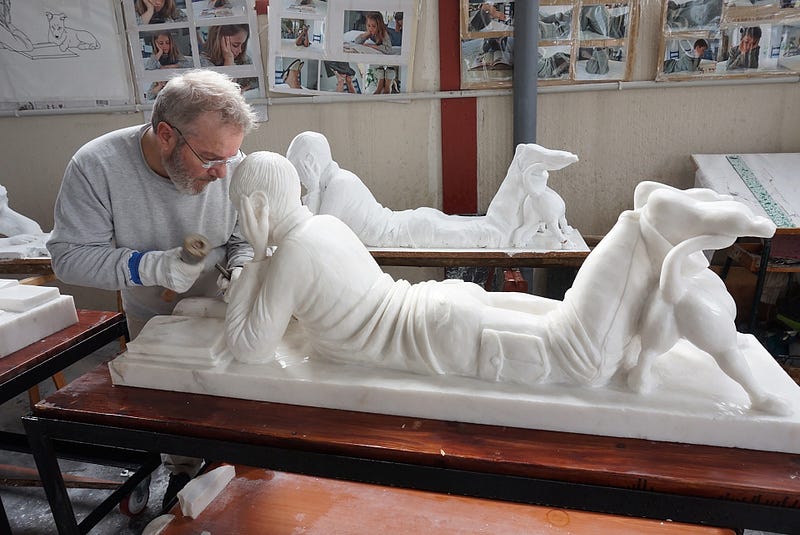
It’s very much the way a sculptor can see a statue within a stone. They see what needs to be taken away and what needs to be left behind.
It’s the exact same thing with fiction, in any character’s life — as in yours — multiple stories take place simultaneously. You may be a parent in one story line, your parent’s child in another. You may be a friend in one arc, someone’s life partner in another.
All these stories exist simultaneously and a writer has to pick out which story they want to tell, leaving out (or interweaving) the details of the others. I call this seeing through the torrent of time. We extract the stories we want to tell out of the flow of many stories existing simultaneously.
And as our greatest artists suggest, the way to figure out what story you want to tell, whether it’s in a song, a poem, a joke or a novel — may well be to start at the end.
I hope this helps you the next time a creative urge grabs you by the hand. In the meantime, Walk Good. Mitch. November 2023.
Thank you for reading and supporting MuserScribe. We publish five days a week, Monday to Friday inclusively 🖋️🌟📚


