
Unmasking My Neurodivergence in the Wild
One small step for me, one giant swivel in an office chair

I had a small but freeing unmasking experience today that I’d like to share with the Internet.
I had a short meeting with my son’s principal (went well, nothing serious). The chair I sat in was one of those nice office chairs that swivel. You know the one. Especially if you’re neurodivergent like me, you know The One.
As I was talking, I noticed that I was swivelling back and forth in the chair. I had a little conversation in my brain wherein, for a micro-second, I thought I should stop and “correct” my behaviour so that I look more “professional” and adult-like.
Then I thought “fuck that”, I AM a professional, I AM an adult, and I am fucking correct.
If I can role-model that an Autistic/ADHD person can be highly intelligent, educated, and eloquent while also swivelling and fidgeting, then perhaps that’s one person’s preconceived notions shattered.
If I can swivel and fidget while still being Adulty-and-Professional, then maybe it’s a tiny step toward that principal thinking twice before correcting one of their students for sitting in a “weird” position, moving around, or fidgeting while listening.
Maybe I can be part of the club of neurodivergents who make people question their assumptions.
We had a good conversation, they were very receptive, it was a respectful and intellectually interesting discussion. I think we both learned something from each other, but more importantly, I learned that I can be an example for neurodivergent kids and offer a lesson for neurotypical adults.
When more neurotypical adults can see that fidgeting does not interfere with one’s ability to listen and communicate, and a person can be weird and wiggly while also being intelligent and eloquent, then more neurotypical people will challenge their assumptions.
And more neurodivergent people will be left alone to stim, fidget, or wiggle however they see fit.
When neurodivergent kids see “weirdos” and fellow neurodivergent people being their authentic selves, while displaying their intelligence and unique abilities, the more neurodivergent role-models they will have.
A plea to NT adults
If you work with kids, especially if you’re a teacher, please stop telling kids to “sit properly”, or “stop fidgeting”. And for the love of sanity, please shred your posters that give ableist examples of “whole body listening”.
If a child is expending their mental energy to focus on “sitting properly” they’ll learn nothing.
“A student who must constantly exert energy and attention toward passing for normal is a student who has less energy and attention available for the tasks of learning and creative participation.” — Dr. Nick Walker
When children are allowed to listen to their own bodies, and move how they need to in order to self-regulate, their brains can focus on learning rather than on forcing themselves to “sit still”.
“Students can be better students when they’re given the space to move in the ways that are optimal for the functioning of their particular neurologies, rather than the ways that are required for the performance of normativity.” — Dr. Nick Walker
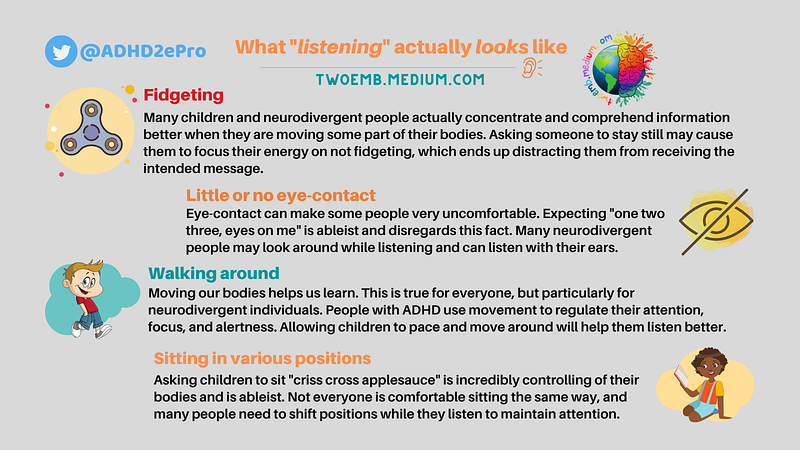
It’s actually not healthy for anyone, especially children, to sit in unnatural and uncomfortable positions just because some arbitrary, made-up rule says we’re supposed to.
We spend entire childhoods admonishing children to sit still, then wonder why we spend their entire adulthoods trying to get them to get up and move more. It’s ridiculous.
We spend entire childhoods admonishing children to sit still, then wonder why we spend their entire adulthoods advising them to get up and move more.
Let’s agree to stop policing other people’s bodies and respect the sensory needs of all individuals, not just neurotypicals.
Kthxbye.
© Jillian Enright, Neurodiversity MB

When you join medium, as a member you’ll have access to unlimited reads for only $5 per month. If you use my referral link, I’ll earn a small commission, and you’ll earn my undying gratitude.
Related stories
References
Walker, N. (2021). Neuroqueer Heresies: Notes on the neurodiversity paradigm, Autistic empowerment, and postnormal possibilities. Autonomous Press.