
Unlocking the Parable of the Unjust Steward
Darkness, hunger, and the cutting of costs
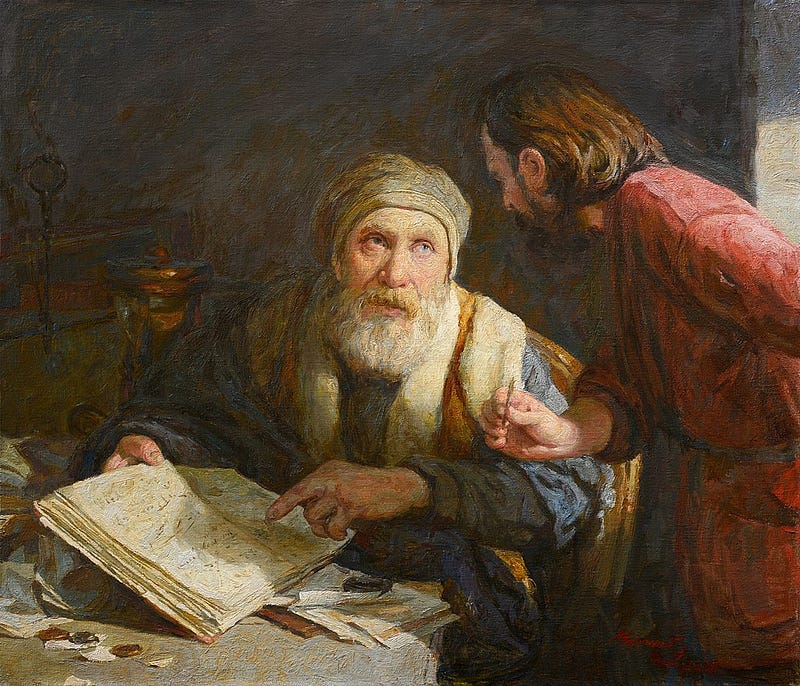

In this article, I will attempt to unlock whatever secrets might have been encoded within Luke’s Parable of the Unjust Steward. I have selected this one specifically thanks to Corine Hilda’s and Steppes of Faith’s recent posts on this exact parable.
According to Wikipedia, this is the most controversial of Jesus’ parables. As my regular readers are well aware, I claim that many of the parables found in the Gospels contain secret meanings. I am not the first to make this claim of course. That honor belongs to Jesus himself.
10 He said, “The knowledge of the secrets of the kingdom of God has been given to you, but to others I speak in parables, so that, “ ‘though seeing, they may not see; though hearing, they may not understand.’ (Luk 8:10 NIV)
This parable however poses certain difficulties. Let me go ahead and reproduce the parable. Do note that in this translation, the word that is usually translated as steward has been given as manager.
1 Jesus told his disciples: “There was a rich man whose manager was accused of wasting his possessions. 2 So he called him in and asked him, ‘What is this I hear about you? Give an account of your management, because you cannot be manager any longer.’ 3 “The manager said to himself, ‘What shall I do now? My master is taking away my job. I’m not strong enough to dig, and I’m ashamed to beg — 4 I know what I’ll do so that, when I lose my job here, people will welcome me into their houses.’ 5 “So he called in each one of his master’s debtors. He asked the first, ‘How much do you owe my master?’ 6 “ ‘Eight hundred gallons of olive oil,’ he replied. “The manager told him, ‘Take your bill, sit down quickly, and make it four hundred.’ 7 “Then he asked the second, ‘And how much do you owe?’ “ ‘A thousand bushels of wheat,’ he replied. “He told him, ‘Take your bill and make it eight hundred.’ 8 “The master commended the dishonest manager because he had acted shrewdly. For the people of this world are more shrewd in dealing with their own kind than are the people of the light. 9 I tell you, use worldly wealth to gain friends for yourselves, so that when it is gone, you will be welcomed into eternal dwellings. 10 “Whoever can be trusted with very little can also be trusted with much, and whoever is dishonest with very little will also be dishonest with much. 11 So if you have not been trustworthy in handling worldly wealth, who will trust you with true riches? 12 And if you have not been trustworthy with someone else’s property, who will give you property of your own? (Luk 16:1–12 NIV)
The biggest difficulty with this parable is that it is a singleton. There is no parallel version in Matthew or Mark, or even in the Gospel of Thomas. Without parallels, it is harder for the original author to provide clues that lead to a hidden meaning. However, as there are no parallels, we have to search the text that is available to us.
Luke 16:10 is a verse that corresponds to verses that occur in the Parable of the Talents and its parallel, the Parable of the Minas. I have just written three articles on these parallel parables here, here, and here. Still, I do not see more than a surface connection between those parables and this one here.
We also have the numerical values of the various goods. To find the original values we need to consult the King James translation.
6 And he said, An hundred measures of oil. And he said unto him, Take thy bill, and sit down quickly, and write fifty. 7 Then said he to another, And how much owest thou? And he said, An hundred measures of wheat. And he said unto him, Take thy bill, and write fourscore. (Luk 16:6–7 KJV)
The King James version is a bit clearer, with a hundred measures of each product. Also, one score was equal to twenty, so fourscore equals eighty. Compare that with the New International version where the quantities are translated to the modern units of gallons and bushels.
6 “ ‘Eight hundred gallons of olive oil,’ he replied. “The manager told him, ‘Take your bill, sit down quickly, and make it four hundred.’ 7 “Then he asked the second, ‘And how much do you owe?’ “ ‘A thousand bushels of wheat,’ he replied. “He told him, ‘Take your bill and make it eight hundred.’ (Luk 16:6–7 NIV)
Still, the numbers don’t reveal much beyond the fact that he reduced the debt of one man by half while the other received only a 20% reduction of what he owed.
When I study this parable and particularly this verse, I wonder about these debtors. I’ve noticed in these parables that the master or other men have various properties where they collect either rent or if the property is a vineyard or a farm, collect the product of the land, be it wine, grain, or oil.
So I suppose that an olive farm owed the one hundred measures of oil, just as a grain farm owed the hundred measures of wheat.
The word that the KJV translated as steward and that the NIV translated as manager, appears only six times in the synoptic Gospels and all of those are in Luke. Once in reference to Chuza, Herod’s steward (Luk 8:3 KJV), four times in the Parable of the Unjust Steward, and once in the Parable of the Faithful and Unfaithful Servant:
35 “Be dressed ready for service and keep your lamps burning, 36 like men waiting for their master to return from a wedding banquet, so that when he comes and knocks they can immediately open the door for him. 37 It will be good for those servants whose master finds them watching when he comes. I tell you the truth, he will dress himself to serve, will have them recline at the table and will come and wait on them. 38 It will be good for those servants whose master finds them ready, even if he comes in the second or third watch of the night. (Luk 12:35–38 NIV)
Here we see what is expected of the steward when the master is away. When the master returns and finds that everything is in order, the master will be so pleased that he will serve his loyal servants.
42 The Lord answered, “Who then is the faithful and wise manager, whom the master puts in charge of his servants to give them their food allowance at the proper time? 43 It will be good for that servant whom the master finds doing so when he returns. 44 I tell you the truth, he will put him in charge of all his possessions. 45 But suppose the servant says to himself, ‘My master is taking a long time in coming,’ and he then begins to beat the menservants and maidservants and to eat and drink and get drunk. 46 The master of that servant will come on a day when he does not expect him and at an hour he is not aware of. He will cut him to pieces and assign him a place with the unbelievers. 47 “That servant who knows his master’s will and does not get ready or does not do what his master wants will be beaten with many blows. 48 But the one who does not know and does things deserving punishment will be beaten with few blows. From everyone who has been given much, much will be demanded; and from the one who has been entrusted with much, much more will be asked. (Luk 12:42–48 NIV)
Notice the final verse above which is a distorted version of that verse from the parable I had traced to a couple of dead-end parables.
10 “Whoever can be trusted with very little can also be trusted with much, and whoever is dishonest with very little will also be dishonest with much. (Luk 16:10 NIV)
My initial examination of the parable should have led me more or less directly to this variant if I had only followed the references carefully enough.
Luke 12:35–48 above lays out the requirements for a good steward. He should keep his lamps burning and be ready for service. He also needs to give the other servants their food allowance, which is translated from a word that means a measured ‘portion of’ grain.
Now, let us suppose that our steward’s master has been out of town and it has been his responsibility, in addition to properly managing his master’s property, to keep the lights at the estate burning at night and to keep the staff fed with bread.
Let us also suppose that our steward, in addition to supposedly wasting his master’s property, has failed to both keep the oil lamps burning at the estate and to ensure that the staff has been getting the bread to which they are entitled. According to the text, the punishment is to be cut into pieces, or as Matthew likes to say:
51 He will cut him to pieces and assign him a place with the hypocrites, where there will be weeping and gnashing of teeth. (Mat 24:51 NIV)
Let us further suppose that this punishment is worse than for whatever mismanagement of property for which our steward has been accused. By reducing the amount of oil and grain that the farmers owed the master, the steward was making it appear in the accounting records, that the farmers had already delivered fifty measures (four hundred gallons) of oil and twenty measures (two hundred bushels of wheat). This would make it look as though this amount of olive oil and wheat had been used by the estate for lighting and for feeding the staff.
Now we come to the parable’s final paradox. The master discovers that the steward changed the quantities in the accounting records and yet he commends the steward for his shrewd actions.
Why might this be?
Notice again that the master claimed that the steward had wasted his property, which can also be translated as wealth. And yet here was clear evidence that the steward had really saved his master four hundred gallons of oil and two hundred bushels of wheat by not keeping the estate lit at night and by not properly feeding the staff.
The master was impressed by the cost-cutting actions of the steward, as the steward was able to demonstrate that he had actually helped to preserve his master’s wealth. By successfully cutting safety, security, and labor costs.