
Unlock Your Storytelling Powers With Unique Writing Prompts
When you use toys as a creative tool, they aren’t toys anymore. Lessons from my sandtray experience.
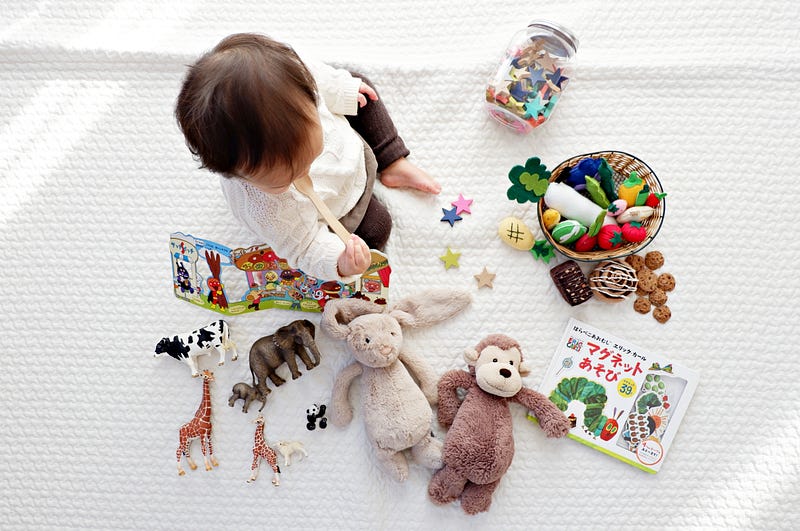
The loving parents hover over their little darling, encouraging the first word.
When Mama or Dada erupts, they set Facebook on fire with news that Junior is finally talking.
Well, in a manner of speaking. Forgive the play on words.
Yes, the child is vocalizing language. But it’s not the first time he’s communicated his thoughts or used language actually.
The writer H.G. Wells noticed his young boys playing what he called floor games.
He had the insight that, while they entertained themselves, they were also engaged in problem-solving. He wrote about his observations in Floor Games, which caught the attention of child psychiatrist Margaret Lowenthal in post-World War 1 England.
Lowenthal realized immediately she could use toys as a therapy technique and thus began, in the early part of the 20th century, a valuable asset in child therapy called sand tray or sandplay.
Carl Jung, long involved with symbols and archetypes, recognized its importance and encouraged his protege Hilda Kalff to study Lowenthal’s methods. Kalff made sandplgy mainstream.
I became a practitioner of sandplay or sandtray as I refer to it, over a dozen years ago. I wrote about it in a previous article which you can find here. I could write reams on sandtray, but here I’ll focus on writing.
A member of my writing group introduced it to us as a means to unlock our desire to collaborate on a writing project.
We were stuck on a form: novel, anthology of memories, short stories? She suggested her sandtray might yield the answer. We shook our heads, not knowing what she was talking about.
Several Saturdays later, we gathered around her collection of small objects and tray of sand. She explained that objects were our first language. Our mother’s breast, the faces of family, toys and foods. Vocal language came later, but the response to images and objects remained in our psyche. It was that level that activated the power of the sandtray.
What do we do, we asked? She’d never used it for such a creative project but suggested someone just pick from her collection of toys and found objects and put something in the sand.
Joan picked a toy airplane and crashed it into the sand.
Margaret, our poet, said, “Death is upon the land.”
The moment was electric. We were no longer looking at toys, but the site of a crash. One by one, we chose an object and added to the story. By the end of the day, we had outlined a novel.
The moment was electric. We were no longer looking at toys, but the site of a crash. One by one, we chose an object and added to the story. By the end of the day, we had outlined a novel.
Several years later, as a life coach working with creative blocks, I found a sandplay teacher who agreed to let me audit her course. I would not receive certification because I was not a therapist, but after two years of training, I had a collection of hundreds if not thousands of objects and added the sandtray to my offerings to clients.
The responses have been universally rewarding, but I’ll speak just to the ability of sandtray to evoke plot and characterization.
I won’t go into the topic of unearthing writing blocks and motivation, which I also did as a life coach.
I have worked with writers who were blocked on stories. Plots that had run into a wall and which had the writers stumped, ready to give up.
I presented them with the tray of sand, which Lowenthal discovered as important to the process. Some people worked in the sand, burying objects, creating landscapes, using the three-dimensionality to see things in the tray they could not in their minds.
They would choose objects and, after some questioning on my part about the plot, they would begin to see relationships or openings in the plot.
The objects would speak to them, or speak to other objects in the sand. It was at this point that their first language would come into play, animating the objects they’d chosen to become real to them, speaking to them as if in their imagination.
As a sandtray facilitator, I knew they had picked objects that were meaningful to them even though at the time, they may have thought they were choosing at random.
Our “object language” guides us in that way when we use three-dimensional objects. Also, I think, when we choose knickknacks in our home. They can resonate with memories or desires.
In the case of working out a plot or difficulty with a character, we have an intention, which guides the selection of the object, and helps clear a path to understanding the problem or the process in the writing.
I gave a class on memoir writing several years ago and started one session with an experiment. On a whim, I packed a dozen objects from my collection and arranged them in the center of the table as I began the class. I briefly explained my intent that they use them as prompts and gave a 30-second explanation of sandtray.
Skepticism reined, but when I began the 15-minute free writing session, each person chose a figure.
Their response gratified me, though it didn’t surprise me. Each person wrote furiously on the inspiration provided by the object.
However, few of the students wrote directly about the piece they chose. One woman picked a canoe and wrote about her loneliness at summer camp. She said the memory came to her as soon as she saw the canoe, which was on the camp’s logo.
Others had similar experiences, but all said that the object they choose, which seemed random when they picked it, took them deeper into their work in progress.
I once conducted my own experiment to test whether I could use sandtray to help with my fiction writing. For a week, each morning, I did a sandtray, choose a series of objects, and placing them in the sand, then studying them to find a story.
I created a blog to publish the results. I photographed the sandtrays and the beginnings of the pieces each day. One story gripped me, and I eventually finished it and published it.
To use sandtray in a therapeutic setting, you must work with someone who is qualified as a therapist and has undergone rigorous training also to understand and practice sandtray.
I want to make it clear, I never offered therapy to people. I discussed at length my use of sandtray as a coaching tool with my teacher, who was and is well-regarded in her field. When she understood my purpose, she agreed to allow me to train with her.
However, using objects such as toys, jewelry, kitchen implements, any figures that represent aspects of life as writing prompts can yield enormous benefits for the writer.
I have benefited from all types of prompts in my writing. Photographs, word lists, opening books and writing from a sentence picked at random.
However, nothing I have used has gone as deep into my creative well as three-dimensional objects.
As my teacher, Dr. Gisla deDomenico would say, on the shelf, the object are inanimate. But once we choose them, and put them in the sand (or on a table if that’s all you have), they become animate, alive for our purpose. They begin to speak to us and we can speak to them. They also speak to each other.
I have often thought of sandtray as having our imagination on display. But in this setting, we can take it to the next level by moving the pieces around, bury them in sand if something is hidden in our story, hear characters complain about how we are treating them, or how other characters are treating them, which can open up new worlds in our story.
There are no rules. You can’t make a mistake.
Just take a few objects and sit with them, have the intention of advancing your story. Move them around and see how they like it. Add furniture, jewelry, food, fences to block them. Just see what happens.
Don’t be surprised if a new story comes to you. Or nothing. If nothing, ask your objects what gives? Why won’t they speak to you? Keep poking them, moving them around, experimenting with trying to get the scene to open up to you.
If you have a writing partner, do it together. Make some rules and break them. See what that’s like. Have no rules and see how everyone manages. Put a secret in the scene, or add some danger if nothing’s happening. Or introduce a savior. Try killing someone. Just use your imagination and keep going as long as you wish.
Then start writing. If nothing comes in the moment, wait a bit. You may get ideas down the road. Use it once; use it often. I hope it helps.