
Can Playing With Toys Help Your Writing?
Why you should use three-dimensional objects as writing prompts.
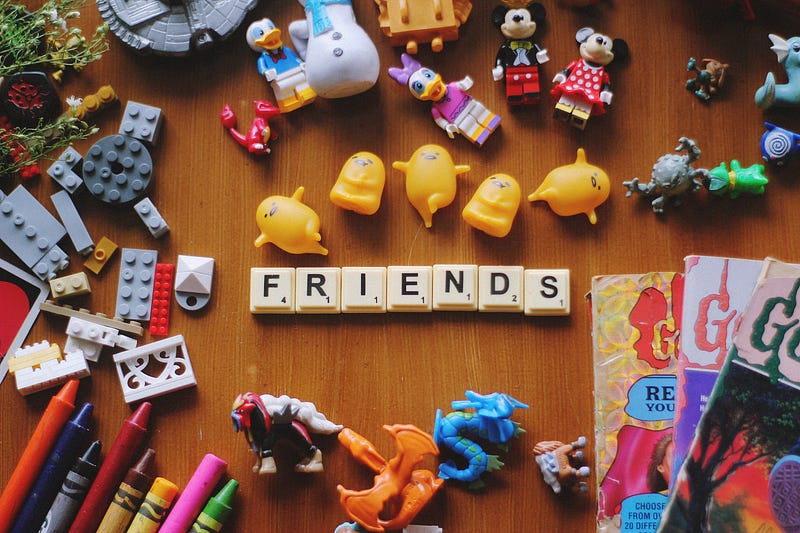
Ten of us in our writing group that day stood in Gilly’s room on the houseboat and circled her collection of toys. Action figures. Matchbook cars. Feathers, marbles, animals, toy soldiers, mismatched earrings, religious icons, baby carriages, planes, dolls, human figures, animals, trees. Every miniature representation of life you ever played with as a kid.
“Pick one,” she said. “Anything that speaks to you. Or choose one that repels you. That scares you or just seems boring. It doesn’t matter. If you don’t know what to pick, close your eyes and just grab one. Trust me, there’s no right or wrong way to do this.”
And so we did. When we each had our object of choice, we faced the sand tray. It was …how can I accurately describe this feature so can see it in your mind?
Simply a tray of sand.
Joan went first. She took her toy airplane, circled it over the tray and, because she is the drama queen we all wish we could be, she accelerated it high over the clouds and smashed it nose first into the sand.
I can still hear the communal intake of breath, feel the shock of horror as that little plaything became a real plane suddenly crashed in the desert. Margaret, one of our resident poets, said in hushed tones, “Death is upon the land.”
And we were off and running. Those few moves began an afternoon my writing group will never forget.
Pull back a few months. Our group had only been meeting six or seven years at that point. I’ve lost track. We’re up to twenty-something now.
At one point a member had suggested we do a collaborative project, and we all leaned in. But what form? An anthology of our work? New essays on a topic we’d choose out of a hat? A book of individual memoirs?
Gilly offered a suggestion. “I’m studying for my certification in sandplay,”she said, “and I think it might help us come to a decision.”
We looked at her with our collective Duh? face. None of us had heard of sandplay or sandtray as she also described it. So she gave us the short course.
Sandplay was mainly a therapeutic tool used by Jungians for children but also adults, and she had a collection of objects and a tray of sand. She didn’t know if it would work, but why not see if it would help us break this months-long logjam.
While we still had no idea what she was talking about, we were pretty much game for anything. At the time, Gilly roomed with a friend on a houseboat, and she invited us to come for a daylong meeting overlooking San Francisco Bay to talk writing and play with her toys.
So there we were. What had moments before been merely a tray of sand and Gilly’s dizzying collection of inanimate objects, suddenly became a crash site with unknown survivors. We could all but smell the burning jet fuel.
One by one, we each took a turn adding our chosen figure to the scene, describing the character we’d picked or the object they owned or the house where they lived and how each figured in the next turn of the plot we were making up on the spot.
With each piece, we added to the story of the crash in the desert begun by Joan and Margaret. Only when someone placed a tree next to the plane did we realize it wasn’t a desert after all. No, the sand had morphed before our eyes into a jungle and now the plane had crashed into a forest.
Next, one of us put glamorous sunglasses near the plane because the passenger was a Hollywood movie star en route to a clinic in Brazil for a facelift. The next character, prompted by something like a box of Band-Aids from a children’s medical kit was the doctor who did the facelifts of the rich and famous to fund his work with the poor villagers in the jungle. He would, of course, eventually fall madly in love with the actress.
And so it went for the rest of the afternoon, each of us making up a piece of the story. Pantsing it, for those of you who write fiction this way. What had at first begun as a tongue-in-cheek exercise, turned deadly serious, the plotting part that is.
Oh, we had laughs, as our story grew and the characters and their lives became real to us, as only a story and characters can become real to writers.
By the end of the day we had plotted an entire novel and populated it with characters that stayed with the story that we wrote, edited, and discussed for the next year.
Some of us were more invested in the story than others. Some of us had other works in progress and pushed our Hollywood star novel to the back burner. Gilly moved back to England to finish her training and receive her sandplay certification. Life moved on for all of us. We never did complete a group project, but I think our work on that book reinvigorated our individual writing and certainly provided a wonderful, creative experience.
Sandtray had me in its grip. After that day, Gilly still needed to accrue practice sessions for her training, and I volunteered. A serious session, not for fun like developing a story. I won’t go into great detail, but I think my first private hour with her is informative if you don’t know the technique.
I picked among other things, an earring in the shape of a skeleton hand, a Halloween trinket, and buried in the sand. Why? Who knows? That’s what I said to Gilly when I’d finished with the tray and it was time for her to discuss it with me. What I realized in a flash of insight that I believe could only have come from studying that hand, buried so deeply, was that it was telling me to have a surgery I’d been dreading.
At that point, arthritis in my hands had become so severe that my doctor said I’d basically lost my opposable thumb. Couldn’t button, couldn’t zip, and I lived with tremendous pain. But I ignored his advice because I was terrified of the surgery that would reconfigure my hands.
However, when I saw the skeleton hand buried in the sand, I had to pay attention. How much clearer could the message be? That buried hand was telling me, help. I’m in pain. You’re not listening to me. The next day, I called the surgeon and had my hands repaired.
Eventually, Gilly encouraged me to learn sandtray. I am not a therapist and did not want to embark on the intensive training it would take at this late stage in my life. I found a practitioner who accepted me into her training program with the understanding that I would use it only for writing and coaching clients. It was one of the most thrilling and gratifying trainings of my life.
Since then, I’ve used my knowledge of sandplay to help writers break through writing blocks, to create and unlock stories both remotely by video and in person. I’ve offered objects from my collection to students in classes I’ve taught for fifteen-minute writing sessions. I’ve written my own stories from sandtrays I’ve created. I make it clear in each of these situations that I am not a therapist, and I do not offer sandplay as therapy.
Suffice it to say, I am convinced of the power of three-dimensional objects as writing prompts.
So what does all this mean for you? Should you knock down my door and try to get into my writing group so you can do cool stuff like do sandplay on a houseboat? Go back to college to get a degree in sandplay? Hire a sandplay expert to help you work through your block? No, just go to your room and pick up your toys.
Why three-dimensional objects work for writing.
I’m not a therapist and I’m not going to advise you to do self-therapy with toys. But I believe an aspect of sandplay can be a valuable tool in the creative process. Play with objects calls on our first language. Before we had words, we had objects. We recognized our mother’s breast as nourishing and comforting. We saw toys, food, faces, and other familiar objects and created narratives about them in our young brains. Later, language filled in the blanks for us.
We still have that ability to communicate through objects. And that is what is at play when you use objects to help you with your writing. All writing prompts are helpful. Random lines from a book; words of the day, even photographs. However, a three-dimensional object becomes animated in a way that can bring a story to life because we interact with it on the level of our first language. We communicate with it in a way we don’t with words or a two-dimensional photo.
How to Use Three-Dimensional Objects In Your Writing
First, there are no rules. When you choose objects to prompt your imagination or open the channels to lead you to your story, don’t worry about picking the “right” object. Our psychic faculties are at work here, and they work below or out of reach of our conscious awareness. So you have helpers, your inner awareness, your higher self, whatever you want to call your center of truth working with you to pick an object that may be useful. You can give your perfectionism a rest here.
Go through your own objects, by which I mean your own toys, your childrens toys, your jewelry, knickknacks, make up accessories. You might end up with small screwdrivers, a Christmas ornament, scissors, an action figure, nail clipper, lipstick, box of bandaids, razor, rosary beads or yarmulke, toy car or small plastic baby.
Arrange them in front of you and pick several, or all of them, or one of them. It doesn’t matter. Place them center stage and see if something comes to you about the subject of your writing, whether it’s fiction or nonfiction.
If nothing comes you, add another object to your scene. Or ask some questions. How do your figures relate to each other? Are they generating a story, or emotion, or more questions? Or ideas about your theme.
Keep all this in the context of the figures or objects in front of you. This isn’t therapy; it isn’t about you-or if it is, make a note for your therapist and move on. Try to tease a story or article out of the figures. Do they relate to the piece you’re working on or are they generating something new? Ask them if something or someone else needs to join them from the other pieces you’ve selected.
Notice if they resist another figure coming into their space and add it anyway. Great. You’ve got some conflict. What’s that all about? Conflict is always at the heart of a story. Do any of these figures need an ally? Can you find one? Or is it a triangle? And what’s that all about?
Is there a victim? A bully? A savior?
Is there an archetype you can work with?
Do these pieces have something to say about you ignoring them, or staying hidden so you can’t finish the story, or do they need something from you so they can come out of hiding and let you hear their voice?
If you’re writing a nonfiction piece, you can use three-dimensional objects the same way. Have you chosen objects or figures that feature in your piece or you should feature in your piece and you’ve forgotten to include?
Or perhaps you see the elements of your piece laid out in front of you and it becomes clear you have the outline in the wrong order. Or too much detail and when you take pieces away you discover the streamlined story you originally had in mind.
Possible uses for three-dimensional objects in your writing.
1. To work with writing blocks. Every writer gets stuck at some point. From small bumps on the road, such as an idea or scene that just needs some gentle goosing to come to the surface, to full-fledged panic when facing the blank page.
2. Outlining a new project that seems to have too many pieces to bring under control.
3. To find the next plot point in a story.
4. To find out why your story got stuck.
5. To flesh out a character.
6. To find topics for an article.
7. To find stories to tell.
8. To discover more about your own writing process.
Or find your own use for the objects in your life to help bring forth your own stories.


