avatarStanley Grant

Free AI web copilot to create summaries, insights and extended knowledge, download it at here

3235

Abstract

lians and nuclear facilities or promoting reconstruction.</p><p id="a0b2">The Ukrainian government usually rarely holds back on criticizing Russia’s friends and procrastinators — vis-à-vis Beijing, it is downright tame. “China has decided to stay out of it,” Volodymyr Zelensky said with some satisfaction in May. “It’s better than helping Russia.” Even more purposefully optimistic, Foreign Minister Dmytro Kuleba proclaimed in the fall, “Who benefits from China’s position? Ukraine, of course, not Russia.”</p><p id="6b67">The cautious attitude of the Ukrainians is undoubtedly reasonable. If Beijing were to start supplying military equipment to the Russians on a large scale, the Russians would be able to show their superiority on the front lines to much greater effect. To be sure, <a href="https://www.politico.eu/article/chinese-companies-are-shipping-rifles-body-armor-to-russia/">there are reports of Chinese arms in Russia</a>. But the volume seems comparatively small so far. Remarkably, <a href="https://kyivindependent.com/ukraines-military-intelligence-says-no-evidence-of-china-supplying-russia-with-weaponry/">Ukrainian military intelligence</a> recently said there was no evidence of such deliveries.</p><h2 id="4b1d">Strategic partners</h2><p id="498e">However, the ostentatious cultivation of friendship between China and Russia belies the fact that relations with Ukraine were close, at least until a year ago. For example, bilateral trade volume reached <a href="https://www.theguardian.com/world/2022/feb/22/ukraine-crisis-poses-dilemma-for-china-but-also-opportunity">$15.4 billion</a> in 2020. Beijing was Kyiv’s largest foreign economic partner, as a buyer of agricultural products, raw materials for industry, and military goods.</p><p id="a886">Relations were properly launched by the sale of an unfinished Soviet combat ship, which in 2012 became the “Liaoning,” China’s first aircraft carrier. A year earlier, the countries had signed a “strategic partnership” agreement: Presidents like Viktor Yanukovych had long pursued a “multivector foreign policy” in which good relations with Beijing, Washington, and Brussels were meant to counterbalance Moscow’s overwhelming influence. For China, Ukraine was of interest as a geographically favorable station on its “new Silk Road”.</p><figure id="1b66"><img src="https://cdn-images-1.readmedium.com/v2/resize:fit:800/1*w36bx2bldj33T8G0WglIPA.jpeg"><figcaption>The Liaoning — China’s first aircraft carrier. Source: <a href="https://commons.wikimedia.org/wiki/File:PLANS_Liaoning_(CV-16)_20211221_-_1.jpg">Wikimedia Commons, Japan Ministry of Defense, Joint Staff Office</a></figcaption></figure><p id="f667">This changed with the 2014 Maidan revolution and Ukraine’s resolute orientation toward the West. Over the past nine years, China has remained an important economic partner for Kyiv, but <a href="https://www.institutmontaigne.org/en/analysis/china-ukraine-partnership-surviving-deteriorating-strategic-environment">politically, relations have been very limited</a>. This was a consequence of escalating tensions between East and West.</p><p id="5601">For the Ukrainians, this meant tying China back as a partner for the construction of a 4G network and <

Options

a href="For%20the%20Ukrainians,%20this%20meant%20tying%20China%20back%20as%20a%20partner%20for%20the%20construction%20of%20a%205G%20network%20and%20preventing%20the%20acquisition%20of%20Motor%20Sitsch,%20a%20turbine%20manufacturer%20of%20strategic%20military%20importance.%20For%20their%20part,%20the%20Chinese%20avoided%20steps%20that%20could%20anger%20Russia.%20Back%20in%202014,%20for%20example,%20they%20abstained%20from%20voting%20on%20a%20UN%20General%20Assembly%20resolution%20condemning%20the%20Crimean%20annexation%20as%20a%20violation%20of%20territorial%20unity.">preventing the acquisition of Motor Sitsch</a>, a turbine manufacturer of strategic military importance, leading to a pending case in an international tribunal where the Chinese are seeking compensation from the Ukrainian government. For their part, the Chinese avoided steps that could anger Russia. Back in 2014, for example, they abstained from voting on a UN General Assembly resolution condemning the Crimean annexation as a violation of territorial integrity.</p><h2 id="03c0">Limited benefits</h2><p id="0d72">The bilateral relationship between Ukraine and China is very unequal. Kyiv simply has no means to influence China’s decisions. Nevertheless, cooperation in strategic areas is maintained to this day. For example, China sources a large share of its corn, barley, and sunflower oil needs from Ukraine. The country is the main buyer of agricultural goods exported under the <a href="https://www.un.org/en/black-sea-grain-initiative/vessel-movements">Black Sea Grain Initiative</a> brokered by the UN.</p><p id="47fe">The war has nevertheless increased the weight of the Ukrainians in Beijing’s eyes, though not in a way that should flatter Kyiv. Xi Jinping sees the conflict as a proxy war with the United States and Zelensky as its puppet. Accordingly, a conversation with Zelensky would serve him primarily as a move toward the West. <a href="https://www.scmp.com/news/china/diplomacy/article/3213418/white-house-hails-possibility-xi-jinping-speaking-ukrainian-president-zelensky">The Americans</a> would very much welcome such a meeting. Whether it takes place will probably depend on whether the Chinese president considers such a gesture important enough to accept a disruption of harmony with Moscow.</p><p id="2f4e">However, peace is unlikely to be achieved until the Chinese find a solution to the Russian occupation of Ukrainian territory. Contrary to Beijing’s belief, the Americans would probably be more willing to compromise on this than the Ukrainians. Xi Jinping cannot avoid addressing the concerns of the Ukrainians — if he is serious about playing the role of a mediator.</p><p id="40fd"><i>Thanks for reading. If you liked the article, you can engage with my story and support me, as well as thousands of other creators, by <a href="https://medium.com/@stanleygrant_2023/membership"><b>signing up to Medium</b></a> to gain instant access to all articles. Follow me on my journey to explore economics, finance, and politics around the world, by leaving <a href="https://medium.com/@stanleygrant_2023/subscribe"><b>your e-mail address</b></a> here to get a message whenever I publish a new article. Thanks!</i></p></article></body>

RUSSIA-UKRAINE WAR

Unequal partners: China’s Xi keeps President Zelensky waiting

Before Putin’s invasion last year, Beijing was Kyiv’s most important trading partner. Today, the Chinese are trying to broker peace but don’t take the Ukrainians seriously.
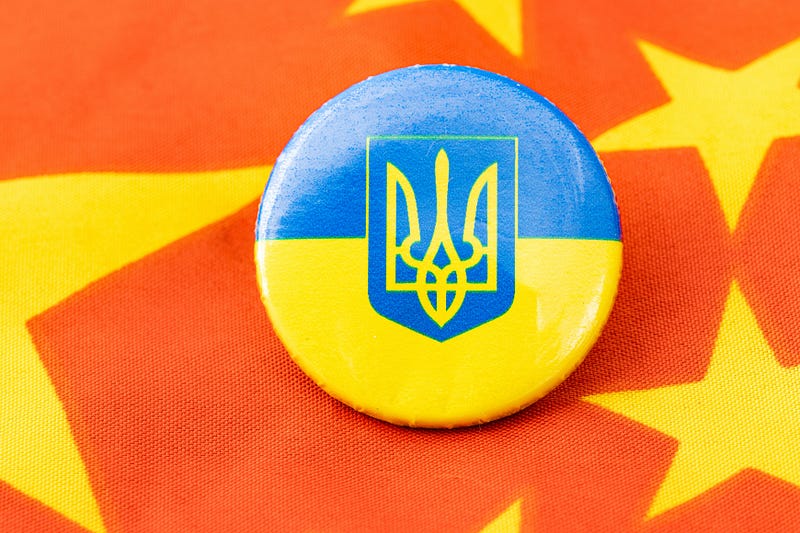
Photo by Marek Studzinski on Unsplash

While Xi Jinping is celebrating Russian-Chinese friendship in Moscow, he keeps Volodimir Selensky waiting: Although there have been rumors for days about a possible telephone conversation between the two presidents, nothing has been confirmed. So far, China’s approval for a discussion is lacking.

There would be enough topics: Beijing has been backing Moscow politically and economically since February 2022, but is still sticking to its “pro-Russian neutrality”. Above all, Xi has so far avoided being drawn into the war by supplying weapons to Russia and thus burning bridges to the West.

One-sided “peace plan”

At the same time, China is trying to make its mark with its recent 12-point “peace plan”. This plan is clearly one-sided. Beijing essentially adopts Moscow’s view of the conflict and condemns Western sanctions and NATO’s eastward expansion in barely veiled terms. Both parties are called upon to reach a cease-fire as quickly as possible, which at present would be tantamount to approving Russian land grabs.

You can find a more detailed analysis of the peace plan here:

Kyiv’s reaction, however, has been surprisingly positive. Some presidential advisers complain that Beijing’s commitment to the principle of territorial integrity is worth nothing without the withdrawal of Moscow’s soldiers. In addition, however, Ukrainians and Americans alike emphasize those aspects that they support, such as the protection of civilians and nuclear facilities or promoting reconstruction.

The Ukrainian government usually rarely holds back on criticizing Russia’s friends and procrastinators — vis-à-vis Beijing, it is downright tame. “China has decided to stay out of it,” Volodymyr Zelensky said with some satisfaction in May. “It’s better than helping Russia.” Even more purposefully optimistic, Foreign Minister Dmytro Kuleba proclaimed in the fall, “Who benefits from China’s position? Ukraine, of course, not Russia.”

The cautious attitude of the Ukrainians is undoubtedly reasonable. If Beijing were to start supplying military equipment to the Russians on a large scale, the Russians would be able to show their superiority on the front lines to much greater effect. To be sure, there are reports of Chinese arms in Russia. But the volume seems comparatively small so far. Remarkably, Ukrainian military intelligence recently said there was no evidence of such deliveries.

Strategic partners

However, the ostentatious cultivation of friendship between China and Russia belies the fact that relations with Ukraine were close, at least until a year ago. For example, bilateral trade volume reached $15.4 billion in 2020. Beijing was Kyiv’s largest foreign economic partner, as a buyer of agricultural products, raw materials for industry, and military goods.

Relations were properly launched by the sale of an unfinished Soviet combat ship, which in 2012 became the “Liaoning,” China’s first aircraft carrier. A year earlier, the countries had signed a “strategic partnership” agreement: Presidents like Viktor Yanukovych had long pursued a “multivector foreign policy” in which good relations with Beijing, Washington, and Brussels were meant to counterbalance Moscow’s overwhelming influence. For China, Ukraine was of interest as a geographically favorable station on its “new Silk Road”.
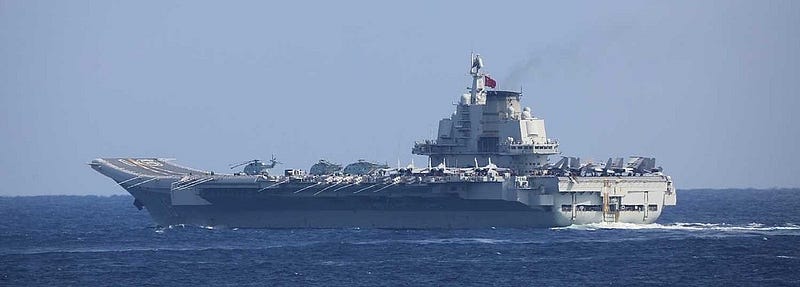
The Liaoning — China’s first aircraft carrier. Source: Wikimedia Commons, Japan Ministry of Defense, Joint Staff Office

This changed with the 2014 Maidan revolution and Ukraine’s resolute orientation toward the West. Over the past nine years, China has remained an important economic partner for Kyiv, but politically, relations have been very limited. This was a consequence of escalating tensions between East and West.

For the Ukrainians, this meant tying China back as a partner for the construction of a 4G network and preventing the acquisition of Motor Sitsch, a turbine manufacturer of strategic military importance, leading to a pending case in an international tribunal where the Chinese are seeking compensation from the Ukrainian government. For their part, the Chinese avoided steps that could anger Russia. Back in 2014, for example, they abstained from voting on a UN General Assembly resolution condemning the Crimean annexation as a violation of territorial integrity.

Limited benefits

The bilateral relationship between Ukraine and China is very unequal. Kyiv simply has no means to influence China’s decisions. Nevertheless, cooperation in strategic areas is maintained to this day. For example, China sources a large share of its corn, barley, and sunflower oil needs from Ukraine. The country is the main buyer of agricultural goods exported under the Black Sea Grain Initiative brokered by the UN.

The war has nevertheless increased the weight of the Ukrainians in Beijing’s eyes, though not in a way that should flatter Kyiv. Xi Jinping sees the conflict as a proxy war with the United States and Zelensky as its puppet. Accordingly, a conversation with Zelensky would serve him primarily as a move toward the West. The Americans would very much welcome such a meeting. Whether it takes place will probably depend on whether the Chinese president considers such a gesture important enough to accept a disruption of harmony with Moscow.

However, peace is unlikely to be achieved until the Chinese find a solution to the Russian occupation of Ukrainian territory. Contrary to Beijing’s belief, the Americans would probably be more willing to compromise on this than the Ukrainians. Xi Jinping cannot avoid addressing the concerns of the Ukrainians — if he is serious about playing the role of a mediator.

Thanks for reading. If you liked the article, you can engage with my story and support me, as well as thousands of other creators, by signing up to Medium to gain instant access to all articles. Follow me on my journey to explore economics, finance, and politics around the world, by leaving your e-mail address here to get a message whenever I publish a new article. Thanks!

Economics
Politics
Finance
China
Ukraine
Recommended from ReadMedium