
Understanding Trade Value
A look behind the hype and doublespeak of NBA executives
The most obvious phenomenon surrounding the Anthony Davis trade soap opera is the wild disparity in perception regarding the respective values of the young core of players in Boston and the Lakers. Some of the reasons are valid; some are simply the pitch of the snake oil salesmen who now wear $5000 Armani suits and travel in private jets, instead of the tattered jeans and ox carts used by their forebears.
Today, I want to take a deeper dive into real trade value of these players, based on past and current performance, and viewed using the tools of modern analytics as opposed to the rosey lens of each team’s rabid fan base. In the end, I will pull them out of the context of their current teams to see how they might fit in on a new team, whether it’s the Pelicans, or some other trade partner.
#1: Past performance
Last year, the Celtics went to game 7 of the Eastern Conference Finals without Kyrie Irving and Gordon Hayward. For most of the season, they were led by Irving, while veterans Marcus Smart, Marcus Morris (.368 3P%) and Al Horford (.429 3P%) anchoring the team. With Irving setting up the offense, all the other players really needed to do was spot up and make open jump shots. According to advanced analytics, Tatum shot his corner three pointers at the highest rate in NBA history, while Brown (+5.4%), Rozier (+6.3%) and Horford (+7.2%) all shot far above their three point percentages from the year before. Here are their regular season stats:
Tatum: 13.9 ppg, 5.0 rpg, 1.6 apg, .434 3P%, .623 TS% (1.33 pps)
Brown: 14.5 ppg, 5.9 rpg, 1.6 apg, .393 3P%, .561 TS% (1.27 pps)
Rozier: 11.3 ppg, 4.7 rpg, 2.9 apg, .395 FG%, .381 3P%, .540 TS%, (1.12 pps), 2.90 ast/to
In the playoffs, Morris (.417 3P%) and Brown (.393 3P%) were on fire, Rozier hit some unconscious late-game three-pointers under pressure that won or saved a few games, and Tatum increased his usage and scoring in crunch time by getting to the rim more and hitting more free throws (even though his 3-point percentage dropped off significantly).
The Celtics had an All-Star and a veteran two-way player in addition to Kyrie Irving, who helped Boston go on a 16-game winning streak at the beginning of the season and led Boston to a 46–20 record before his season ended. The Celtics finished the season 9–7, then squeaked out a 7-game series against a Bucks team with an interim coach, before exceeding all expectations in beating the favored 76ers, whose players and coaches choked away two wins out of their five game series.
NOTE: people forget that Horford was the key to beating Philadelphia, as his ability to pull Embiid away from the paint completely opened up the floor for Boston, along with his excellent defense. And Brad Stevens’ famous in bounds (ATO) plays helped pull off two comeback wins when the 76ers led the entire game.
On the other hand, the young Lakers had no All-Stars to get them through crunch time. They lost at least 15 games where they either led or were tied late in the 4th quarter, including two overtime losses to the Warriors, a double overtime loss to the Rockets and three losses to Portland.
As I wrote about the rookie of the year race at the half way point last year, Kyle Kuzma (16.1 ppg, 6.3 rpg, 1.8 apg, .366 3P%, .549 TS%, 1.19 pps) made a good case for being the best offensive player in last year’s rookie class, as he had signature games where he put the team on his back to beat Houston (38–7–4, 7 for 10 on 3-pointers) and Boston (28–4–3, 5 for 7 on 3-pointers, with 17 points in the 4th quarter.) However, Tatum was a far better defender.
Brandon Ingram made some big strides in his second year, and had a month in January where he showed future All-Star potential (19.1 ppg, 6.0 rpg, 4.1 apg, 1.36 ast/to ratio).
And for those people not blinded by bad first impressions and the annoying hype of Lavar and Magic, Lonzo Ball had an impressive rookie season. Compared to all guards — not just point guards — he was #3 in rebounds, #7 in assists, #7 in blocks, #10 in blocks, with an ast/to ratio of 2.78. And after those first month where he struggled with the pressure, he came back to average 33.1% on his three pointers.
Before injuries and trades took out three of their core players at the end of February, the Lakers were on a 20–9 run, and looked like they had an outside shot at finishing at or above .500. Playing in the West and without a star to help them win tight games, the Lakers missed the post season, and never had the chance to show what they could do under playoff game pressure.
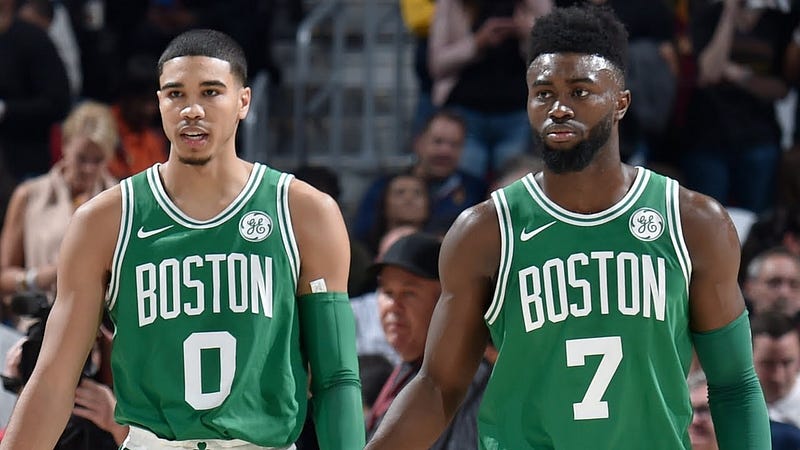
Conclusions: Boston’s young guys not only played better, but they proved themselves by winning under the greatest pressure, including a game 7 and two series wins. To show you how far the media and fans reacted to Boston’s surprising success, Tatum was annointed a transcendent, generational player, Brown was considered a sure future All-Star, and Rozier was thought of as a possible replacement for Kyrie Irving.
Boston fans were so irrational, they spurned the idea of trading Brown, Rozier, other reserves and some first round picks for Kawhi Leonard. Look at where Toronto is now.
#2: Present performance
I wrote extensively about the Lakers’ and Celtics’ problems during the first half of this season.
The combination of increased expectations, adjusting to new stars being added to the roster, opponents now game planning against the young players, and the simple law of regression to the mean has completely changed the conversation about Boston’s young players.
In Boston, the young guys have all had large drop offs in their shooting. Brown, who has struggled with competing for minutes with Gordon Hayward, has been unplayable at times (.326 3P%), and only started to recover his form. Overall, Tatum is the only one playing close to his level from last year, with more points and rebounds, though less efficient as a scorer:
Tatum: 16.3 ppg, 6.2 rpg, 1.9 apg, .372 3P%, .554 TS% (1.22 pps)
Brown: 12.7 ppg, 4.3 rpg, 1.3 apg, .326 3P%, .531 TS% (1.18 pps)
Rozier: 8.8 ppg, 4.2 rpg, 3.1 apg, .381 FG%, .354 3P%, .495 TS%, 3.36 ast/to
On the other hand, the Lakers young players have struggled to fit in with the ball dominant offense of LeBron James. Only Kyle Kuzma has really enjoyed good chemistry with LeBron (in terms of his shooting percentages).
Here are the young guys’ stats for the entire season:
Kuzma: 16.1 ppg, 6.3 rpg, 1.8 apg, .463 FG%, .549 TS% (1.22 pps)
Ingram: 17.1ppg, 4.9 rpg, 3.0 apg, .539 TS% (1.25 pps)
Ball: 9.9 ppg, 5.3 rpg, 5.4 apg, .406 FG%, .329 3P%, .487 TS%, 2.45 ast/to
If we look at the simple stats, you wouldn’t see that much difference between these pairs of forwards (Tatum-Kuzma), shooting guards (Brown-Tatum) and point guards (Rozier-Ball).
Now look at the young Lakers’ stats when LeBron was hurt. (I didn’t include Kuzma’s got against OKC when he got hurt in the first half).
Kuzma: 22.9 ppg, 6.0 rpg, 3.1 apg, .437 FG%, .531 TS% (1.19 pps)
Ingram: 19.2 ppg, 6.0 rpg, 4.0 apg, .505 FG%, .551 TS% (1.29 pps)
Ball: 12.1 ppg, 5.9 rpg, 7.2 apg, .424 FG%, .388 3P%, .489 TS%, 3.0 ast/to
People will rightly point out that the Celtics have a much better record and that there are more talented key players on the Celtics (Horford, Irving, Morris, Smart) who take away minutes and stats from the young Celtics than the Lakers, who only have LeBron and Rondo to really impact their games. That is a fair point, which is why I turned to Cranjis basketball, a hoops analytic site that does a much deeper level of analysis so their gambling subscribers have an edge when they bet.
Here is the grading system used by Cranjis that ranks all NBA players, and the side by side comparisons of these pairs of players.
Here are the charts he created. I just counted up the grades. If you want to count differences in tenths of a percent, go ahead, but it doesn’t really change the overall comparison of each pair of players.
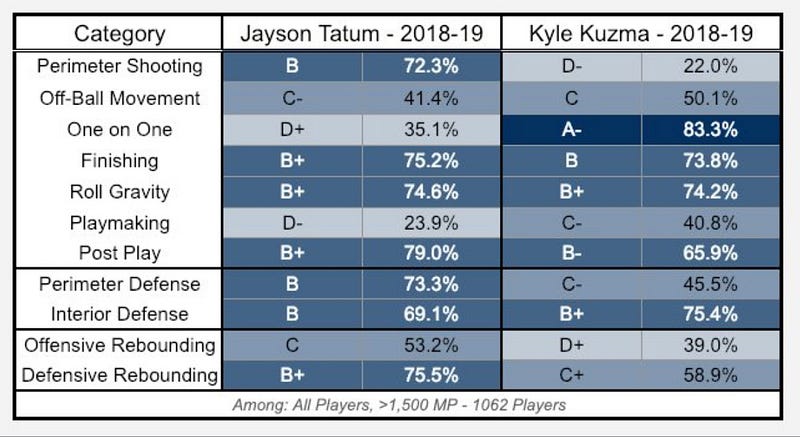
Tatum has a 6–4 edge over Kuzma, with 1 tie. This is confirmed by the eye test, where Kuzma’s offensive stats are slightly better than Tatum’s, but Tatum is a more efficient scorer and much better as a perimeter defender and under the boards.
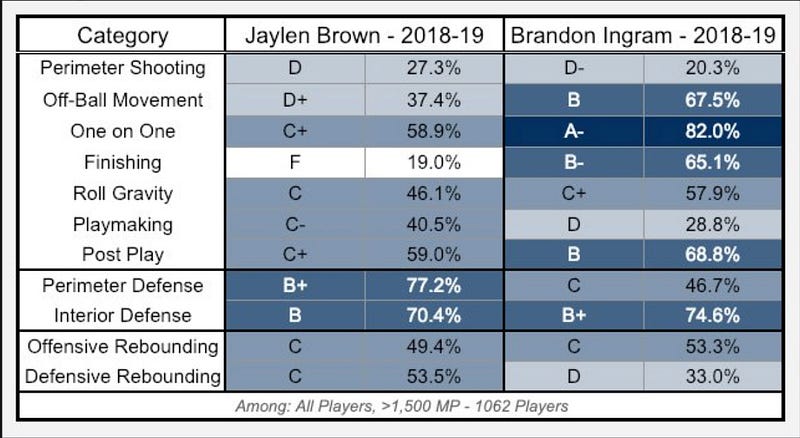
Ingram has a 6–4 edge, with 1 tie. What stands out is how bad Brown has been on offense this year. And the offensive stats of Ingram are much better in every area except 3-point shooting, where Ingram has been horrible (.308 3P%).
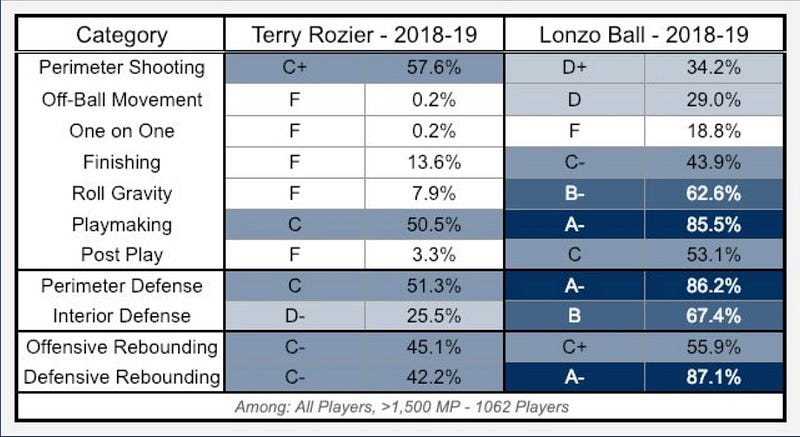
Lonzo has a 9–1 edge, with 1 tie.
The difference was so great between Lonzo and Rozier, Cranjis did a grade comparison between Smart and Ball.
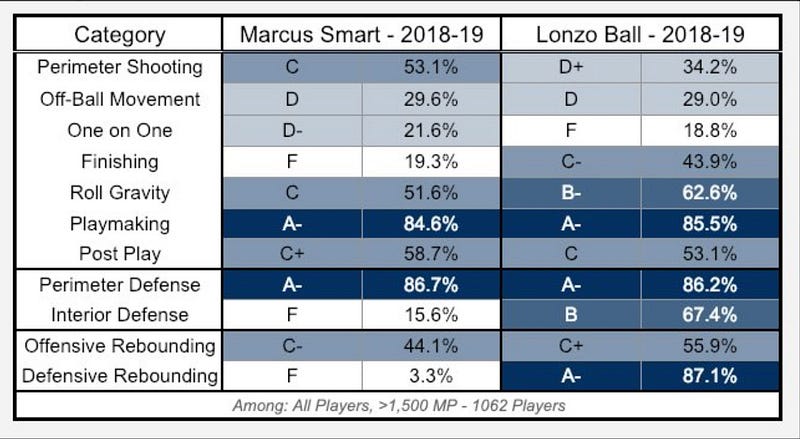
Lonzo has a 5–3 advantage, with 3 ties. Smart (career .308 3P%) is having the greatest shooting year of his life (.377 3P%), which is the reason the difference wasn’t more decisive.
Conclusions: Tatum is still the best of these players, but the Lakers’ trio are tightly bunched in the next group. There’s another gap to Brown and Smart and another gap down to Rozier.
Once we strip away the expectations of linear improvement for last year’s Celtics, the Lakers young players are far closer in value than people realize. But the Lakers’ horrific 3-point shooting has overshadowed all the improvements they’ve made since last year.
For Lonzo, his stats fell way off because he has deferred so much to LeBron. When he was given the reins of the offense during LeBron’s absence, his stats returned to last year’s levels with a significant improvement in his ability to finish at the rim and in 3-point shooting that resulted in a 20% improvement in his scoring average. He still needs lots of improvement in his shooting, especially at the free throw line, which could conceivably move him closer to averaging 13–15 ppg, which makes him enough of an offensive threat to force defenses to play him honestly and spread the floor.
#3: Understanding the value of other players, and the influence of great coaching.
Now that we’ve looked at the past and present performance of these young players, we have to answer the question “how well will these young players play when they are moved into a new situation?”
Here is a list of Boston’s core players (played at least 20 minutes per game) between 2014–2017 who are no longer with the Celtics:
Jeff Green, Brandon Bass, Avery Bradley, Jared Sullinger, Rajon Rondo, Evan Turner, Jae Crowder, Kelly Olynyk, Isaiah Thomas, and Amir Johnson.
Aside from Bass and Johnson who were older players, almost every one of the them had their best seasons under Brad Stevens, went on to sign big contracts with other teams, and never matched their performance in Boston.
Jeff Green (2014–2015) career high 17.6 ppg, then turned into a Memphis 1st round pick, Austin Rivers and Tayshaun Prince (who became a trade asset to acquire Isaiah Thomas). Green never came close to his numbers in Boston, but did come back to have one incredible game that helped Cleveland beat the Celtics in the 2018 Eastern Conference Finals.
Avery Bradley (2016–2017) career highs with 16.3 ppg, and .369 3P%, due a large contract (2 years, $25M with Detroit) but traded for Marcus Morris, who is more valuable (top Celtics volume three point shooter at .414 3P%) and on a $5M contract. Bradley is now averaging 8.2 points on .337 3P% with the Clippers.
Evan Turner (2015–2016) turned his career around after a big drop off in Indiana, signing for half the money of the last year of his rookie contract with Boston. Turner’s production improved by 30% compared to his last year at Indiana with 10.5 ppg, 4.9 rpg, 4.4 apg and a career best .456 FG%. The following year, he signed a massive four-year $70 million contract and has only matched his output in his third year with his new team.
Rajon Rondo (2006–2015), after a number of injuries was still a solid point guard, averaging 8.3 ppg, 7.5 rpg, and 10.8 apg, was traded to Dallas along with Dwight Powell for Jae Crowder, Jameer Nelson, Brandan Wright, and two draft picks. Rondo didn’t get along with coach Carlyle and his stay in Dallas was a disaster. Nelson got traded for Nate Robinson and Wright was turned into a protected 1st round pick.
Jae Crowder (2015–2017) had career highs in rebounds, assists, and .398 3P%, along with 13.9 ppg in his last year with the Celtics. He was part of the trade that brought Kyriee Irving to the Celtics, and was a disappointment in Cleveland. Working with a better coach in Utah, his game has recovered but has never matched his performance under Brad Stevens.
Kelly Olynyk (2013–2017) had the game of his life in game 7 of the 2017 Boston-Washington playoff series, scoring 26 points. His other great achievment was dislocating Kevin Love’s shoulder in a losing effort in the 2016 playoffs. He turned that one playoff game into a massive 4-year $50 million contract for a league average role player.
Isaiah Thomas (2014–2017) had career highs of 28.9 ppg, 5.9 apg, .463 FG%, .909 FT%, and .546 eFG%. After his injury and surgery, he was traded to Cleveland as part of the package that brought in Kyrie Irving.
This season, Kyrie Irving is enjoying career highs with 4.9 rpg, 7.0 apg, 1.7 stlpg, 0.5 blkpg, .503 FG%, and .574 eFG%, while averaging 1.6 ppg less than his career high.
Observing this consistent improvement in players’ performance while with Boston seems to indicate how much of an influence Brad Stevens can have on his players. This year was the only year where he had too many similar players competing for minutes.
Just like the incredible stats consistently put up by average guards in Mike D’Antoni’s system (believe it or not, this guy shot .399 3P%, and averaged 8.8 assists with the 2014 Los Angeles Lakers), we have to assume that the real ability of Boston’s young players is being enhanced by Coach Stevens’ system and player development.
For this reason, if I were in the Pelicans’ front office I would have serious reservations about trading for any players outside of Marcus Smart and Jayson Tatum and would demand additional players and draft picks to make a trade for Anthony Davis.
By comparison, the Lakers have almost no offensive system in place, outside of their transition offense and a couple of simple plays. Currently, the Lakers are a bottom 10 team in offensive efficiency, scoring 1.043 points per possession (ppp), while Boston scores 1.092 ppp. When we take into account that the Lakers are #3 in the NBA in fast break efficiency, and #3 in fast break points per game (fast break points comprise 17% of the Lakers offense, compared to 14.6% of Boston’s offense), the disparity between each team’s half court offense is even larger.
That should mean that the current group of young Lakers players will improve if they are brought under a coach with a sound offensive system. The only comparisons we have currently are D’Angelo Russell and Julius Randle (we can’t compare what happens to players playing in Cleveland.
Russell after a poor season last year due to injuries, is averaging career highs with 19.8 ppg, 6.5 apg, .437 FG% and .380 3P%. He was selected as a reserve for the All-Star game.
Randle came off the bench to start last season for the Lakers, but quickly became their best player, averaging 19 ppg and 9 rpg when he played at least 30 minutes per game. This year with New Orleans, Randle is playing 29.6 minutes per game, while averaging 20.1 ppg, 9.3 rpg, 3.0apg, .544 FG% and even shooting better on three pointers (.340 3P%) than Kuzma and Ingram.
I see no reason to doubt similar jumps in the games of Ball, Ingram and Kuzma.
And I’m thankful that New Orleans refuses to do a deal with the Lakers. Watch the Pelicans get fleeced by Danny Ainge this summer.


