
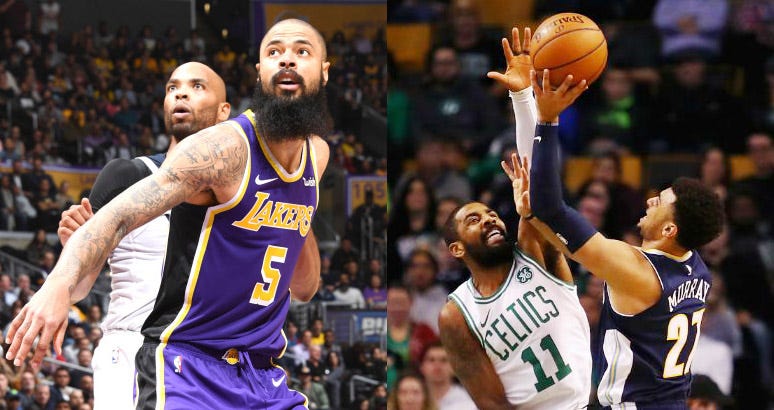
A Tale of Two Cities, NBA Style
In basketball, one piece can solve a puzzle, but one piece too many creates one.
[Update 11/19/18]: I started thinking about this comparison when I saw the Celtics play one of the ugliest games of the year at OKC, while the Lakers beat the then-invincible Denver Nuggets. After Tyson Chandler signed with the Lakers, I had to write about the contrast between these teams. Finally, I added an update at the end, as this analysis correctly predicted the team trends in games over the following ten days. Everything in italics contains updated stats.
An NBA deep dive into the Lakers and Celtics
NBA analysts and blog boys were convinced of two things this season:
- The Lakers don’t have enough outside shooting for a LeBron James-centered team.
- The Boston Celtics are a super team with incredible depth and talent.
So far, neither of these opinions are playing out, as of this update, the Lakers are shooting 36.1% on 3-pointers (#11 in the league), while the juggernaut Celtics, are shooting 34.9% (#19 in the league). The toothless Lakers are #9 in offensive efficiency, and the potent Celtics are #27.
Neither team was playing up to fans’ expectations, as the Lakers (5–6) have been horrible on defense, while the Celtics (6–4) have been horrible on offense. I think this all has to do with the concept of basketball harmony and making the pieces fit together. Here’s a breakdown of each team’s problems.
A) The Lakers were missing a piece
Ever since training camp began, it was clear that the loss of Julius Randle and Brook Lopez left the Lakers without a playable backup center. They tried Kyle Kuzma as a small ball 5, but that experiment was a disaster. From there, they turned to undrafted, G-League bound Johnathan Williams, and end of bench/G League vet Ivaca Zubac, and the results were just a hair better than complete disaster.
On Sunday, the Phoenix Suns inexplicably bought out Tyson Chandler’s contract. This type of maneuver is usually done much later in the season, but whatever. Chandler wasn’t playing well, and probably didn’t fit in with all the young guys as an aging veteran.
Three days later, he signed with the Lakers, played against Minnesota the same night, and looked like a new man. He had 9 rebounds in 23 minutes, including a couple of offensive rebounds in the last 46 seconds of the game to preserve a close win by the Lakers.
The question is, how much can a role player (who scored only 2 points) mean to the well being of a team? If you break down the Lakers’ terrible defense, you’ll notice a very disjointed picture.
They are a 10 top defensive team in some areas:
- Steals per defensive play (#9)
- Block Percentage (#10)
- Points off Turnovers (#7)
But a bottom 10 team in almost everything else:
- Opponent FG% (#23)
- Opponent 3P% (#20)
- Defensive Rebounding % (#26)
- Opponent Points off Turnovers (#24)
- Opponent Second Chance Points (#22)
- Opponent Points in the Paint (#29)
In one sentence, the Lakers force and score a lot of point off turnovers, are terrible defending shooters, and get absolutely killed on offensive rebounds.
As many people have said, defense doesn’t end until you secure the rebound.
If we look at Defensive Rebounding Percentage and Opponent Points in the Paint, the addition of Chandler seems to have filled a gaping hole in the defense in his first three games.
Def Reb%, all games: #24
Def Reb%, with Chandler: #7
Opponent Points in the Paint, all games: #29
Opponent Points in the Paint, with Chandler: #6
Do the Lakers still stink on defense?
Sadly, the answer is occasionally, as they are #20 in defensive efficiency for the season, but #13 over the 6 games Chandler has played. Included in this span were their first two games holding an opponent under 100 points, but a jet lag set back where they gave up 130 in their only loss. (See the update at the end).
The veteran players (especially LeBron) don’t hustle to contest 3-point shooters and young players (Ingram, Kuzma, Hart) don’t communicate and make the proper rotations, so even if they run and jump as hard as they can to contest shooters, they are too late getting there to make a difference.
For the Lakers to become a good team, they will need to find a way to become a mid-tier defense, or they will be doomed to repeat the Cleveland formula of the last four years, but in a much tougher conference.
Will Chandler continue to make a huge difference for the rest of the season?
Against Minnesota, the Lakers still did what they do best, dominating in fast break points (24–13) and points in the paint (46–34), but they also won the rebounding battle (54–47) for one of the few times this year. And rebounding allows the Lakers to get out in transition, where they are in the top 4 in possessions, frequency and points.
If the Minnesota game is a sign of things to come, there were good signs. Minnesota only shot 45.1% on field goals, which would put the Lakers at #15 in the league, which is a huge improvement. However, Jimmy Butler and Derek Rose were on fire from behind the arc, and Minnesota scored 110 points by virtue of making 20 of 40 3-point shots. Assuming other teams can’t consistently match this degree of accuracy, maybe the Lakers defense will improve to league average.
B) The Celtics have one piece too many.
Last season, the Celtics lost Gordon Hayward and Kyrie Irving before going on an improbable playoff run that got them one game away from the NBA Finals. This year, they are struggling to find a balance between reintegrating the two All-Stars and giving the young core enough minutes to continue playing at last year’s level.
In spite of Brad Stevens’ coaching genius, the Celtics have been unwatchable for most of the season. Their game against OKC pitted the two worst offensive teams in basketball at the time, and it was ugly.
The difficulty of having too many guys demanding minutes has led to offensive problems that show up in the stats of the young guys.
- Jayson Tatum shot 28.6% on 3-pointers in October (compared to 42.1% last year). Even though he’s improved in that area, he is still shooting only 40.6% overall, down from 47.5% last year. But the iso play is leading to poor shot selection, as his percentage of shots near the rim has dropped to 24%, and his 3-pointers at 32.3%, while his mid range jump shots now make up over 43% of his total shots. (Last year, he finished at the rim 38%, shot 3-pointers 34.2%, and mid-range jumpers 27.6% of the time.)
- Terry Rozier is playing 3 minutes less per game, but his points, rebounds, and assists have dropped disproportionately. He’s also shooting only 35.5% overall, as he’s pressing to jack up shots, knowing he’s not going to get as much playing time, while hoping to get a big contract when he becomes a free agent at the end of this season.
- Jaylen Brown is shooting like dog crap (.379 FG%, .297 3P%). He’s playing 1.5 minutes less, but all his stats are disproportionately worse.
- Marcus Smart is incredibly important to Boston, but he has sacrificed more minutes than anyone on the team. In spite of being the NBA’s premier brick manufacturing facility, Boston’s offensive rating is 112.4 (good for #6 in the NBA) when he’s ON the court! While he is clearly the heart and soul of the Celtics’ defense, he is still producing more in rebounds, assists, steals and blocks per minute than he did last year. His overall On/Off rating is +15.9, the best on the team. There’s something seriously wrong with a team that plays their most effective player 22% less minutes per game.
Now, look at the play of the veterans, who make up 63.3% of the Celtics payroll:
- Gordon Hayward is shooting and defending poorly, with an On/Off rating of -9.8. Even worse, he is taking minutes away from the young guys and Marcus Morris, who has been on fire this season.
- Kyrie Irving, in spite of his wonderful offense, is still a minus defender. When he is on the court, the team’s defensive rating balloons to 108.6 — the equivalent of the Brooklyn Nets (#17). His On/Off rating is -9.2.
- Al Horford was expected to make the most sacrifices in terms of shots, to give the more gifted offensive players more opportunities. Guess what? He’s turned into Lance Stephenson, as he’s shooting almost 50% more 3-pointers and only making 29.6% of them. His On/Off rating is -9.1, and his defense has taken a huge dump.
It’s early in the season, and the Celtics have Brad Stevens, so things might work out.
But they might not.
The problem is not the fact that the Toronto Raptors are the best team in the East.
I already predicted that.
The real problem is that the Celtics have a rapidly closing window with their current roster construction.
They can’t afford to alienate their young core by cutting into playing time. And they won’t be able to pay these guys appropriately when they are eligible for their next contract if they keep paying the incredibly bloated salaries going to the three veterans who are either injury prone (Irving), not sure of fully recovering from a gruesome injury (Hayward) or on the down side of their career (Horford is 32, but trying to play like Draymond Green).
The question is can they (should they?) incorporate all of these extra pieces?
My guess is that if Ainge is smart, he will trade Irving who has showy offensive numbers that will intrigue the dumb GMs he regularly bamboozles, just like those shiny mobiles you hang above a baby’s crib to keep them occupied.
To me, this is as good a reason as any to get rid of Irving, who got fined $25K for his ridiculous behavior:
If a team gets bitch slapped all night by a player to the tune of 48 points, you give hard fouls when he goes to the rim. You don’t pretend to be a tough guy by throwing the ball into the stands after the game. That just makes the Celtics look soft, and that goes against the franchise’s DNA.
While I’m not a fan of Hayward, I don’t think the Celtics could move his contract without giving up draft assets. Teams won’t want three years and almost $100 million for a player who was never a max player even at his best, and now struggling to overcome his terrible injury.
Remember, Boston had the contracts and the assets to make San Antonio an offer they couldn’t refuse. Can you imagine a line up of Kawhi Leonard, Rozier, Brown, Tatum and Horford? Not only does that block Toronto from making the leap, it would have given Boston the one thing they need to have a chance to win a title — the one guy who has guarded and beaten Kevin Durant and LeBron James in consecutive playoff series.
Both the Lakers and the Celtics will have big questions to answer as the season progresses.
For now, the Celtics are struggling, and Toronto looks like the main competition for Golden State this year. The face a big test on the second game of a back to back, playing in Utah, followed by a trip to Portland. If things don’t go well, the Celtics could be 7–6 before heading home.
In Los Angeles, no one knows if all the close losses are a sign of weakness or just the right kind of preparation for the young players to learn to compete in playoff conditions. They face two winnable games and a chance to be 7–6 before a home game against Portland before going East for two of three games against bottom dwellers.
It will be interesting to follow the journey of each team.
Update, Nov. 19th: A bow for now
A week went gone by and the Celtic did lose both games to fall to 7–6
But they got well in a hurry by heading back east and trouncing the Chicago Bulls. A week after I published this article, the national media is writing stories about Boston’s horrible offense. You’re welcome, ESPN.
Boston faced a huge test that felt like their season was on the line as they hosted Toronto tonight. Another loss might start all kinds of drama, as the difficulty of integrating Gordon Hayward and Kyrie Irving back into the starting lineup may create some friction with the young guys who reached game 7 of the ECF without any help.
They finally discovered to their offense — don’t let anyone touch the ball but Kyrie Irving
Kyrie Irving had the best game of his career (even better than game 5 of the 2016 NBA Finals), with 43 points, 11 assists, and 69% shooting. He scored 17 straight points in the 4th quarter, and either scored or assisted on every basket in overtime, as Boston overcame a 10-point 3rd quarter deficit to win 123–116. (They also needed Kawhi Leonard to miss two mid-range jump shots and a game saving loose ball foul by the refs to overturn a Toronto putback with 1.2 seconds left in regulation. Did I mention the game was played in Boston? This kind of play — a taller, stronger player walks a smaller defender in toward the bakets, and then outjumps the short player in front to grab a rebound — happens hundreds of times throughout each NBA season and almost never gets called.)
Boston lost the next night to Utah, and the drama started up anyway. Here’s the ESPN headline:
“Brad Stevens, Kyrie Irving call out Celtics after another loss to Jazz”
The Celtics are now 9–7, and they have the one thing that cures all ails: playing in the Eastern Conference
With upcoming games against Charlotte, New York and Atlanta, Boston should fatten up their record and keep pace with Indiana and Philadelphia. They will be tested on the road at Dallas, yes, I said Dallas, who beat Utah by 50 points (three days before Utah beat the Celtics) and New Orleans (5–1 in their last games, including Toronto’s first home loss of the season).
For the Lakers, the role played by Tyson Chandler has been massive.
He helped the Lakers crush Sacramento, and hold the kings (they’ve got to win something before they earn a capital letter) to under 100 points, an extraordinary defensive effort I analyzed here:
On the second night of a back to back, the Lakers got lazy and almost blew a 16-point lead to the Hawks, but Chandler made the play of the night, blocking a shot with no time remaining to preserve a 1-point win.
Three days later, the Lakers played perhaps their best game of the season, overcoming the red-hot Portland Trailblazers and current #2 seed in the West to win going away, 126–117. Portland started out hitting 7 of 10 three-pointers and took a 13-point lead. The Lakers defense stiffened, and LeBron James showed fans again why he is the best basketball player on the planet:
The Lakers are starting to look like a good team, as they are on a 4-game win streak, with three winnable games on a short road trip to Orlando, Miami and Cleveland. Miami is a trap game, as it’s the second game of a back to back, and LeBron is unbelievably 0–7 at Miami since he left the Heat. If the Lakers can win 2 out of 3, their record will be 10–7, and probably move up to the #6 seed.
Okay, the Lakers are still a work in progress. But LeBron James is very, very good.
I wrote the above part of the update last Thursday, Nov. 14, and left in the paragraph above (before the road trip) to show how little anyone can predict the NBA. The Lakers played like a team that had never boarded an airplane and flown east of the Mississippi, losing 130–117 to Orlando, and making Vucevic and Augustin look like the second coming of Shaq and Kobe.
On the second night of a back to back, as if to send a message, LeBron decided to show the league what happens if he wants to take over a game at the start and dominate like it was 2014.
While LeBron had an amazing first 30 minutes (41 points on 23 shots), the young Lakers never played well enough to blow the game completely open after the Lakers took an 18-point lead early in the 3rd quarter.
LeBron came back with 8:08 in the 4th quarter and finally cooled off. The young guys became too passive, and stood around watching LeBron, so the offense ground to a stand still, allowing Miami to cut the deficit to 8 points. Fortunately, Brandon Ingram hit a clutch shot to build the lead back up to 10 points with 3:46 left, and the Lakers defense got enough stops to hold off the Heat.
The Lakers are now 9–7, and their future depends solely on their defense, which you can roughly define as “holding” teams to less than 120 points.
Regardless of how poorly the young core might shoot on a given night, LeBron is still the guy you want at the end of a close game. But they have to play good enough defense to keep games close. In Orlando, they gave up 130 points. In Miami, they held the Heat to 97 points, and that will always get the job done.
As crazy as it sounds, if the Lakers “hold” teams to under 120 points, their record is 9–1.
For the season, the Lakers are a top 10 offense with a bottom 10 defense. Since Chandler joined the team, the Lakers are 5–1, with the #7 offense and the #13 defense. Defense fuels their fast break (#2), and gives them tons of points in the paint (#2). Combine that with the team’s solid 3-point shooting (#11 at 36.1%), and the Lakers will never have to worry about their offense.
Final Conclusions
I think the basic difference between these two teams can be summed up as follows:
Even though Kyrie Irving can only play like LeBron James a handful of times throughout a season, the Celtics don’t need more than that.
Playing in the Eastern Conference, the Celtics will be no worse than a #4 seed, but they will struggle to win the East because it’s far more likely for Kawhi and Giannis (and even Embiid) to play four dominant games in a series than Kyrie.
Even though LeBron James is still the King, the young core needs a lot of work going forward.
Lonzo (21), Ingram (21), Kuzma (23), Hart (24) and KCP (25) have been uneven throughout the season on one side of the ball or the other. To succeed in the West and make a deep playoff run, they need to shore up their weaknesses, especially on defense.
The West is impossibly deep, as last year’s lottery teams like Sacramento, Dallas and Memphis have surprised the league with their good play. There are currently 12 teams at .500 that could possibly compete for a playoff spot, while Dallas has some great young talent and riding a 4-game winning streak (wins over OKC, Utah and Golden State). But the West is quietly opening up at the top.
Golden State is struggling with injuries and interior turmoil and Houston looks like they are regaining their mojo, so both teams should eventually dominate the West. For the moment, the #8 seed in the West is only two games out of first place.
More importantly, the #3 seed is completely up for grabs, and with it home court advantage in the first round and a potential match up with the Rockets in the second.
Avoiding the Warriors with a healthy Boogie Cousins should be the #1 priority of every team in the West.
I definitely like how the Lakers match up against the Rockets. The teams have played only once, but it was an amazing game with multiple lead changes until Rondo, Ingram and Chris Paul got ejected for fighting at 109–108.
Let’s hope the season stays this exciting for the whole year.


