
Understanding My Partner’s Autigender and Neuroqueer Identity
When autism and gender are inextricably linked
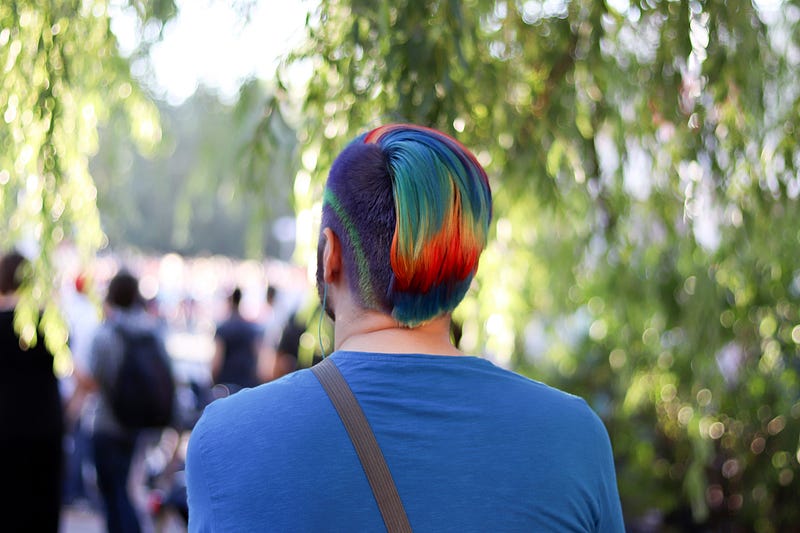
He painted his nails for our first date. Blue polish with little specs of color sprinkled throughout, like confetti.
His hair was also a vibrant blue, longish and swept to the side. The color of his glasses? You guessed it — blue frames.
I was instantly attracted to his physical appearance. And from our pre-date text and video chats, I knew I was even more drawn to his intellect.
Before we met in person, we’d talked about all the topics you cover when getting to know someone. Work, hobbies, what we’re looking for in a relationship, and so on.
From the beginning, we dove fearlessly into our thoughts and experiences around sexuality — a subject we’re both passionate about.
He shared that he identifies as autigender and neuroqueer. His pronouns are he/she/they — take your pick.
There’s an overwhelming amount of information out there, but in essence — his gender identity and sexual orientation are fundamentally shaped by the way he experiences the world as an autistic individual.
Both terms were listed on his dating profile, which made him stand out in a sea of dudes who were sending “Hey, what’s up” messages in the hopes of scoring sex without so much as crafting a clever opener.
I’d never heard of either label. And let me tell you, I love to learn. I also love a unique, hyperintelligent person who can teach me something new. It’s a real turn-on.
“Infodumping is one of my love languages,” he texted. “If you’re okay with that, I can tell you all about it.”
“Infodump away!” I replied.
Autism and gender identity
My partner — I’ll affectionately call him Blue — had a lot to teach me about his journey in a society that doesn’t always accept that gender is a spectrum. One as varied and colorful as his painted nails.
He didn’t receive his diagnosis until the age of 38. That’s when he began to heavily research autism and discover just how much it impacted his life — and his identity.
“I was mocked for years for being ‘effeminate,’” he shared with me. “As a kid, I struggled to understand why one thing was okay for boys to do and another was not.”
Through therapy and research, he discovered his identity as autigender, meaning he understands his gender uniquely through the context of being autistic.
The term was born in 2014, when two Tumblr users were discussing how their autism directly affects their perception of gender.
Autigender isn’t necessarily a gender in itself, although for some it can be. For my partner, and many others, it’s about the difficulties autistic individuals have with interpreting and understanding societal constructs.
“I don’t feel male or female,” he told me. “I just am.”
Blue presents as masculine in his physical features, which is why I tend to use “he” the most, but many of his mannerisms are traditionally feminine. Masculinity is a mask he learned to wear to blend into social settings.
It’s important to share, as Blue did with me, that not all autistic individuals identify as autigender. But he does.
“I can’t accept societal norms, so the idea of gender is hard for me,” he explained. “Colors being feminine or masculine, gender roles and biases — they make no sense. It’s just people deciding to impose an idea on society.”
Be neuroqueer by neuroqueering
In our early days of dating, the other facet Blue and I discussed at length is his sexual orientation: neuroqueer.
Through vulnerable conversations with him and my own deep dive into research, I learned that author and educator Nick Walker, PhD, first coined the term in an academic paper she wrote in 2008.
Neuroqueer refers to someone whose identity, selfhood, gender performance, and/or neurocognitive style is shaped by their neurodivergence.
Though it can be an adjective, Dr. Walker thought of it as a verb first. She states that neuroqueering is the practice of queering (defying/disrupting) neuronormativity and heternormativity simultaneously:
It was an extension of the way queer is used as a verb in Queer Theory; I was expanding the Queer Theory conceptualization of queering to encompass the queering of neurocognitive norms as well as gender norms — and, in the process, I was examining how socially imposed neuronormativity and heteronormativity were entwined with one another, and how the queering of either of those two forms of normativity entwined with and blended into the queering of the other one.
Blue feels a strong connection to the feminine and the masculine — and everything in between.
Sometimes he likes to wear lipstick when we go out. He almost always has painted nails. He likes to wear women’s clothes once in a while — a behavior that’s connected to his genderfluidity as well as his sensory issues.
His skin is hypersensitive, so he hates rough clothing textures. Materials like silk and velvet feel amazing. Growing up, the soft fabrics used for girls’ clothes were more appealing to him than boys’ clothes.
As far as sexual attraction, Blue likes feminine and androgynous features. In his day-to-day, he’s found himself attracted to women, men, non-binary, and transgender individuals.
Personality, however, is the deciding factor. “By the time I’m having sex with someone, I’m already attracted to them as a person,” he explained. “Their genitals are irrelevant.”
Don’t teach children to “act your gender”
Part of the work Blue does for his job is advocacy. He’s a fantastic speaker, which is why he’s so good at helping people learn about autism and other neurodivergent strengths and challenges.
Understanding his gender identity really came together for me when he explained that autistic children are too often pushed to act like neurotypical kids.
When this happens — whether in the home, at school, or in therapy — these children are inevitably pushed to act like their assigned heteronormative gender as well.
Blue was, and still is, often pushed by the people around him to mask and “act normal.” In a society where gender norms were invented by neurotypicals, it makes perfect sense to me that his gender and sexuality are inextricably linked to his neurodivergent wiring.
Embracing divergence
It’s been 11 months since our first date, and the way I see the world has changed. A whole new part of the universe has opened up, thanks to Blue.
It was always there, but I didn’t know about it until he showed me.
I’ve gained a better understanding and a deeper love for diversity and the entire neurodivergent community. I’ve also learned how performative gender is. It’s about how we identify, yes. but also how we’re perceived.
Fem, masc, gay, or straight — I love my partner’s entire spectrum.
By listening to his thoughts and experiences, I can see who he uniquely is, inside and out. And I can love him better, now that he’s opened my eyes to a world full of divergent beauty.
Thank you for reading. If you liked this story, you can support my work by joining Medium for $5 a month. You’ll also get access to other incredible writers on the platform.
Sign up for my newsletter or connect with me on Twitter to stay updated on all my latest creations.


