avatarBrett Berry

Summary

The web content introduces exponent properties through an exploration of a unique number problem, where the goal is to find a number between 2 and 200,000,000,000,000 that is simultaneously a perfect square, a perfect cube, and a fifth power.

Abstract

The article titled "Understanding Exponent Properties and An Unusual Number Problem" delves into the mathematical properties of exponents as a means to solve a specific puzzle. The problem presented is to identify the sole number between 2 and 200,000,000,000,000 that is a perfect square, cube, and fifth power. The article references the book "Puzzles in Math & Logic" by Aaron J. Friedland as the source of this challenge. It provides a brief introduction to exponents, recalling that an exponent indicates how many times a number is multiplied by itself. The article then illustrates exponent properties using diagrams, emphasizing that when multiplying terms with the same base, their exponents are added, and when raising a term with an exponent to another exponent, the powers are multiplied. The lesson aims to equip readers with the understanding necessary to tackle the unusual number problem and encourages them to apply these properties to find the solution.

Opinions

  • The author believes that understanding exponent properties is key to solving the unusual number problem.
  • The article implies that the number Wilfred is looking for is rare and difficult to find, as Wilfred has already checked up to 100,000 without success.
  • The author suggests that readers who are new to the concept of exponents should review the previous lesson provided, indicating a pedagogical approach to teaching the subject.
  • The use of diagrams to explain exponent properties indicates a preference for visual learning aids.
  • The author is optimistic that the reader will find the lesson helpful, as evidenced by the encouragement to apply the knowledge and the invitation to express appreciation for the content by clicking the heart icon.

Understanding Exponent Properties

and An Unusual Number Problem

An Unusual Number Problem

Wilfred heard that there is only one number between 2 and 200,000,000,000,000 which is a perfect square, a perfect cube, and a fifth power, and has decided to look for it.

So far he has checked every number up to 100,000 and is beginning to get somewhat discouraged. Perhaps you can help him find it?

— This puzzle came from “Puzzles in Math & Logic” by Aaron J. Friedland

Need Help Getting Started?

If you’re just joining us, Welcome! I introduced exponents in lesson two. Check it out if you need a refresher!

Today we’re covering properties of exponents (the key to solving the above problem!)

Exponent Properties

Recall an exponent describes the number of times a value is multiplied with itself. For example, six x’s multiplied together is the same as “x to the sixth power.”

Diagram 1

Using the associative property, regroup the terms.

Diagram 2

(x • x) equals x-squared, so the expression is the same as having three x-squared’s multiplied together.

Diagram 3

This is the same as “x-squared cubed” or “x-squared raised to the third power.”

Diagram 4

This demonstrates two properties of exponents:

  1. To multiply terms with exponents together make sure the bases are all the same, in this case they were all x, then add the exponents (see diagram 3).
  2. When raising a term with an exponent to another exponent, multiply the powers together. For example:
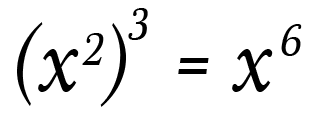
I could also work backwards.

Start with x raised to the sixth power. Since 6 = 3 x 2, rewrite the expression like this:
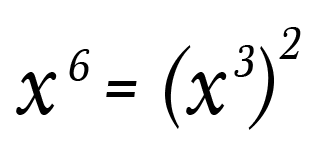
X-cubed raised to the second power means I am multiplying two x-cubes together.
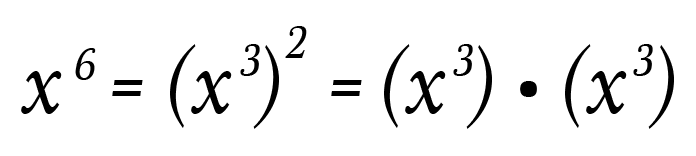
Which is equal to six x’s multiplied together.

That should get you started in the right direction!

Next Lesson: An Unusual Number Solution

Thanks for reading!

Please click the ❤ to let me know you learned something new!

Mathematics
Math
Puzzle
Tutorial
Math Fundamentals
Recommended from ReadMedium