avatarBrett Berry

Free AI web copilot to create summaries, insights and extended knowledge, download it at here

2312

Abstract

<i>b-cubed</i> by 10, and <i>c-to-the-fifth</i> by 6.</p><figure id="870f"><img src="https://cdn-images-1.readmedium.com/v2/resize:fit:800/1*_vxhUQblXfkHxDh01jb1eg.png"><figcaption></figcaption></figure><p id="5a17">Now here’s the cool part. Remember how in the last post I showed how<b><i> x-squared</i> cubed is the same as <i>x-cubed</i> squared</b>? Use that same trick to flip the powers around, like so:</p><figure id="cc92"><img src="https://cdn-images-1.readmedium.com/v2/resize:fit:800/1*HHFzE6bQeEkln-gAFI58qg.png"><figcaption></figcaption></figure><p id="d68c">This is awesome because we now have formed expressions that involve a <i>perfect square, perfect cube</i> and a <i>fifth power </i>of different numbers.</p><p id="d6fa">Writing this long hand may make it more evident to you.</p><figure id="3c63"><img src="https://cdn-images-1.readmedium.com/v2/resize:fit:800/1*5gtHK9bTZDbI5QM56xVPcA.png"><figcaption></figcaption></figure><p id="1910">Now we can solve for the answer as well as the square root, cube root and fifth root. They should all have the same result, so set them equal to one another.</p><figure id="8f7b"><img src="https://cdn-images-1.readmedium.com/v2/resize:fit:800/1*-yIE8HtYCBrwDxIo6U3gfQ.png"><figcaption></figcaption></figure><p id="3dc0">I know that raising a number to the 30th power is going to produce a very large product. So I’ll begin with a small number to test. I can’t use 1 because our range is 2 to 200,000,000,000,000. Instead I’ll try 2.</p><p id="3756">Using a calculator, I compute:</p><figure id="e9c5"><img src="https://cdn-images-1.readmedium.com/v2/resize:fit:800/1*wf6omlKGIoD5I0d76DzCAg.png"><figcaption></figcaption></figure><p id="9703">This is less than our upper bound of 200,000,000,000,000, so it must be the answer! Furthermore, we can find the roots by plugging in 2 into the appropriate variables.</p><p id="a815">The <b>square root </b>of 1,073,741,824 is:</p><figure id="1836"><img src="https://cdn-images-1.readmedium.com/v2/resize:fit:800/1*2Pjfh4c1v7HGR0HvjnjuTA.png"><figcaption></figcaption></figure><p id="ae64">The <b>cube root</b> of 1,073,741,824 is:</p><figure id="11c2"><img src="https://cdn-images-1.readmedium.com/v2/resize:fit:800/1*oqdnWWpwyCCRzT43RzFJ1w.png"><figcaption></figcaption></figure><p id="6951">The <b>fifth root

Options

</b> of 1,073,741,824 is:</p><figure id="f68e"><img src="https://cdn-images-1.readmedium.com/v2/resize:fit:800/1*YGhljt8Ezd0kUTDCOtMxqg.png"><figcaption></figcaption></figure><p id="1b14"><i>Sweet, we’re done here. See you next time!</i></p><p id="4849"><i>Next Lesson:<a href="https://readmedium.com/how-common-core-can-prepare-students-518c2fb72e3#.yqnlouhef"> Understanding Common Core Style Math Models for Parents</a></i></p><p id="db1b"><i>Thanks for reading!</i></p><p id="a319"><i>Please click the ❤ to let me know you learned something new!</i></p><div id="54f6" class="link-block"> <a href="https://readmedium.com/the-monty-hall-game-show-problem-ef68c8581845"> <div> <div> <h2>The Monty Hall Game Show Problem</h2> <div><h3>Bayes’ Theorem</h3></div> <div><p>medium.com</p></div> </div> <div> <div style="background-image: url(https://miro.readmedium.com/v2/resize:fit:320/1*MqSq_Oj0K_lEErFwwFag6g.png)"></div> </div> </div> </a> </div><div id="18ef" class="link-block"> <a href="https://readmedium.com/find-perfect-squares-mentally-with-this-trick-b8fa2c116d73"> <div> <div> <h2>Find Perfect Squares Mentally with this Trick</h2> <div><h3>mental math series, part 6</h3></div> <div><p>medium.com</p></div> </div> <div> <div style="background-image: url(https://miro.readmedium.com/v2/resize:fit:320/1*2MMK774vWGNZ6Mqrq2TulA.png)"></div> </div> </div> </a> </div><div id="b560" class="link-block"> <a href="https://readmedium.com/intro-to-modular-arithmetic-34ad9d4537d1"> <div> <div> <h2>Intro to Modular Arithmetic</h2> <div><h3>Equivalence Classes and Circular Counting</h3></div> <div><p>medium.com</p></div> </div> <div> <div style="background-image: url(https://miro.readmedium.com/v2/resize:fit:320/1*vpJPkyD-7Y01KI3fWM595A.png)"></div> </div> </div> </a> </div></article></body>

An Unusual Number Solution

Wilfred heard that there is only one whole number between 2 and 200,000,000,000,000 which is a perfect square, a perfect cube, and a fifth power, and has decided to look for it.

So far he has checked out every whole number up to 100,000 and is beginning to get somewhat discouraged. Perhaps you can help him find it?

— This puzzle came from “Puzzles in Math & Logic” by Aaron J. Friedland.

If you’re seeing this riddle for the first time and want to try if for yourself, see the last post for helpful information to get you started!

The Answer
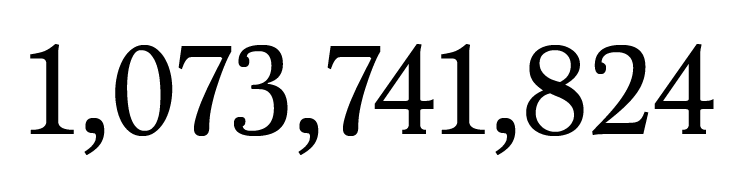
How did I find it?

Okay, I’m no genius and definitely did not guess it, but the problem is solvable in a timely manner if you utilize exponent properties.

We need to find some number squared, some number cubed and some number to the fifth power that yield the same result. So begin by defining a, b, and c as the “some numbers” and raise them to the desired powers.
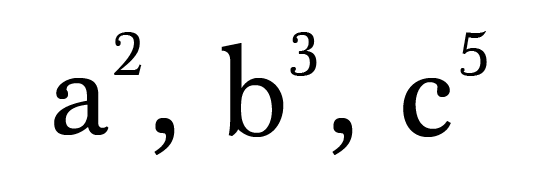
Next I need to make all the exponents match. This will ensure that if I plug in the same number for a, b and c they will result in the same total.

To do this I need to find the least common multiple (LCM) of 2, 3 and 5. Since they are all prime numbers I can multiply them together to find the LCM.
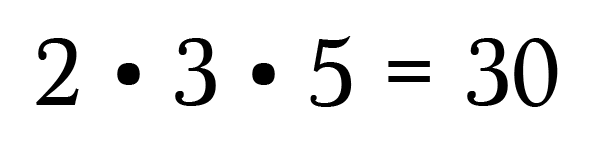
Now let’s adjust a, b and c so that they all have exponents of power 30 (the LCM). To do this, raise a-squared by 15, b-cubed by 10, and c-to-the-fifth by 6.
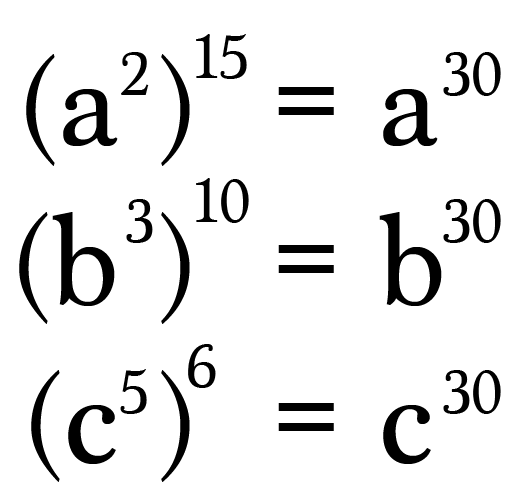
Now here’s the cool part. Remember how in the last post I showed how x-squared cubed is the same as x-cubed squared? Use that same trick to flip the powers around, like so:
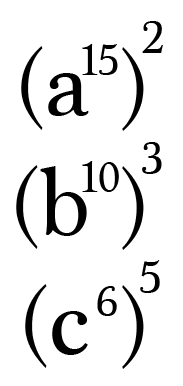
This is awesome because we now have formed expressions that involve a perfect square, perfect cube and a fifth power of different numbers.

Writing this long hand may make it more evident to you.
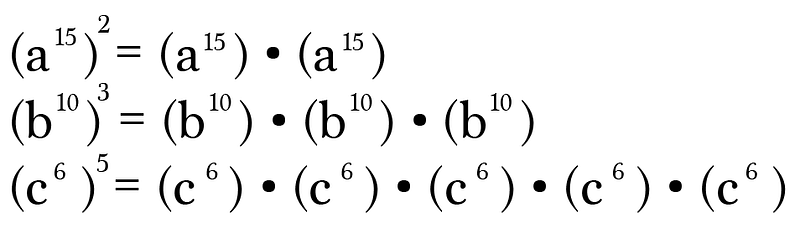
Now we can solve for the answer as well as the square root, cube root and fifth root. They should all have the same result, so set them equal to one another.
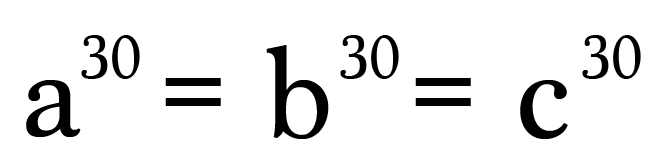
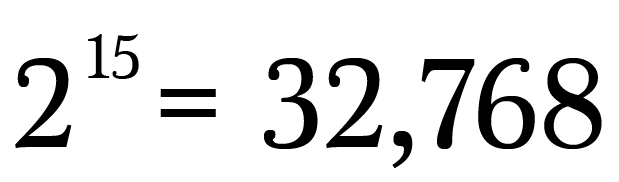
I know that raising a number to the 30th power is going to produce a very large product. So I’ll begin with a small number to test. I can’t use 1 because our range is 2 to 200,000,000,000,000. Instead I’ll try 2.

Using a calculator, I compute:

This is less than our upper bound of 200,000,000,000,000, so it must be the answer! Furthermore, we can find the roots by plugging in 2 into the appropriate variables.

The square root of 1,073,741,824 is:
The cube root of 1,073,741,824 is:
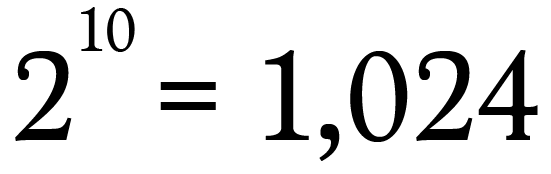
The fifth root of 1,073,741,824 is:
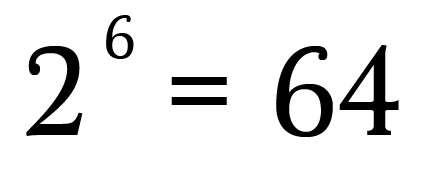
Sweet, we’re done here. See you next time!

Next Lesson: Understanding Common Core Style Math Models for Parents

Thanks for reading!

Please click the ❤ to let me know you learned something new!

Mathematics
Math
Puzzle
Riddles
Problem Solving
Recommended from ReadMedium