
Undersea organisms turned the ship into a vibrant reef. How long did it take them?
Eight years of research in the Red Sea have yielded surprising results. Scientists have documented how the SS Thistlegorm wreck, resting on the seabed, has turned into an artificial coral reef. It is now a refuge for as many organisms as natural reefs are home to.
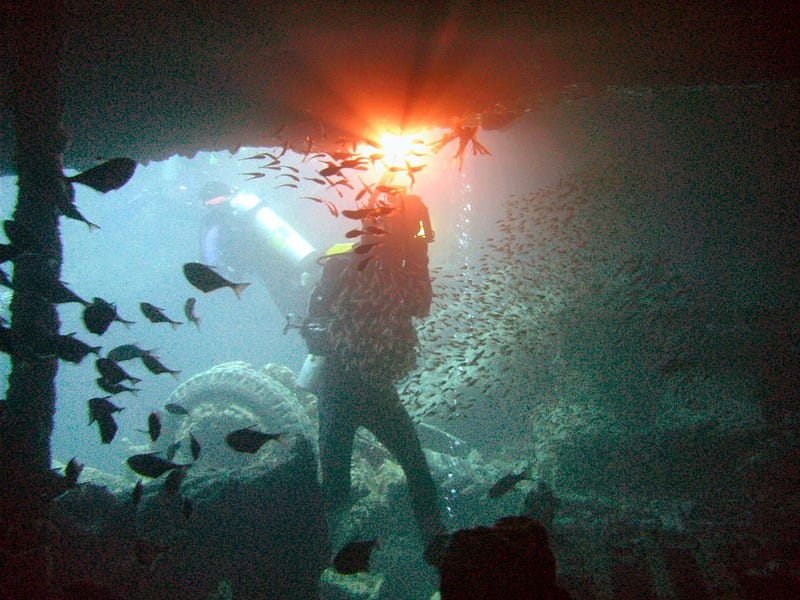
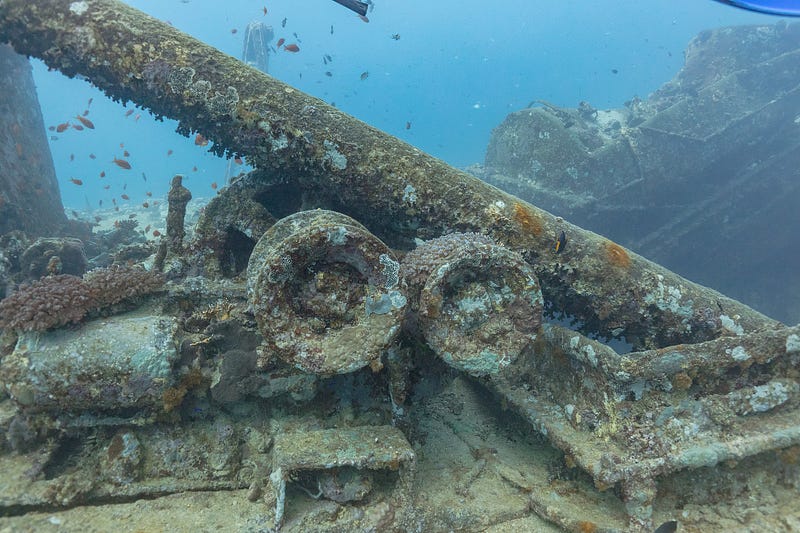
Videos of the dive to the wreck of the SS Thistlegorm show an extraordinary underwater world. Shoals of multicolored fish swirl around the anti-aircraft guns, still on the bow. On deck, the beautiful corals of the Red Sea unfold. Everywhere — on the deck and around the hull — is full of life.
What can be seen on the wreck of the SS Thistlegorm?
No less interesting sights await those who dive into the depths of the ship. Larger fish appear in the hold. Some are as unusual as the Napoleon fish (or humphead wrasse, Cheilinus undulatus) or the giant moray eel (Gymnothorax javanicus). Divers visiting the wreck must divide their attention between the fish and the cargo that was sunk with the ship. Rows of motorcycles, transport vehicles, even trucks still stand on the SS Thistlegorm. A thick layer of silt covers them.
What was the voyage of the SS Thistlegorm like?
It took only a few decades to turn the ship into a lush underwater ecosystem. The SS Thistlegorm is a British transport vessel from the Second World War. It sank during its fourth voyage in 1941.
At the time, the ship was sailing with supplies for British forces stationed in North Africa. It carried ammunition, engines, transport cars, spare parts, motorcycles, even locomotives. He had a long journey behind him. In September, he sailed from Glasgow, circumnavigated all of Africa, passed Madagascar and entered the Red Sea. He was headed for Alexandria. On October 6, he anchored in the Gulf of Suez before entering the Suez Canal. At two o’clock in the morning, it was spotted by German bombers. The ship was bombed and went down.
Today it rests at a depth of 16 meters (stern) to 33 meters (bow). Since the 1990s it has been one of the favorite diving sites in the Red Sea. It has a natural coral reef nearby, and is only 70 km (by boat) from the popular resort of Sharm el-Sheikh.
How long did it take to explore the wreck?
The popularity of the wreck among divers was decided by scientists. The project, led by marine life researchers from the University of Bologna, began in 2007. For eight years they collected data on marine organisms living in the wreck.
They were assisted by volunteers involved in the citizen science program “Scuba Tourism for the Environment.” On recreational dives, they looked at the creatures that had turned the SS Thistlegorm into their home. Later, they filled out detailed questionnaires prepared by the researchers.
The scientists were particularly interested in how diverse the ecosystem that has developed around the wreck is. That is — how many species from different taxonomic units are present on it. The researchers distinguished 72 taxa — that is, groups of related organisms — characteristic of the main Red Sea ecosystems. They then questioned divers about whether they had seen representatives of them underwater.
How is an artificial coral reef created?
As it turned out, over the decades the wreck has turned into a vibrant artificial coral reef. Representatives of as many as 71 taxa — of the 72 sought — have been observed underwater.
“The SS Thistlegorm provides an important example showing how a complex ecosystem similar to those of natural reefs can form and persist around an artificial coral reef”, the researchers wrote in a paper published in the journal PLOS One.
In their view, the study of artificial reefs such as the SS Thistlegorm wreck can help protect natural reefs whose existence is threatened by climate catastrophe.
It is estimated that as many as three million shipwrecks lie at the bottom of Earth’s oceans. That’s enough to have an impact on fragile marine ecosystems. Many of the ships, built of wood, have become places where underwater microorganisms thrive.
A year ago, scientists showed that bacterial biofilms, archaeons and fungi develop on sunken ships. In this way, wooden wrecks become home to creatures at the beginning of food chains. And all the ships on the ocean floor — useful structures that can provide shelter and life for all sorts of marine organisms.
Source: PLOS One
Cool that you made it to the end of this article. I will be very pleased if you appreciate the effort of creating it and leave some claps here, or maybe even start following me. It would be nice if you also left a tip! Thank you!


