
Undeck
What you do to the halls after Christmas is over
Today’s New York Times Spelling Bee letters:
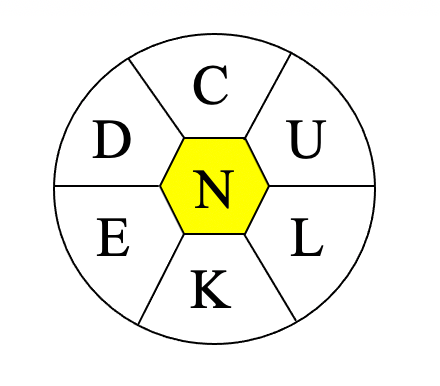
C, D, E, K, L, U, and center N (all words must include N)
Merriam-Webster says…
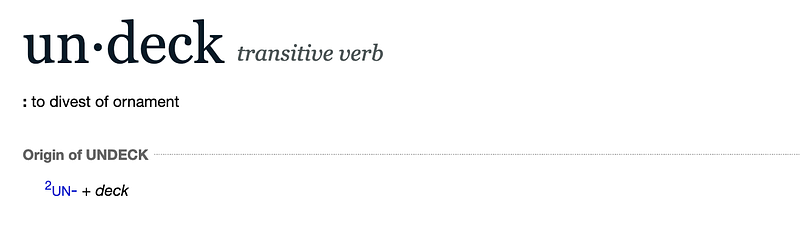
Silly little dictionary! Don’t you know undeck can’t possibly be a word if the New York Times says it ain’t?
For further fascinating facts, check out the Spelling Bee Master.
What’s your favorite dord* from today’s puzzle?
My Two Cents
Having played the Spelling Bee for several years now, there are some patterns I have noticed. Like how some words I consider obscure (eyetooth and ghee from yesterday’s game are two good examples) are accepted, while others I know or appear to be very obvious are not (the infamous alee).
Another oddity I’ve observed is how certain prefixes are treated ambiguously. Some words with the prefix are listed, others are not. Spoiler alert here for those who haven’t finished today’s game. The controversial prefix is un-, and only two words were considered valid: undue and unneeded. Uncle was also accepted, but that is not a word with the prefix un-, unless it means “not a cle”.
Among the rejected words with the prefix un- are unceded, undeluded, undulled, unended, unkeeled, unkennel… and today’s daily dord and its past participle: undeck / undecked.
What is the criterion for deciding that a word with a prefix counts while a different one doesn’t? I’m not asking rhetorically; I would really love to know the reasoning behind it. Is it because the words listed in the previous paragraph are considered obscure? Even if they are, wouldn’t it be logical (and gracious, and even educational) to assume that if someone can figure out the word “deluded” or “kennel” they may try to paste the prefix un- and get another word and more points, and learn something along the way?
If anyone knows the answer or has a theory, please let me know in the comments section.
United Kingdom of Christmas carols
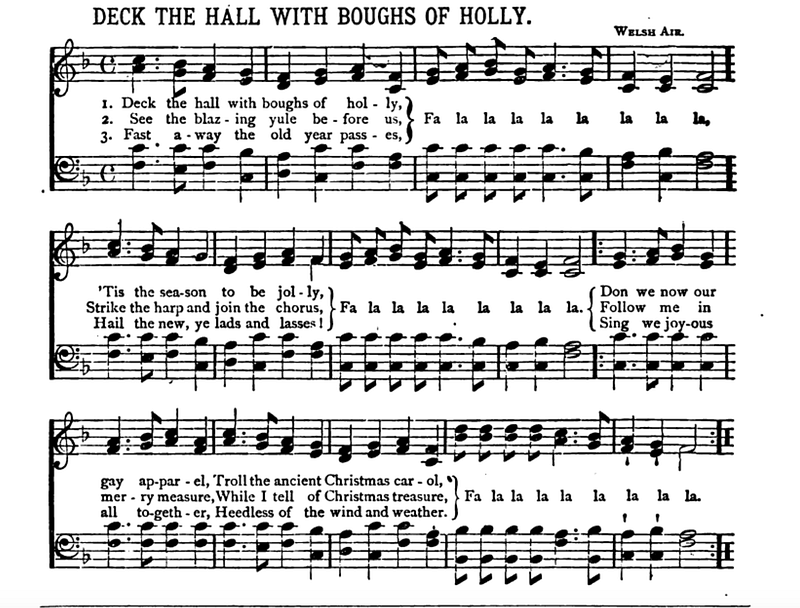
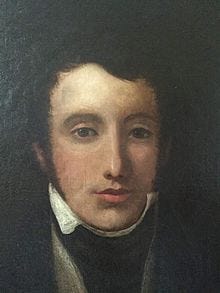
The song you know today as “Deck the Halls” is the result of an unintended joint effort by three cultures, all in the UK. One is the English, as in the language itself, used to write the lyrics people sing every December. The second is Scottish, as in the nationality of Thomas Oliphant, the lyricist who wrote the words people sing every December. The third is Welsh, as in the original version of the winter carol that people now sing every December.
Did I make it clear that “Deck the Halls” is sung every December? (This is important, so please pay attention!)
Oliphant’s original 1862 lyrics mentioned quite a bit of drinking; the words were later adjusted by someone who thought drinking and Christmas didn’t go together (imagine that!); that second version of the carol is the one most people are familiar with now. For example, in the first stanza, where it says “Don we now our gay apparel”, Oliphant had penned “Fill the meadcup, drain the barrel”. (Mead is a fermented beverage made of water and honey, malt, and yeast.)
Similarly, Oliphant’s “See the flowing bowl before us” was replaced with “See the blazing yule before us” and “Laughing, quaffing all together” was changed to “Sing we joyous all together”.
It’s quite obvious that Thomas Oliphant truly enjoyed the holiday season. You can see it in his flushed cheeks and glazed eyes…
Now, the verb “deck” as used in the song is considered obsolete even by the dictionary. See below at definition 1:
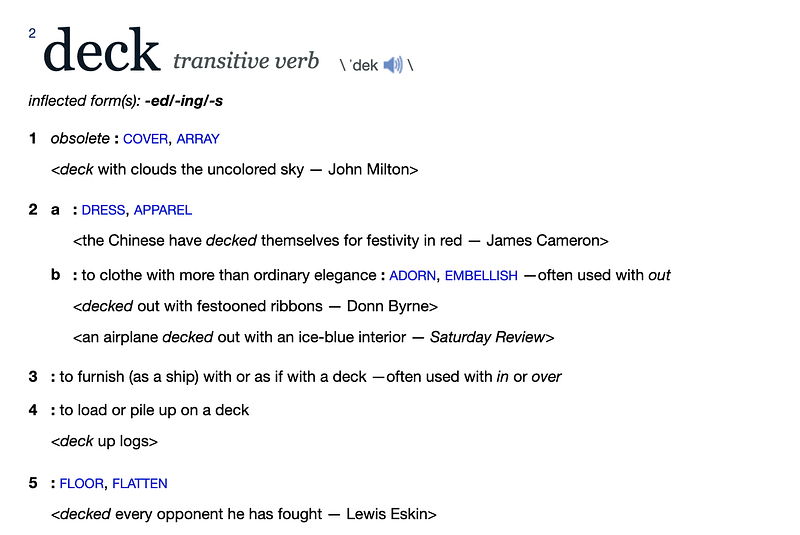
And that’s strange, don’t you think, considering so many people sing this song… every December! (I told you earlier that point was important.)
Even if you don’t know all the words, surely you know the first seven: “Deck the halls with boughs of holly”. Heck, the name of the carol is “Deck the Halls”. As in “Cover or array the halls…”
Now, if you deck the halls around Christmastime… what do you do after the holiday season is over?
That’s right! You undeck them. Otherwise they’d be decked year-round and you wouldn’t have to place boughs of holly on them for a few weeks before having to remove all the boughs of holly, only to place the boughs of holly back on again eleven months later… hmmm, wait a second… there’s an idea!
Love is in the Christmas air
“Deck the Halls” began its life as an old Welsh air, first found in a musical manuscript by Welsh harpist John Parry dating back to the 1700s. Poet John Ceiriog Hughes later wrote his own lyrics and a middle verse was added by folk singers later. In the eighteenth century the tune spread widely, with Mozart allegedly using it in his 18th violin sonata (1778) and Haydn arranging it under the Welsh title, “Nos galan”.
In 1912, Ruth Herbert Lewis made a wax cylinder recording of a Welshman named Benjamin Davies singing a song, “Can y Coach faier”, which uses the old melody now associated with “Deck the Halls”. The recording is available at the British Library Sound Archive website. And for your convenience, we present you the link below. (We aim to please here at Silly Little Dictionary!)
Interestingly, the earliest available lyrics have less to do with decking the halls and more to do with cavorting with one’s beloved. Here are the Welsh and English lyrics found in the earliest publication of the “Nos Galan” melody:
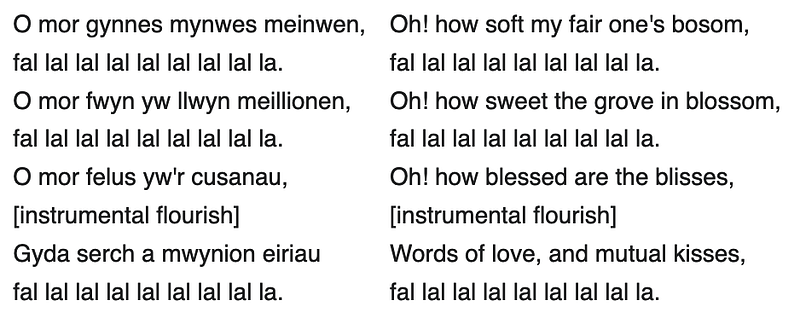
So, to recap, a song about hanky-panky with a lover became a tune about hitting the bottle during the holidays and was later sanitized into a carol about decorating your home and buying new clothes.
I can see a conspiracy theory about how the retail industry kidnapped Christmas starting to brew…
Now, this article is being written months before Christmas, which means the halls do not have any boughs of holly on them because someone undecked them at the beginning of the year. And after a few weeks during the holiday season, the halls will be yet again undecked. Which means they spend most of the year undecked! Yet, despite that pressing evidence, the editors of the Spelling Bee still declared that undeck is a dord*.
You can check out my previous entry on another dord* here:
*What the heck is a dord, you ask? Here’s the answer: