
Unau
Not including this word for sloth was a deadly sin
Today’s New York Times Spelling Bee letters:
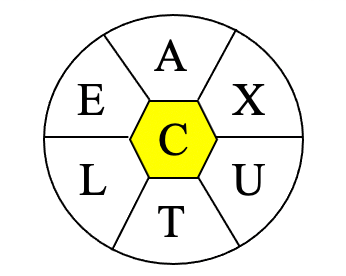
A, E, L, T, U, X, and center N (all words must include N).
Merriam-Webster says…
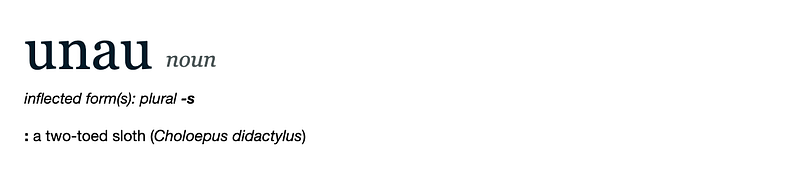
Silly little dictionary! Don’t you know that unau can’t possibly be a word if the New York Times says it ain’t?
For further fascinating facts, check out the Spelling Bee Master.
What’s your favorite dord* from today’s puzzle?
My Two Cents
It seems the sloth has been trending for the last few years, thanks mainly to the 2016 animated film Zootopia. No spoilers here in case you haven’t seen it. Just mentioning that the film includes a three-toed sloth named Flash, who is described as the “fastest” in the DMV.
Flash is now the protagonist of several memes, as well as GIF of his slow-motion smile that you can use as a reaction when texting friends.
Slower than a sloth
No one ever uses that expression. People usually refer to turtles or snails when they search for metaphors about extreme lack of speed. But sloths are slower than turtles, and the only reason they are faster than snails is because they are much bigger. In any case, sloths are the slowest mammals of the world, if not the slowest animal of them all.
The word unau comes from the Tupi people, indigenous to Brazil. Then somehow it became part of the French language, where it still appears if you search the dictionary. How it made it into English is not clear. At least not to me. Probably at some point in time when speaking French was the ultimate coolness. Maybe when Jean-Paul Belmondo was a sex symbol?
Here’s the interesting thing about its supposed native Brazilian origin, according to Merriam-Webster:
“The use of the word unau as a generic name for the two-toed sloth (and ai as a name for the three-toed sloth) is owed to Georges-Louis Leclerc de Buffon, who so denominated them in Histoire naturelle, générale et particulière, tome treizième (Paris, 1765), p. 34 ff. The word ai is well-documented (see note at ai), but unau is apparently reported only in a description of the sloth by the French Capuchin priest Claude d’Abbeville, who resided on the island of Maranhão in 1612–15: (“There are two kinds of them [sloths], some are about as large as hares, which they call unaü, and others are almost two times as large, which they call unaü oaüssou, and all the more monstrous.”) Though the suffixed word oaüssou [wasu] means “large” in Tupi, and a number of other names cited by d’Abbeville are familiar from other records, unaü does not appear to be attested elsewhere.”
To sum it all up: I have no idea why unau is now part of the English language.
But it is! The dictionary says so. Silly little dictionary…
What is clear is that unau is used to refer only to the two-toed sloth, not the three-toed one. And certainly not the four-toed sloth, mainly because it doesn’t exist.
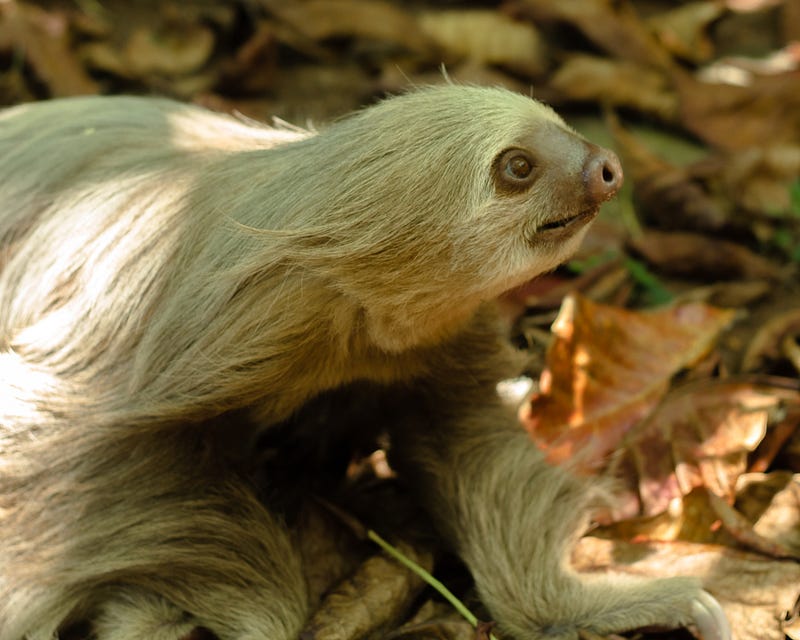
The photo at the top of today’s column is of a two-toed sloth, but here’s a quick visual comparison:
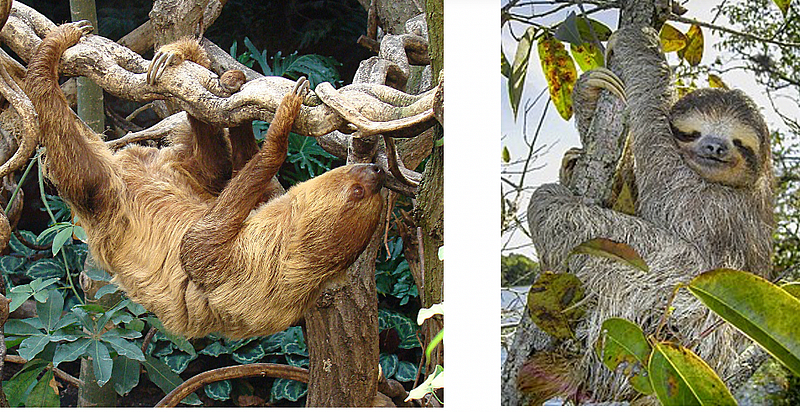
You can clearly see that the sloth on the left has two claws on the front paw while the one on the right has three. Both have three claws on their hind legs.
There are two existing species of unau, and they both roam around veeeery slowly in Central and South America. The three-toed sloth also lives in the same general areas, and the species sometimes share forests. No word yet on whether or not they get intimate across species, but I’ll look into that if enough readers request it.
The sloth on the right is known as the “brown-throated three-toed sloth”, and it’s smiling masked visage is probably the one most familiar to sloth groupies all over the world. Plus, it’s the only sloth that has an OnlyFans page.
Unaus spend their lives hanging in and from trees. They don’t walk around so much as they drag their bodies with their arms. In Caracas, Venezuela, where I grew up, there is a town called El Hatillo. Like most towns and cities in the country, it has a square named after Simón Bolivar:
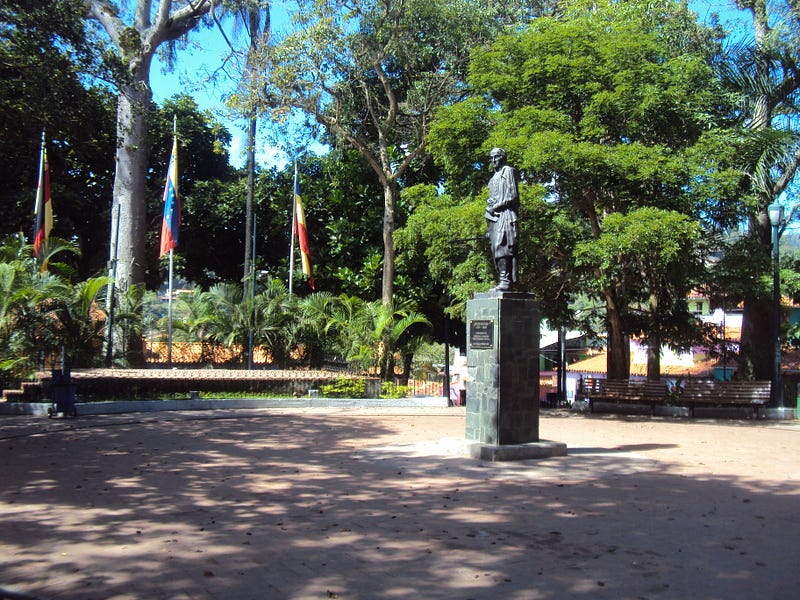
There were a couple of unaus that lived in the trees you see in the photo. They were well-known by locals and a nice surprise for tourists. And they were not as nocturnal and shy as you may have read. (The sloths, not the tourists.) Sometimes they would cross the square or even try to cross the street, in which some local resident would take it upon themselves to stop all traffic until the sloth was safely on the other side.
In other words, an hour. I’m kidding. It took only 48 minutes.
I saw the sloths almost every time I would go visit the town, which had been incorporated into the greater Caracas metropolitan area. So whenever I see or hear about sloths, my mind automatically goes back to El Hatillo. El Hatillo had fantastic restaurants back then, although the sloths did not eat there.
That’s because unaus eat mainly leaves and shoots, which lets me segue into this.
Comma commaleon
In 2003, Lynne Truss, an English author and former sports journalist, published a bestselling book about grammar.
I am not kidding.
The book became a New York Times best-seller. Perhaps if it had featured a sloth instead of a panda, the same New York Times would have accepted unau as a word for today’s Spelling Bee puzzle.
But it featured a panda. Or at least, a joke about a panda that gave the book its title. Now, because pandas and unaus share a similar diet, I’ve adapted the joke so the protagonist is a sloth.
A sloth crawls into a bar. After a couple of hours, he reaches the stool and sits down. The sloth orders a sandwich, eats it, then draws a gun and fires two shots in the air.
“Why? Why are you behaving in this strange, un-sloth-like fashion?” asks the confused waiter, as the sloth crawls back towards the exit. The sloth produces a badly punctuated wildlife manual and tosses it over his shoulder.
“I’m a sloth,” he says, at the door. “Look it up.”
The waiter turns to the relevant entry and, sure enough, finds an explanation.
“Sloth: A slow-moving arboreal mammal, native to South and Central America. Eats, shoots and leaves.”
The grammar error in this case is that there shouldn’t be a comma after “eats”. It changes the meaning of the whole sentence, and the meaning of the sloth’s life.
Okay, enough grammar for now. I do recommend Lynne Truss’s book; it’s written in a light, friendly, yet very informative way.
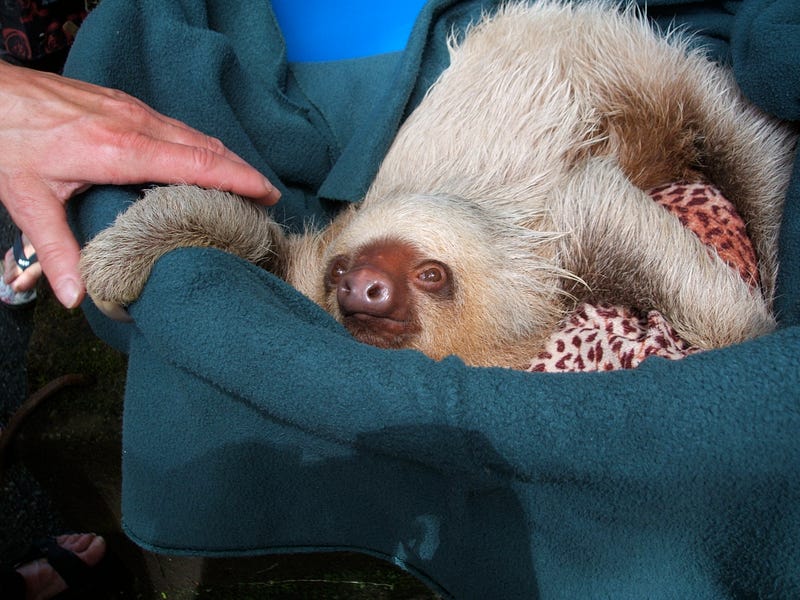
Let’s end today’s article with some cuteness. It’s Friday, after all. A photo of a baby unau that was rescued in Costa Rica:
Despite the fact that unaus exist and are very mindful of their grammar, the editors of the Spelling Bee puzzle decided that unau is a dord.*
You can check out my previous entry on another dord* here:
*What the heck is a dord, you ask? Here’s the answer: