avatarJames Marinero, MSc, MBA

Free AI web copilot to create summaries, insights and extended knowledge, download it at here

4394

Abstract

e-has-changed-the-war-game-95af25311b0d">synthesis of big data and precision weapons</a> has minimised collateral damage — Ukraine, after all, is usually firing these weapons within its own territory and populace. At the same time it has struck fear into Russian forces.</p><div id="027f" class="link-block"> <a href="https://t.me/liveukraine_eng/3767"> <div> <div> <h2>Live: Ukraine</h2> <div><h3>Ukrainian drone wins game of hide and seek, finding Russian soldier hidden in bush and delivering a pair of grenades to…</h3></div> <div><p>t.me</p></div> </div> <div> <div style="background-image: url(https://miro.readmedium.com/v2/resize:fit:320/0*CrqXCpvru9VVlPVP)"></div> </div> </div> </a> </div><p id="afa8">I would sum the strategy up with the following phrase:</p><blockquote id="2b82"><p>No individual Russian soldier should feel safe on Ukrainian soil.</p></blockquote><p id="88de">The strategy (if it is indeed a defined strategy) has created unease in the Russian command structure and forced changes in the deployment of weapons dumps by Russia, the <a href="https://eurasiantimes.com/6000-km-away-from-ukraine-russia-moves-its-nuclear-bomber-fleet/">relocation of strategic aircraft</a> and a review of the use of Battalion Tactical Group (BTG) formations. Ukraine has also started to target military installations within Russia itself, such as the Engels strategic bomber base 450 km inside Russia.</p><p id="2e77">But a serious psychological blow was executed on 1 January 2023 when <a href="https://www.bbc.com/news/world-europe-64142650">Ukraine HIMARS weapons hit a military dormitory</a> next to an ammunition dump in the Russian-occupied city of Makiivka in Donetsk (within Ukraine’s international borders). Casualty estimates vary but the Russian Defence Ministry has admitted to 63 dead. The real number is thought to much higher, in the hundreds. The dead troops are thought to be some of 300,000 that Putin conscripted in 2022 and were under the control of the Wagner Group.</p><p id="f8d9">The effect of the strike will have been to re-inforce the fear of HIMARS felt by many Russian troops and will lead them further to question the capability of their officers (there is <a href="https://dnyuz.com/2023/01/03/russian-outrage-grows-after-strike-kills-dozens-of-troops-in-ukraine/">outrage in Russia</a> at the command incompetence).</p><p id="c5ef">This successful strike on a substantial Russian force contingent is coming close to being an own-goal for Ukraine as it seeks to defend the moral high ground. Whatever the rights and wrongs, it has risked increasing levels of public support for Putin in Russia and the creation of a ‘revenge’ mentality amongst segments of the population. That’s war, I guess.</p><p id="8f8c">The plummeting levels of morale had already been recognised by the Russian high command:</p><blockquote id="7057"><p>On 14 December 2022, the Russian Ministry of Defence announced the establishment of two ‘front line creative brigades’ tasked with raising the morale of troops deployed on the ‘special military operation’.</p></blockquote><blockquote id="413d"><p>Russian media reports that the ranks will include opera singers, actors and circus performers. This follows a recent campaign by the Russian MoD to encourage the public to donate musical instruments to deployed soldiers.</p></blockquote><blockquote id="9f27"><p>Military music and organised entertainment for deployed troops have a long history in many militaries but in Russia they are strongly intertwined with the Soviet-era concept of ideological political education.</p></blockquote><blockquote id="120f"><p>Fragile morale almost certainly continues to be a significant vulnerability across much of the Russian force. However, soldiers’ concerns primarily focus on very high casualty rates, poor leadership, pay problems, lack of equipment and ammunition, and lack of clarity about the war’s objectives. The creative brigades’ efforts are unlikely to substantively alleviate these concerns.</p></blockquote><p id="65a3">Source:</p> <figure id="afb1"> <div> <div> <img class="ratio" src="http://placehold.it/16x9"> <iframe class="" src="h

Options

ttps://cdn.embedly.com/widgets/media.html?type=text%2Fhtml&key=a19fcc184b9711e1b4764040d3dc5c07&schema=twitter&url=https%3A//twitter.com/defencehq/status/1604355132983910402&image=https%3A//i.embed.ly/1/image%3Furl%3Dhttps%253A%252F%252Fabs.twimg.com%252Ferrors%252Flogo46x38.png%26key%3Da19fcc184b9711e1b4764040d3dc5c07" allowfullscreen="" frameborder="0" height="281" width="500"> </div> </div> </figure></iframe></div></div></figure><p id="e8ef"><a href="https://www.youtube.com/watch?v=VSQDWZ6zSC8">It ain’t half hot, Ivan</a></p><p id="6c81">I couldn’t resist that, but <i>‘in Russia they are strongly intertwined with the Soviet-era concept of ideological political education.’</i></p><p id="3729">That’ll help Ukraine. Brainwashing.</p><h1 id="4a8c">Conclusion</h1><p id="93ee">Russia is not conducting a war to win the hearts and minds of the Ukrainian people. It is bent on erasing Ukraine as a concept, a culture, a heritage, a people.</p><p id="199d">Even should Russia completely defeat Ukraine (however defined), it has so far built up a vast reservoir of hatred and anger in the Ukrainian populace that would take generations to remove, if ever.</p><p id="ee1a">The two countries have clearly marked out their strategies (although they might not be explicit) with Ukraine taking the moral high-ground, realising that any behaviour akin to Moscow’s would rapidly result in a stoppage of the weapons flow from NATO countries.</p><p id="8756">But Ukraine has to tread carefully.</p><p id="c87d">Are the strategies more fundamental I wonder? Does Ukraine’s reflect Western values about the importance and rights of the individual as compared with Russia’s which sees the individual as expendable within state supremacy and only of value as part of a mass of workers? Unless you are Vladimir Putin, of course. That individual is supreme within the system.</p><h1 id="19c6">Final thought</h1><p id="e5d9">What does this say about morale levels and command problems in the Russian forces:</p><figure id="d932"><img src="https://cdn-images-1.readmedium.com/v2/resize:fit:800/0*QYyMCEsEET4TujRx"><figcaption>UK Defence Intelligence analysis. Image: <a href="https://twitter.com/DefenceHQ/status/1604711619635945472?s=20">Twitter</a></figcaption></figure><p id="a33a"><i>Author’s note: The concept, structure, style and creative content in this story are all my own and I hope that is obvious to a reader. I do not employ third party writers. However, I do occasionally use an AI assistant to research and present small sections of factual content and data. All facts are checked where possible and sources quoted.</i></p><p id="c5d6"><i>About me: If you follow me I guarantee variety in your inbox with some unusual perspectives! I write on a wide range of topics including humor, tech, space, geopolitics and travel, together with daily news events and the minutiae of my daily life living on a boat. Yes, I really do live on a boat (some readers don’t believe that). I also write about…</i></p><p id="e83f"><b>…psychopathy in warfare</b></p><p id="2b7a"><i>If you appreciate stories like these and want to support other writers and me, consider signing up to become a Medium member. It’s only $5 a month, giving you unlimited access to incredible stories on Medium. If you sign up using my link below, I’ll earn a small commission at no extra cost to you.</i></p><div id="67d5" class="link-block"> <a href="https://james-marinero.medium.com/membership"> <div> <div> <h2>Join Medium with my referral link - James Marinero</h2> <div><h3>Read every story from James Marinero (and thousands of other writers on Medium). Your membership fee directly supports…</h3></div> <div><p>james-marinero.medium.com</p></div> </div> <div> <div style="background-image: url(https://miro.readmedium.com/v2/resize:fit:320/0*G-z8tezbRf9X9pyj)"></div> </div> </div> </a> </div><p id="4829"><i>Or maybe just <a href="https://ko-fi.com/jamesmarinero">buy me a coffee?</a> and tell me what you liked reading (or not)…</i></p><figure id="97e7"><img src="https://cdn-images-1.readmedium.com/v2/resize:fit:800/1*F7CRvNpnsbM3yYySfOeIjA.png"><figcaption></figcaption></figure></article></body>

Ukraine War

Ukraine: Psychological Warfare — Two Sides, Two Approaches

Different targets, tools and techniques to wear down the enemy
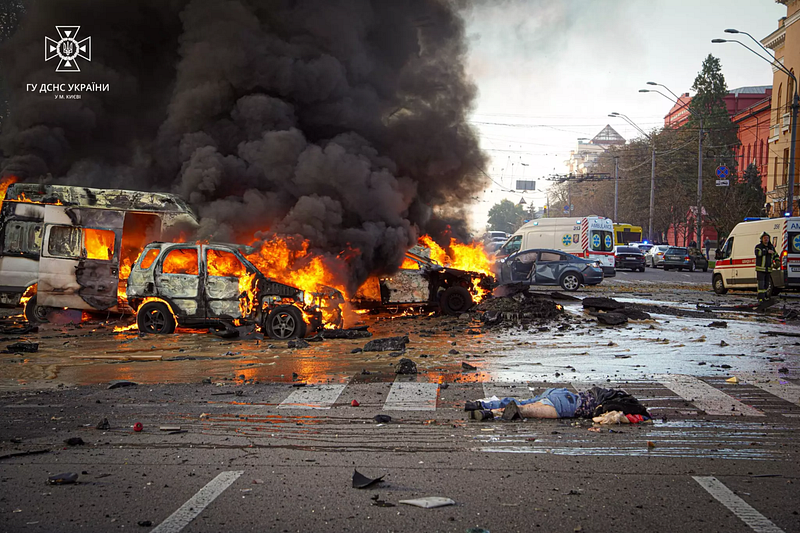
Kyiv after Russian missile strikes on 10 October 2022. Intersection of Volodymyrska Street and Taras Shevchenko Boulevard.. Image credit:kyiv.dsns.gov.ua.

This article is about the broader psychological war between the Ukraine and Russia — high level psyops.

Put simply, Russia is attempting to terrorise the population of Ukraine, whereas Ukraine is trying to terrorise the individual Russian soldiers and airmen — and their commanders.

Let’s look at this in a little more detail, considering some of the evidence. Note that I have used Wikipedia as one of my sources — the site may be subject to bias concerning the Ukraine war.

Russian psychological strategy

Of course I don’t know what the Russian strategy is, even if Putin himself does. But the evidence points clearly to a Russian terror campaign against the Ukrainian people:

  • direct and widespread attacks on Ukraine’s civilian infrastructure (the power grid, water supplies) which is arguably a war crime. This assault ramped up from 10 October 2022 when Sergey Surovikin was given overall command of Russian armed forces in Ukraine.
  • a pattern of destruction of Ukraine’s cultural heritage, 183 in total: 78 religious sites, 13 museums, 35 historic buildings, 31 buildings, dedicated to cultural activities, 17 monuments, 9 libraries (Wikipedia)
  • repeated missile and artillery attacks on Ukraine’s schools
  • repeated missile and artillery attacks on Ukraine’s hospitals — with at least 703 attacks on Ukrainian healthcare facilities carried out by November 2022, with 144 such facilities completely destroyed by Russian strikes (Wikipedia)

The list goes on, with Russia targeting places where people gather including markets, malls and intersections.

The argument that the weaponry was aimed at nearby military targets just doesn’t wash with me. The statistics don’t bear it out.

Some collateral damage and civilian death is inevitable in war, but there is a pattern here which swamps the argument of ‘collateral damage’ and Russia has been accused of many war crimes during the war.

A tried and tested strategy

Russia has used this terror strategy several times before, a notable example being the Second Chechen War. The First Chechen War had been an embarrassing failure under Yeltsin, but soon after he took power from Yeltsin, Putin set out to reverse that failure with the Second Chechen War when Grozny was razed.

The strategy has also been used by Russia in Afghanistan and Syria where Sergey Surovkin cut his terror teeth.

Ukrainian psychological strategy

It seems that this is based on Ukraine holding the moral high ground, carefully targeting only Russian armed forces using high precision weapons, notably the US-supplied HIMARS multiple launch rocket system and high grade intel data.

The near real-time synthesis of big data and precision weapons has minimised collateral damage — Ukraine, after all, is usually firing these weapons within its own territory and populace. At the same time it has struck fear into Russian forces.

I would sum the strategy up with the following phrase:

No individual Russian soldier should feel safe on Ukrainian soil.

The strategy (if it is indeed a defined strategy) has created unease in the Russian command structure and forced changes in the deployment of weapons dumps by Russia, the relocation of strategic aircraft and a review of the use of Battalion Tactical Group (BTG) formations. Ukraine has also started to target military installations within Russia itself, such as the Engels strategic bomber base 450 km inside Russia.

But a serious psychological blow was executed on 1 January 2023 when Ukraine HIMARS weapons hit a military dormitory next to an ammunition dump in the Russian-occupied city of Makiivka in Donetsk (within Ukraine’s international borders). Casualty estimates vary but the Russian Defence Ministry has admitted to 63 dead. The real number is thought to much higher, in the hundreds. The dead troops are thought to be some of 300,000 that Putin conscripted in 2022 and were under the control of the Wagner Group.

The effect of the strike will have been to re-inforce the fear of HIMARS felt by many Russian troops and will lead them further to question the capability of their officers (there is outrage in Russia at the command incompetence).

This successful strike on a substantial Russian force contingent is coming close to being an own-goal for Ukraine as it seeks to defend the moral high ground. Whatever the rights and wrongs, it has risked increasing levels of public support for Putin in Russia and the creation of a ‘revenge’ mentality amongst segments of the population. That’s war, I guess.

The plummeting levels of morale had already been recognised by the Russian high command:

On 14 December 2022, the Russian Ministry of Defence announced the establishment of two ‘front line creative brigades’ tasked with raising the morale of troops deployed on the ‘special military operation’.

Russian media reports that the ranks will include opera singers, actors and circus performers. This follows a recent campaign by the Russian MoD to encourage the public to donate musical instruments to deployed soldiers.

Military music and organised entertainment for deployed troops have a long history in many militaries but in Russia they are strongly intertwined with the Soviet-era concept of ideological political education.

Fragile morale almost certainly continues to be a significant vulnerability across much of the Russian force. However, soldiers’ concerns primarily focus on very high casualty rates, poor leadership, pay problems, lack of equipment and ammunition, and lack of clarity about the war’s objectives. The creative brigades’ efforts are unlikely to substantively alleviate these concerns.

Source:

It ain’t half hot, Ivan

I couldn’t resist that, but ‘in Russia they are strongly intertwined with the Soviet-era concept of ideological political education.’

That’ll help Ukraine. Brainwashing.

Conclusion

Russia is not conducting a war to win the hearts and minds of the Ukrainian people. It is bent on erasing Ukraine as a concept, a culture, a heritage, a people.

Even should Russia completely defeat Ukraine (however defined), it has so far built up a vast reservoir of hatred and anger in the Ukrainian populace that would take generations to remove, if ever.

The two countries have clearly marked out their strategies (although they might not be explicit) with Ukraine taking the moral high-ground, realising that any behaviour akin to Moscow’s would rapidly result in a stoppage of the weapons flow from NATO countries.

But Ukraine has to tread carefully.

Are the strategies more fundamental I wonder? Does Ukraine’s reflect Western values about the importance and rights of the individual as compared with Russia’s which sees the individual as expendable within state supremacy and only of value as part of a mass of workers? Unless you are Vladimir Putin, of course. That individual is supreme within the system.

Final thought

What does this say about morale levels and command problems in the Russian forces:
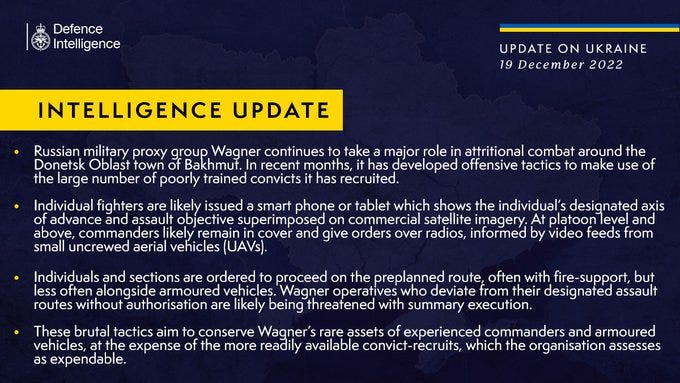
UK Defence Intelligence analysis. Image: Twitter

Author’s note: The concept, structure, style and creative content in this story are all my own and I hope that is obvious to a reader. I do not employ third party writers. However, I do occasionally use an AI assistant to research and present small sections of factual content and data. All facts are checked where possible and sources quoted.

About me: If you follow me I guarantee variety in your inbox with some unusual perspectives! I write on a wide range of topics including humor, tech, space, geopolitics and travel, together with daily news events and the minutiae of my daily life living on a boat. Yes, I really do live on a boat (some readers don’t believe that). I also write about…

…psychopathy in warfare

If you appreciate stories like these and want to support other writers and me, consider signing up to become a Medium member. It’s only $5 a month, giving you unlimited access to incredible stories on Medium. If you sign up using my link below, I’ll earn a small commission at no extra cost to you.

Or maybe just buy me a coffee? and tell me what you liked reading (or not)…

Ukraine War
Russia
Psyops
Military
Psychological Warfare
Recommended from ReadMedium