*Nri70WunpBA3gGDeLYAiaA.png"><figcaption>Screenshot from <a href="https://en.wikipedia.org/wiki/S-300_missile_system">Wikipedia</a>, author overlay</figcaption></figure><p id="5c41">First deployed by the Soviet Union in 1979, the design objective was the air defence of large industrial and administrative facilities, military bases, and to control airspace against enemy strike aircraft.</p><p id="3080">The S-300P series as used by Ukraine saw the introduction of the TEL and mobile radar and command-post vehicles.</p><p id="c483">This variant featured the new 5V55R missiles which increased the maximum engagement range to 90 km and introduced a terminal semi-active radar homing (SARH) guidance mode.</p><figure id="f77a"><img src="https://cdn-images-1.readmedium.com/v2/resize:fit:800/0*AqNL60tbTbvGhGHr.jpeg"><figcaption>S-300PMU-2 64N6E2 acquisition radar (part of 83M6E2 command post). Image source: By No machine-readable author provided. .:Ajvol:. assumed (based on copyright claims). — No machine-readable source provided. Own work assumed (based on copyright claims)., Public Domain, <a href="https://commons.wikimedia.org/w/index.php?curid=285599">https://commons.wikimedia.org/w/index.php?curid=285599</a></figcaption></figure><p id="b0fe">The system is fully automated, though manual observation and operation are also believed to be possible. Modules may be located near the central command post, or as far as 40 km away. Each radar provides target designation for the central command post.</p><p id="589c">The time to readiness was reduced to 30 minutes and trajectory optimizations allowed the 5V55KD missile to reach a range of 75 km.</p><p id="68e7">Early versions used a hot launch system which could damage the TEL in case of a launch failure, later versions were cold launch. Missiles are catapulted clear of the launching tubes before their rocket motor fires, and can accelerate at up to 100 <a href="https://en.wikipedia.org/wiki/G-force"><i>g</i></a> (1 km/s2). They launch straight upwards and then angle towards their target, removing the need to aim the missiles before launch and reducing preparation time. (Wikipedia)</p><p id="59c9">A warhead will have from 19,000 to 36,000 metal fragments, depending on missile type. (<a href="http://naviny.by/rubrics/politic/2011/10/17/ic_articles_112_175478/">naviny.by</a>)</p><p id="d969">In a strange twist of geopolitical history the S-300 is used by some NATO members including Greece and Bulgaria.</p><blockquote id="524d"><p><i>Ukraine’s inventory included several variants: S-300PT, S-300PS, S-300PMU, S-300V1. Only six systems were kept in working conditions between 2004 and 2014; as a result, only 40% of Ukrainian S-300 systems were in good condition prior to 2014.</i></p></blockquote><blockquote id="b374"><p><i>Due to the war with Russia, Ukraine started repairing and pushing back to service several armaments, including several S-300 batteries, with at least 4 batteries overhauled in the period of 2014–15.</i></p></blockquote><blockquote id="b7e8"><p><i>34 launchers remained in Crimea after the 2014 Russian annexation of Crimea.</i></p></blockquote><blockquote id="181b"><p><i>Prior to the 2022 Russian invasion of Ukraine, the country had around 100 batteries. It received an additional battery from Slovakia in April 2022. (<a href="https://en.wikipedia.org/wiki/S-300_missile_system">Wikipedia</a>).</i></p></blockquote><p id="aef0">A wide range of physical camouflage and EM protection techniques are used.</p><h1 id="02e7">Flexible batteries</h1><p id="f152">The number of TELs (launchers, designated 5P85–1) in a battery is variable, as the command and control system can flexibly integrate multiple radars and launchers according to requirements, availability and damage to other batteries (no launchers are orphaned).</p><p id="cd49">Therefore, it is difficult to estimate how many actual launchers Ukraine has. And we don’t know how many missiles it has (or had as of February 202) for those launchers.</p><p id="7008">Neither do we know if Ukraine has the capacity to build more missiles itself.</p><p id="78d9">I’ve tried to bottom-out some of the numbers.</p><h1 id="5ced">The missile balance</h1><p id="92db">According to <a href="http://www.inbsite.com/missiles2.html">http://www.inbsite.com/missiles2.html</a> the total production for the S-300P systems was 3,000 launchers and 28,000 missiles through 2012. Many were exported — China was a big customer. That is an average of 9.3 missiles per launcher.</p><p id="afeb">It a
Options
ppears that at the start of the 2022 Russian invasion Ukraine had 100 batteries of S300 missiles. And as I said earlier, we don’t know the number of missiles — nor do we know the type of missile, although it is probably the 5V55R missile.</p><figure id="452b"><img src="https://cdn-images-1.readmedium.com/v2/resize:fit:800/1*WQ9Qb6w7yAWQWsHqzycErw.png"><figcaption>Author table, source data: <a href="http://pvo.guns.ru/s300p/index_s300pt.htm">http://pvo.guns.ru/s300p/index_s300pt.htm</a> via Wikipedia</figcaption></figure><p id="79ae">Based on the 9.3 missiles/launcher average, that would have given Ukraine 930 missiles.</p><p id="0ad8">Besides the S-300P family, Russia has many other S-300 variants.</p><p id="b844">How many in total? Wikipedia quotes the number in Russia as 2,000 launchers. Based on the average of 9.3 missiles per launcher we calculated, that gave Russia 18,600 missiles at the outbreak of hostilities.</p><p id="379d">It’s certain that many will have been retained to protect mainland Russian facilities in line with their original purpose, so how many were available for use against Ukraine is unknown.</p><h1 id="7a6b">Conclusion</h1><p id="63d2">Missile for missile, Ukraine is hopelessly outnumbered in the S-300 class.</p><p id="4cd2">The potential for mis-identification disaster is obvious, and it’s not all down to missile type.</p><p id="2be5">What is not clear is what type of incoming Russian missile was being defended against. Was it an S-300? It’s immaterial now, but it could have been.</p><p id="777f">From the way I read the tea leaves, it’s unlikely that a surprise attack of that nature could have been launched by Russia without NATO having some foreknowledge — it’s thought that the US at least has good intel within the higher levels of the Russian armed forces and government.</p><p id="c5da">However, word this week is that the formal line of command from Putin is branching and that he is bypassing the Secretary of the Security Council of the Russian Federation, Nikolai Patrushev (<a href="https://readmedium.com/russia-is-destabilizing-305fb360986f">Nadin Brzezinski</a>) and other members. That’s a real worry.</p><p id="d6cb">This war has shown the weaknesses of Russia’s armed forces and its arsenal. Many missiles are old, poorly maintained and inaccurate. I’m surprised that we haven’t yet seen an incident where a Russian-launched missile has landed in a NATO country.</p><p id="3cdf">Surely, that will happen soon — unless Russia runs out of missiles first? Not likely.</p><p id="2d20">The one incontrovertible fact is that if Putin’s army had not invaded Ukraine then no missiles would have fallen on Poland on 15th November 2022, and those people would still be alive — along with tens of thousands of others, Ukrainian and Russian alike.</p><p id="4e08"><i>About me: If you follow me I guarantee variety in your inbox with some unusual perspectives! I write on a wide range of topics including humor, tech, space, geopolitics and travel, together with daily news events and the minutiae of my daily life living on a boat. Yes, I really do live on a boat (some readers don’t believe that). I also write about…</i></p><p id="b706"><b>…teetering on the edge of WWIII</b></p><p id="7576"><i>If you appreciate stories like these and want to support other writers and me, consider signing up to become a Medium member. It’s only $5 a month, giving you unlimited access to incredible stories on Medium. If you sign up using my link below, I’ll earn a small commission at no extra cost to you.</i></p><div id="a7c1" class="link-block">
<a href="https://james-marinero.medium.com/membership">
<div>
<div>
<h2>Join Medium with my referral link - James Marinero</h2>
<div><h3>Read every story from James Marinero (and thousands of other writers on Medium). Your membership fee directly supports…</h3></div>
<div><p>james-marinero.medium.com</p></div>
</div>
<div>
<div style="background-image: url(https://miro.readmedium.com/v2/resize:fit:320/0*1YHjnO5fok88LSpu)"></div>
</div>
</div>
</a>
</div><p id="46c3"><i>Or maybe just <a href="https://ko-fi.com/jamesmarinero">buy me a coffee?</a> and tell me what you liked reading (or not)…</i></p><figure id="9552"><img src="https://cdn-images-1.readmedium.com/v2/resize:fit:800/1*0chfaohu-z_vrO8sI4wdJA.png"><figcaption></figcaption></figure></article></body>
Ukraine War
Ukraine: Battle of the S300 Missiles
This war has created a new set of dangerous weapons scenarios that put the world on a knife-edge
This story was triggered by the November 15, 2022 event at the Ukraine/Poland border when the world held its breath for a few hours.
Did Russia launch missiles into Poland?
Would it trigger Article 5 of the NATO Treaty — All for one and one for all?
Caution
NATO was cautious about the original Ukrainian claim that Russia had launched the missiles and wise minds prevailed. Now that ‘the dust has settled’ the general consensus is that the missiles which landed in Poland and killed Polish citizens were Ukrainian S-300 air defence missiles. They were launched to counter a Russian missile attack on Ukrainian territory.
The difficulty in these situations is knowing whether and when to act.
Did the event really presage a Russian attack on a NATO country?
Russian desperation?
Driven by rapidly dwindling supply of precision weapons, Russia has been using its S-300 air defence missiles as surface to surface missiles.
Ukraine has them too, as a legacy from the days of the Soviet Union.
And Ukraine has been using them to defend against … wait for it … the incoming Russian S300 missiles (and others).
What is the S-300?
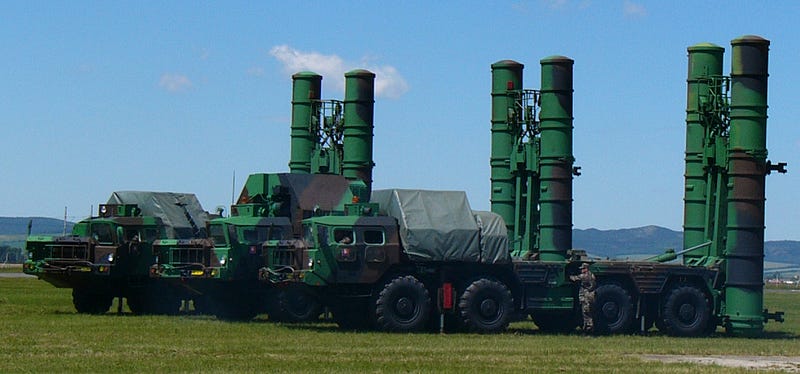
The S-300 is arguably the most potent anti-aircraft missile system currently fielded anywhere and provides area defence for Moscow and other major Russian infrastucture — as well as being used as an offensive ground to ground missile.
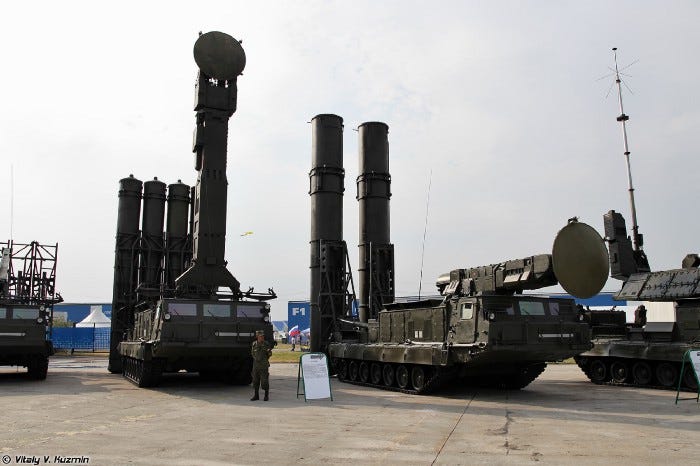
The S-300 is a line of Soviet-era long range surface-to-air missile systems. It was developed to defend against air raids and cruise missiles but later variants were also developed to be able to intercept ballistic missiles.
Produced between 1975 and 2011/2012 (production end year dates are disputed) , there are many variants in its complex family tree:
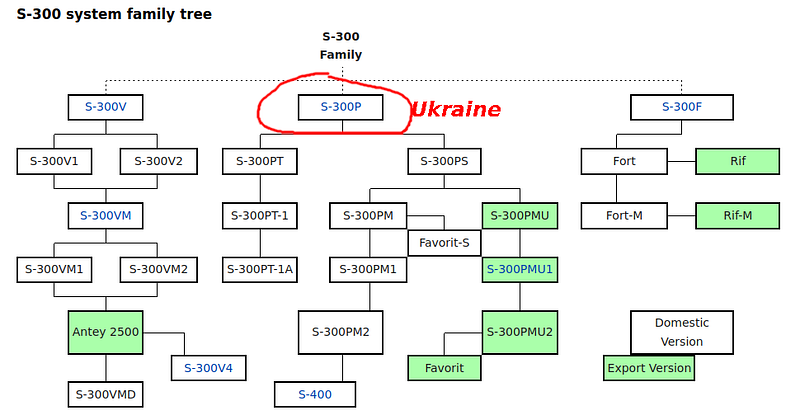
First deployed by the Soviet Union in 1979, the design objective was the air defence of large industrial and administrative facilities, military bases, and to control airspace against enemy strike aircraft.
The S-300P series as used by Ukraine saw the introduction of the TEL and mobile radar and command-post vehicles.
This variant featured the new 5V55R missiles which increased the maximum engagement range to 90 km and introduced a terminal semi-active radar homing (SARH) guidance mode.
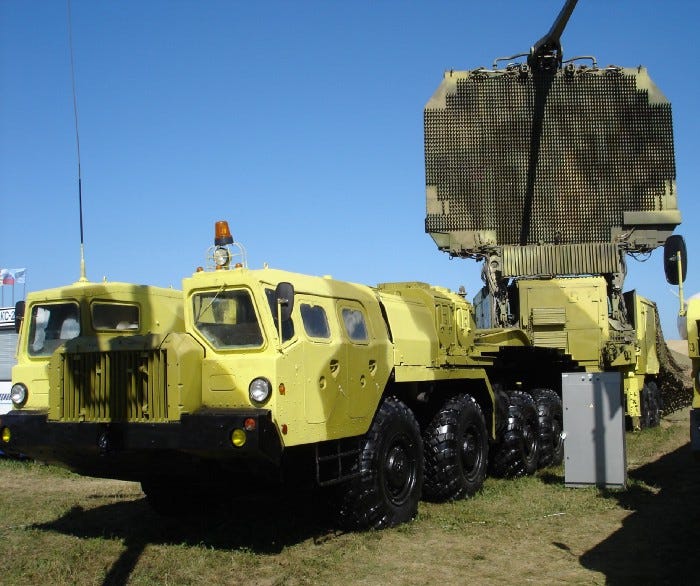
S-300PMU-2 64N6E2 acquisition radar (part of 83M6E2 command post). Image source: By No machine-readable author provided. .:Ajvol:. assumed (based on copyright claims). — No machine-readable source provided. Own work assumed (based on copyright claims)., Public Domain, https://commons.wikimedia.org/w/index.php?curid=285599
The system is fully automated, though manual observation and operation are also believed to be possible. Modules may be located near the central command post, or as far as 40 km away. Each radar provides target designation for the central command post.
The time to readiness was reduced to 30 minutes and trajectory optimizations allowed the 5V55KD missile to reach a range of 75 km.
Early versions used a hot launch system which could damage the TEL in case of a launch failure, later versions were cold launch. Missiles are catapulted clear of the launching tubes before their rocket motor fires, and can accelerate at up to 100 g (1 km/s2). They launch straight upwards and then angle towards their target, removing the need to aim the missiles before launch and reducing preparation time. (Wikipedia)
A warhead will have from 19,000 to 36,000 metal fragments, depending on missile type. (naviny.by)
In a strange twist of geopolitical history the S-300 is used by some NATO members including Greece and Bulgaria.
Ukraine’s inventory included several variants: S-300PT, S-300PS, S-300PMU, S-300V1. Only six systems were kept in working conditions between 2004 and 2014; as a result, only 40% of Ukrainian S-300 systems were in good condition prior to 2014.
Due to the war with Russia, Ukraine started repairing and pushing back to service several armaments, including several S-300 batteries, with at least 4 batteries overhauled in the period of 2014–15.
34 launchers remained in Crimea after the 2014 Russian annexation of Crimea.
Prior to the 2022 Russian invasion of Ukraine, the country had around 100 batteries. It received an additional battery from Slovakia in April 2022. (Wikipedia).
A wide range of physical camouflage and EM protection techniques are used.
Flexible batteries
The number of TELs (launchers, designated 5P85–1) in a battery is variable, as the command and control system can flexibly integrate multiple radars and launchers according to requirements, availability and damage to other batteries (no launchers are orphaned).
Therefore, it is difficult to estimate how many actual launchers Ukraine has. And we don’t know how many missiles it has (or had as of February 202) for those launchers.
Neither do we know if Ukraine has the capacity to build more missiles itself.
I’ve tried to bottom-out some of the numbers.
The missile balance
According to http://www.inbsite.com/missiles2.html the total production for the S-300P systems was 3,000 launchers and 28,000 missiles through 2012. Many were exported — China was a big customer. That is an average of 9.3 missiles per launcher.
It appears that at the start of the 2022 Russian invasion Ukraine had 100 batteries of S300 missiles. And as I said earlier, we don’t know the number of missiles — nor do we know the type of missile, although it is probably the 5V55R missile.

Based on the 9.3 missiles/launcher average, that would have given Ukraine 930 missiles.
Besides the S-300P family, Russia has many other S-300 variants.
How many in total? Wikipedia quotes the number in Russia as 2,000 launchers. Based on the average of 9.3 missiles per launcher we calculated, that gave Russia 18,600 missiles at the outbreak of hostilities.
It’s certain that many will have been retained to protect mainland Russian facilities in line with their original purpose, so how many were available for use against Ukraine is unknown.
Conclusion
Missile for missile, Ukraine is hopelessly outnumbered in the S-300 class.
The potential for mis-identification disaster is obvious, and it’s not all down to missile type.
What is not clear is what type of incoming Russian missile was being defended against. Was it an S-300? It’s immaterial now, but it could have been.
From the way I read the tea leaves, it’s unlikely that a surprise attack of that nature could have been launched by Russia without NATO having some foreknowledge — it’s thought that the US at least has good intel within the higher levels of the Russian armed forces and government.
However, word this week is that the formal line of command from Putin is branching and that he is bypassing the Secretary of the Security Council of the Russian Federation, Nikolai Patrushev (Nadin Brzezinski) and other members. That’s a real worry.
This war has shown the weaknesses of Russia’s armed forces and its arsenal. Many missiles are old, poorly maintained and inaccurate. I’m surprised that we haven’t yet seen an incident where a Russian-launched missile has landed in a NATO country.
Surely, that will happen soon — unless Russia runs out of missiles first? Not likely.
The one incontrovertible fact is that if Putin’s army had not invaded Ukraine then no missiles would have fallen on Poland on 15th November 2022, and those people would still be alive — along with tens of thousands of others, Ukrainian and Russian alike.
About me: If you follow me I guarantee variety in your inbox with some unusual perspectives! I write on a wide range of topics including humor, tech, space, geopolitics and travel, together with daily news events and the minutiae of my daily life living on a boat. Yes, I really do live on a boat (some readers don’t believe that). I also write about…
…teetering on the edge of WWIII
If you appreciate stories like these and want to support other writers and me, consider signing up to become a Medium member. It’s only $5 a month, giving you unlimited access to incredible stories on Medium. If you sign up using my link below, I’ll earn a small commission at no extra cost to you.