avatarJeffrey Goodman

Free AI web copilot to create summaries, insights and extended knowledge, download it at here

6996

Abstract

to see what food prices would feel like to a tourist from one country visiting the other.</p><p id="6e83">Today we are taking food prices in “work-minutes.”</p><figure id="9354"><img src="https://cdn-images-1.readmedium.com/v2/resize:fit:800/1*ppllakIQ2wEud1yUaG609Q.jpeg"><figcaption>Analysis performed by author. Graphic created by author, August 2023.</figcaption></figure><p id="fe99">Look at the <b>“Local Person’s Perspective on Costs”</b> section.</p><p id="faf9">In the U.S., it takes the median worker in their 20s about 32 minutes to earn enough money to buy that 10.85 teriyaki bowl from Safeway.</p><p id="915d">In Japan, it takes the median worker in their 20s about 12 minutes to earn enough money to buy that ¥389 teriyaki package from Peacock Market.</p><p id="611c">The U.S. worker has to work about 2.7 times longer than the Japanese worker to buy that package of food.</p><p id="2493">Note that 2.7X when we measure costs in “work-minutes” is a smaller cost multiple than we saw in the previous article where the 10.85 U.S. cost was 4X the ¥389 cost once we converted one currency to the other (at 143 ¥/.)</p><p id="c10d"><b>But 2.7X means that the teriyaki chicken bowl in the U.S. is still going to feel almost 3 times as expensive</b> to the median American earner in their 20s as a similar food package in Tokyo will cost the median Japanese person in their 20s.</p><h1 id="6081">Comparison #2. Sushi packages bought in supermarkets</h1><figure id="375a"><img src="https://cdn-images-1.readmedium.com/v2/resize:fit:800/1*TkQ9ZZl7U6LP49jiSxEx7A.jpeg"><figcaption>Sushi photo from <a href="https://stopandshop.com/product/hissho-sushi-rainbow-roll-raw-avail.-11am-7pm-7-oz-pkg/257672">Stop&amp;Shop in Providence, RI</a>. Total cost with tax is 14.03.</figcaption></figure><figure id="f054"><img src="https://cdn-images-1.readmedium.com/v2/resize:fit:800/1*VWOFYByVxHsBpz9o9pBC0w.jpeg"><figcaption>Sushi photo from Tokyu Store in Nakameguro, Tokyo. Photos taken by author in December 2022. Total cost with tax is ¥861. This package, however, contains almost twice as much sushi as the package from Stop&Shop. To make the comparison somewhat more fair, I’m going to discount the price on the larger package by 25% to ¥646.</figcaption></figure><p id="d698">Let’s compare sushi offerings one more time from (1) the Stop&Shop in Providence, Rhode Island and (2) the Tokyu Store supermarket in Tokyo.</p><p id="5abc">This time we look at costs measured in work-minutes.</p><figure id="850d"><img src="https://cdn-images-1.readmedium.com/v2/resize:fit:800/1*3lajfMqdIcLlY3UTljcplw.jpeg"><figcaption>Analysis performed by author. Graphic created by author, August 2023.</figcaption></figure><p id="e912">And again, the cost differential narrows when we measure it in work-minutes — i.e., how the cost feels to a local resident in their 20s earning the median wage.</p><p id="8a62">41.3 minutes to earn enough in the U.S. to buy the Stop&Shop sushi roll vs. 20 minutes for a median earner in their 20s in Japan to buy the larger sushi package in Tokyo.</p><p id="8dd4"><b>It takes the U.S. worker about 2X as many work-minutes as it takes the Japanese worker. </b>That’s a smaller cost difference than the 3X when we did the straight currency conversion that a tourist would be thinking in terms of, but it’s still a substantial difference.</p><p id="813d">Prices continue to be substantially less expensive in Tokyo than in the U.S.</p><h1 id="02f8">Comparison #3. Cherry Tomatoes, 10 oz. packages</h1><figure id="0c93"><img src="https://cdn-images-1.readmedium.com/v2/resize:fit:800/1*yGHKSF-9iKs5Q-PsGCNjvw.jpeg"><figcaption>Analysis performed by author. Graphic created by author, August 2023. Currency exchange rate = ¥143/1.</figcaption></figure><p id="0d25">I compared Cherry Tomatoes from Safeway in San Francisco with “Mini-tomatoes” from Tokyu Store in Tokyo. Both had packages that were roughly 10 oz.</p><p id="41eb">We can see that a 10 oz. package of cherry tomatoes in the U.S. is <b>just over 2 times</b> the price of a similar-sized (roughly 11 oz.) package of mini-tomatoes in Tokyo.</p><p id="d885">In terms of how many work-minutes it takes the median worker in their 20s in each country to buy their respective package of cherry tomatoes, it’s only 50% more in the U.S. than in Japan. (That’s the ratio of 1.5 that we see in the above table.)</p><p id="2ab2">But that means that the cherry tomatoes are still going to feel 50% more expensive to the median US worker in their 20s than it will to the corresponding Japanese worker when they go to buy cherry tomatoes in Japan.</p><p id="e89d">50% more expensive is still 50% more expensive.</p><p id="56c3">And that’s the smallest difference we’ve seen so far.</p><h1 id="2707">Comparison #4. Baked Goods — Scone vs. Rustique</h1><figure id="a9e4"><img src="https://cdn-images-1.readmedium.com/v2/resize:fit:800/1*3h6Ekpe06n9Oyk8Lc_37wQ.jpeg"><figcaption>Photo taken by author in August 2023 in San Francisco.</figcaption></figure><figure id="08ac"><img src="https://cdn-images-1.readmedium.com/v2/resize:fit:800/1*KzsnK-FwvB6Lk7-xB8sMRA.jpeg"><figcaption>Photo taken by author in December 2022 in Tokyo, Japan.</figcaption></figure><p id="1c2e">Scones in San Francisco vs. rustiques in Tokyo — which one is going to feel more expensive to a local in the local currency?</p><figure id="77e5"><img src="https://cdn-images-1.readmedium.com/v2/resize:fit:800/1*-I00wVBOpu9qTZzpC5o8GQ.jpeg"><figcaption>Analysis performed by author. Graphic created by author, August 2023. Currency exchange rate = ¥143/1.</figcaption></figure><p id="cdea">11.8 minutes to earn enough in the U.S. to buy the San Francisco scone vs. 5.6 minutes for a median earner in their 20s in Japan to buy the rustique in Tokyo.</p><p id="f4d7"><b>It takes the U.S. median worker in their 20s about 2X as many work-minutes as it takes the corresponding Japanese worker.</b></p><h1 id="21df">Summary and Takeaways</h1><ol><li>When we measure the price differences based on work-minutes (instead of doing a straight currency conversion), we see that it’s cheaper and easier for people in Japan making the median salary to buy food than it is for U.S. people in the U.S. to buy comparable food products when they earn a median salary in the U.S.</li><li>It’s a common narrative in the U.S. to pound the table and beat our chests about how efficient American corporations are at producing world-class goods and services at competitive prices.

In contrast to that, Japanese corporations are often portrayed as being slow and outdated and not being as smart or aggressive as U.S. corporations, and that’s why prices are so high in Japan.

As we see, though, when we actually look at data and do a commonsense analysis, one of those two statements above is not true.

Perhaps <b>both of them </b>are not true.

Otherwise, how do you explain U.S. food prices for Americans — at least, the ones we have looked at so far — taking SO

Options

MUCH MORE OF A BITE out of the American’s income than is the case with Japanese food in being so much more expensive than Japanese food prices?</li><li>If you are a tourist, all you need to care about for comparing prices between your home country and the one you are visiting is the exchange rate.

If you are a local in one country and wonder how the local people in <i>another</i> country are doing in terms of local prices in relation to<i> their</i> cost of living, you need to do something like a “work-minutes” calculation for how much things cost.</li></ol><p id="c77f">My personal sense of the situation is, there are structural factors in both countries making prices in each country look the way they do.</p><ul><li><b>Japan is hyper-efficient and hyper-focused on driving down prices. </b>While that does have the effect of making it hard for companies to raise salaries (and costs), it has also clearly had the effect of holding down prices in Japan over the past 30+ years.

“…Even marriage ceremonies are on sale, with discount wedding halls offering weddings for $600 — less than a tenth of what ceremonies typically cost here just a decade ago….” <a href="https://www.nytimes.com/2010/10/17/world/asia/17japan.html">New York Times</a>, 10/17/2010.</li><li><b>By contrast, the U.S. is hyper-lenient when it comes to letting corporations gain monopoly or near-monopoly pricing power. </b>And once corporations in the U.S. have pricing power like that, they wield it relentlessly and mercilessly by raising prices in order to maximize their own profits.

For instance, we knew all the way back in late 2021 — courtesy of analysts like <a href="https://www.thebignewsletter.com">Matt Stoller</a> — that <a href="https://www.thebignewsletter.com/p/corporate-profits-drive-60-of-inflation">corporate profit-gouging in the U.S. was responsible for around 60% of the inflation</a> seen up to that point in the pandemic.

By mid-2022, even mainstream news outlets like CBS News were reporting that “<a href="https://www.cbsnews.com/news/retail-price-gouging-lowes-amazon-target-accountable-us/">Companies use inflation to hike prices and generate huge profits</a>.”

So it’s no surprise that inflation in the U.S. over the past 30 years would have dramatically outpaced inflation in Japan.</li></ul><div id="0cff" class="link-block"> <a href="https://www.thebignewsletter.com/p/corporate-profits-drive-60-of-inflation"> <div> <div> <h2>Corporate Profits Drive 60% of Inflation Increases</h2> <div><h3>Higher prices aren't just a result of supply chain chaos or government spending. Inflation is being driven by the…</h3></div> <div><p>www.thebignewsletter.com</p></div> </div> <div> <div style="background-image: url(https://miro.readmedium.com/v2/resize:fit:320/0*BkuPnAehPyRbDf4t)"></div> </div> </div> </a> </div><div id="9e85" class="link-block"> <a href="https://www.cbsnews.com/news/retail-price-gouging-lowes-amazon-target-accountable-us/"> <div> <div> <h2>Companies use inflation to hike prices and generate huge profits, report says</h2> <div><h3>The top 10 retailers have raked in $99 billion of profit last year, according to one corporate accountability group.</h3></div> <div><p>www.cbsnews.com</p></div> </div> <div> <div style="background-image: url(https://miro.readmedium.com/v2/resize:fit:320/0*g0r0N-ltuIqAtHnR)"></div> </div> </div> </a> </div><p id="c609">Finally, from the personal perspective of someone who has lived in Tokyo, if I think back to how far ¥1,000 would go in Tokyo back in the early 90s, it did not feel to me at the time as though it went that far.</p><p id="6848">By contrast, today in 2023 in Tokyo, ¥1,000 feels as though it will buy a lot.</p><p id="bc35">It’s the opposite here in the U.S.</p><p id="c041">In terms of how many minutes or hours or days I’d have to work to buy something, everything here seems more expensive than it did 30 years ago.</p><p id="905c">And it’s not just “a little bit more expensive” — things are crazily more expensive than they were back in the early 90s.</p><p id="4853"><b><i>What do people think — what factors are driving this divergence in food pricing over the last few decades between Japan and the U.S.?</i></b></p><h1 id="a337">Related and recent articles</h1><p id="da85"><a href="https://bright52.medium.com/my-health-insurance-company-asked-for-feedback-on-my-specialist-i-blew-my-top-c212af65fb2b"><b>My Health Insurance Company Asked for Feedback</b></a> on My Specialist. I Blew My Top. • <a href="https://bright52.medium.com/is-this-the-dirty-little-secret-why-americans-see-the-doctor-less-often-than-japanese-25051a68d544"><b>Is this the Dirty Little Secret</b></a> Why Americans See the Doctor Less Often Than Japanese? • <a href="https://bright52.medium.com/life-expectancy-vs-healthcare-costs-in-the-u-s-2bc7ff1df621"><b>Life Expectancy vs. Healthcare Costs</b></a> in the U.S., Japan, Germany, etc. • <a href="https://bright52.medium.com/my-top-1-friend-was-floored-by-the-cost-of-his-familys-health-insurance-4ac481809595"><b>My Top 1% Friend Was Floored by the Cost</b></a> of His Family’s Health Insurance • <a href="https://bright52.medium.com/u-s-or-japan-part-1-where-does-it-cost-more-to-eat-healthy-tasty-food-6b0b905a3e7c"><b>U.S. or Japan, Part 1</b></a><b>. </b>Where Does It Cost More to Eat Healthy, Tasty Food? • <a href="https://bright52.medium.com/u-s-or-japan-part-2-how-to-measure-the-cost-of-healthy-tasty-food-7a96173e6883"><b>U.S. or Japan, Part 2</b></a><b>. </b>How to Measure the Cost of Healthy, Tasty Food • <a href="https://bright52.medium.com/u-s-or-japan-part-3-which-countrys-restaurants-are-the-better-deal-2cd802a79602"><b>U.S. or Japan, Part 3</b></a><b>. </b>Which Country’s Restaurants Are the Better Deal? • <a href="https://bright52.medium.com/the-samuel-l-jackson-approach-to-dealing-with-centrist-democrats-post-roe-and-pre-2022-midterms-cee963f28e72"><b>The Samuel L. Jackson Approach</b></a> to Dealing with Centrist Democrats • <a href="https://bright52.medium.com/the-money-you-save-by-paying-extra-in-only-years-1-3-of-student-loan-repayments-97aba0caba8e"><b>The Money You Save by Paying Extra in ONLY Years 1–3 </b></a>of Student Loan Repayments</p><p id="b5a3"><a href="https://bright52.medium.com/subscribe"><b><i>Subscribe</i></b></a><i> to receive email notifications when I post new articles.</i></p><p id="2c96"><i>Again, thank you for reading, <a href="https://bright52.medium.com/subscribe"><b>subscribing</b></a>, clapping, and sharing — I appreciate your time and attention!</i></p><p id="f35c"><a href="https://bright52.medium.com/about"><b>Jeffrey Goodman</b></a></p></article></body>

U.S. or Japan, Part 2 — How to Measure the Cost of Healthy, Tasty Food

What does the cost of food — or anything else — feel like to a local vs. what it feels like to a tourist visiting from another country?
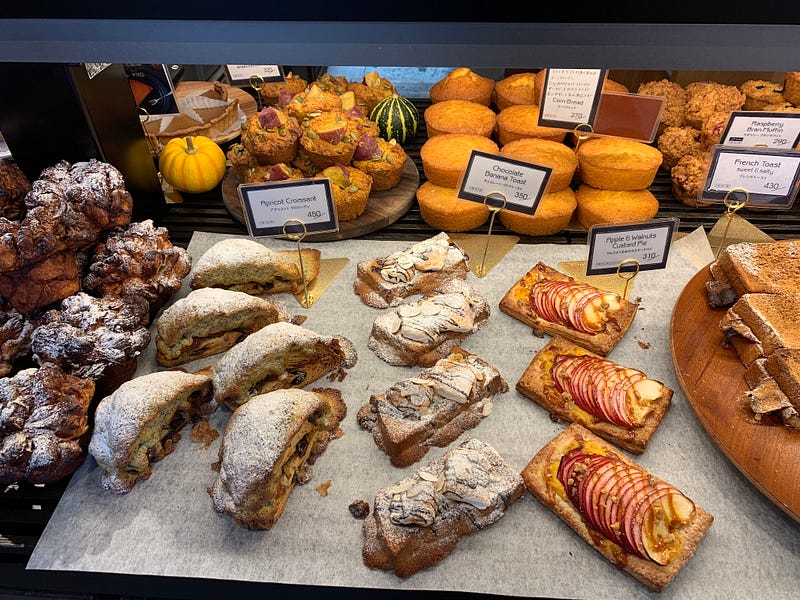
Photo taken by author. October 2019. Tokyo, Japan.

Related and recent articles

My Health Insurance Company Asked for Feedback on My Specialist. I Blew My Top. • Is this the Dirty Little Secret Why Americans See the Doctor Less Often Than Japanese? • Life Expectancy vs. Healthcare Costs in the U.S., Japan, Germany, etc. • My Top 1% Friend Was Floored by the Cost of His Family’s Health Insurance • U.S. or Japan, Part 1. Where Does It Cost More to Eat Healthy, Tasty Food? • U.S. or Japan, Part 2. How to Measure the Cost of Healthy, Tasty Food • U.S. or Japan, Part 3. Which Country’s Restaurants Are the Better Deal? • The Samuel L. Jackson Approach to Dealing with Centrist Democrats • The Money You Save by Paying Extra in ONLY Years 1–3 of Student Loan Repayments

(Subscribe to receive email notifications when I post new articles.)

In the previous article, we used exchange rates to convert several food prices in Japan and in the U.S. to the other country’s currency to see what food prices might feel like to a tourist from one country visiting the other country.

Anyone who has ever visited another country has probably done exactly that calculation at least once to get a sense of how expensive or how cheap prices felt in the country they were visiting.

But that’s not helpful when you want to get a feel for how expensive a sushi lunch from a supermarket in Japan would feel to a Japanese person who lives there.

Nor is it helpful to get a sense of how expensive a muffin from a local bakery feels to a person living in San Francisco.

The good news is, there is a way to do this, too.

Another way of thinking about differences in prices between two countries

We’re going to factor in median income in each country and then compare the prices of the same foods as before to the median income in their respective countries.

So for our purposes now, we’re going to use the median income a person in their 20s in each country earns as the annual income we compare food prices to.

The food purchases we have looked at so far between Japan and the U.S. are fairly inexpensive.

When we factor in median incomes for both countries and how many hours per year median workers put in, it turns out that the amounts of time it takes to earn the money required to buy these foods are measured in minutes.

So for the rest of this article, we will measure prices in each country in work-minutes — i.e., how many minutes would the median worker in their 20s have to work to have enough money to buy each food item.

Now let’s calculate the number of work-minutes it takes to buy the four food products we looked at in the previous article.

Food prices measured in “work-minutes” for Japan and the U.S.

Here is the short version of how I used (1) median income, (2) hours worked, and (3) food prices in each currency to calculate the number of work-minutes necessary to buy the food products below.

  • We calculate how much the median person in their 20s in Japan and in the U.S. earns per-hour and per-minute, based on (1) median earnings per year and (2) number of hours that the median worker in their 20s works each year.
  • From there, it’s easy to figure how many minutes a person in Japan or in the US would have to work to buy each food product we looked at previously.

This lets us get a sense of how affordable something is for a person in their home country based on how much they earn each year at home.

Comparison #1. Teriyaki Chicken as a prepackaged meal from the supermarket
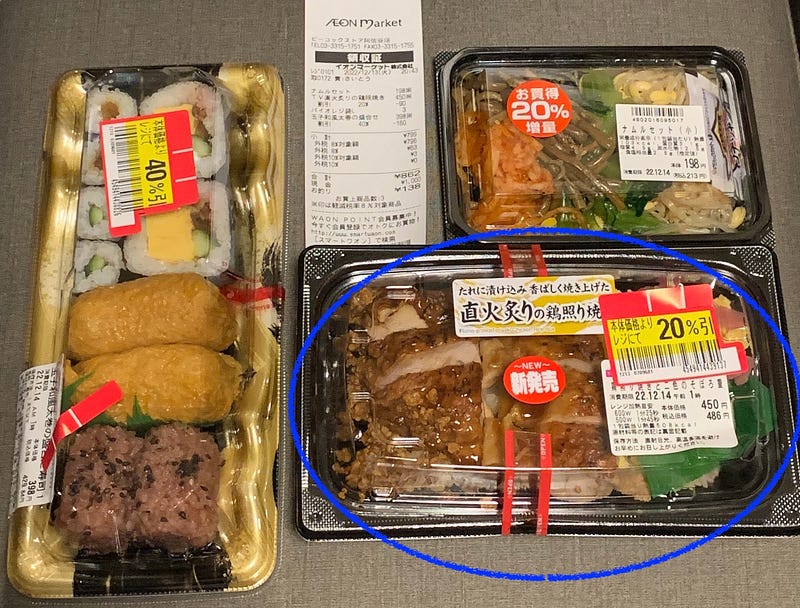
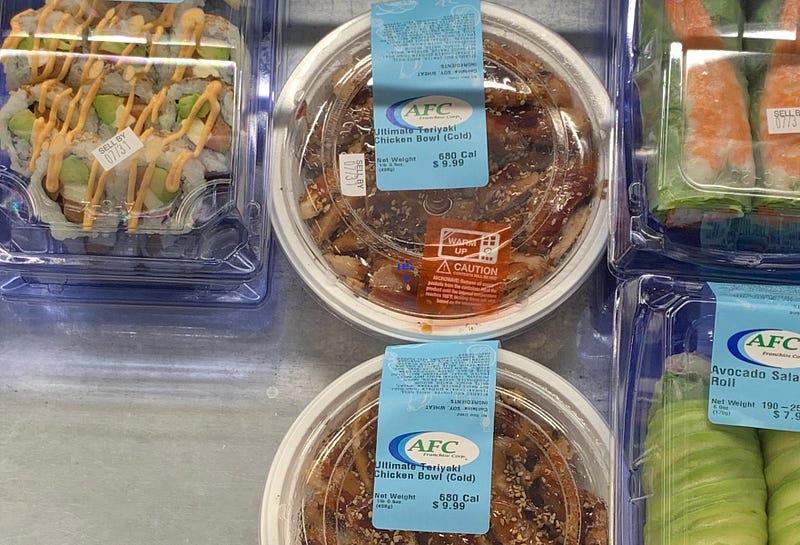
Photo taken by author in Tokyo in December 2022. Food purchased at Peacock Market in Tokyo.
Photo taken by author in San Francisco in July 2023. Food purchased at Safeway in San Francisco. (Note: this teriyaki chicken bowl as supplied by AFC is available in grocery stores across the U.S. — it is not a San Francisco-only product.)

We will start again with two prepackaged teriyaki chicken meals: (1) from a Safeway in San Francisco and (2) from a mid-sized Japanese supermarket in Tokyo called Peacock Store.

In the previous article, we just did currency conversions to see what food prices would feel like to a tourist from one country visiting the other.

Today we are taking food prices in “work-minutes.”
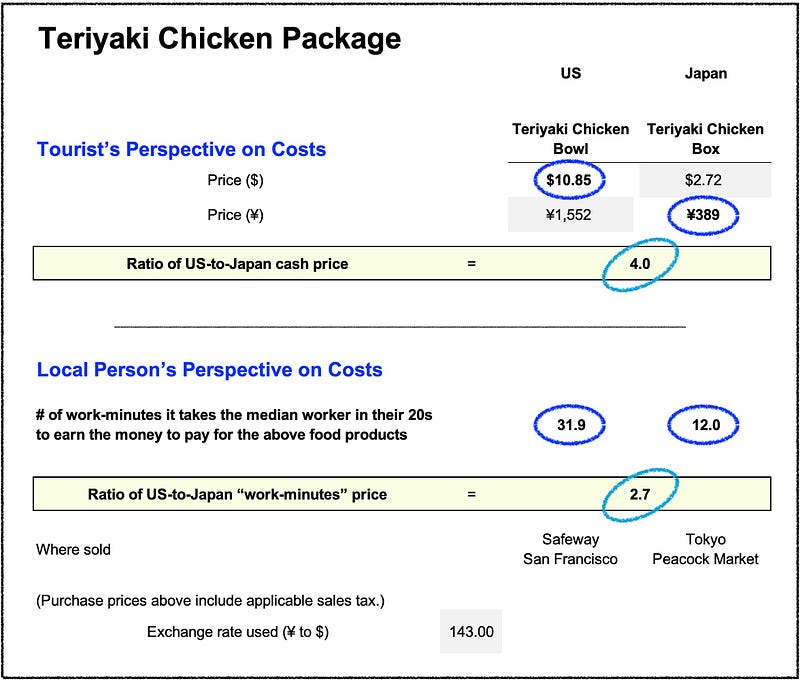
Analysis performed by author. Graphic created by author, August 2023.

Look at the “Local Person’s Perspective on Costs” section.

In the U.S., it takes the median worker in their 20s about 32 minutes to earn enough money to buy that $10.85 teriyaki bowl from Safeway.

In Japan, it takes the median worker in their 20s about 12 minutes to earn enough money to buy that ¥389 teriyaki package from Peacock Market.

The U.S. worker has to work about 2.7 times longer than the Japanese worker to buy that package of food.

Note that 2.7X when we measure costs in “work-minutes” is a smaller cost multiple than we saw in the previous article where the $10.85 U.S. cost was 4X the ¥389 cost once we converted one currency to the other (at 143 ¥/$.)

But 2.7X means that the teriyaki chicken bowl in the U.S. is still going to feel almost 3 times as expensive to the median American earner in their 20s as a similar food package in Tokyo will cost the median Japanese person in their 20s.

Comparison #2. Sushi packages bought in supermarkets
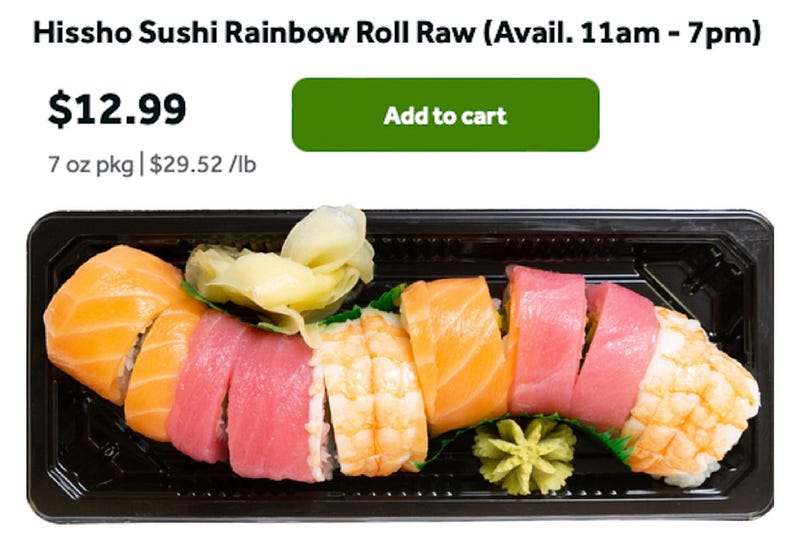
Sushi photo from Stop&Shop in Providence, RI. Total cost with tax is $14.03.
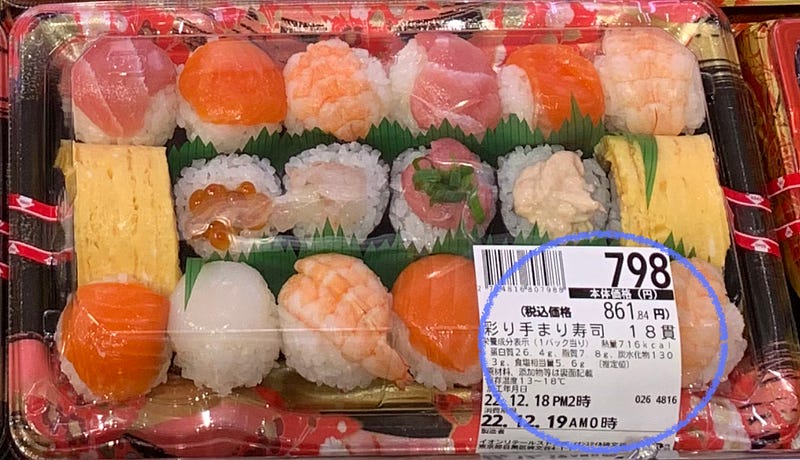
Sushi photo from Tokyu Store in Nakameguro, Tokyo. Photos taken by author in December 2022. Total cost with tax is ¥861. This package, however, contains almost twice as much sushi as the package from Stop&Shop. To make the comparison somewhat more fair, I’m going to discount the price on the larger package by 25% to ¥646.

Let’s compare sushi offerings one more time from (1) the Stop&Shop in Providence, Rhode Island and (2) the Tokyu Store supermarket in Tokyo.

This time we look at costs measured in work-minutes.
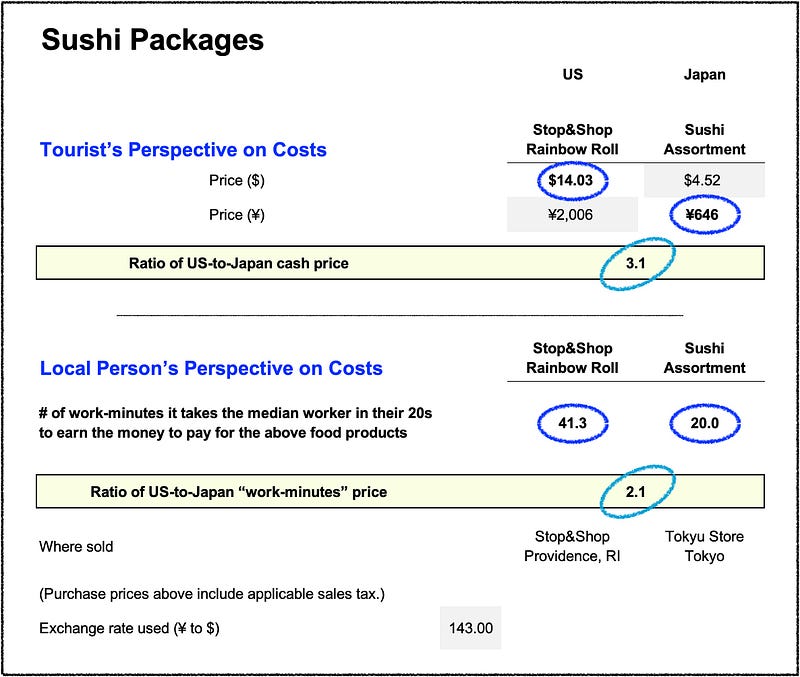
Analysis performed by author. Graphic created by author, August 2023.

And again, the cost differential narrows when we measure it in work-minutes — i.e., how the cost feels to a local resident in their 20s earning the median wage.

41.3 minutes to earn enough in the U.S. to buy the Stop&Shop sushi roll vs. 20 minutes for a median earner in their 20s in Japan to buy the larger sushi package in Tokyo.

It takes the U.S. worker about 2X as many work-minutes as it takes the Japanese worker. That’s a smaller cost difference than the 3X when we did the straight currency conversion that a tourist would be thinking in terms of, but it’s still a substantial difference.

Prices continue to be substantially less expensive in Tokyo than in the U.S.

Comparison #3. Cherry Tomatoes, 10 oz. packages
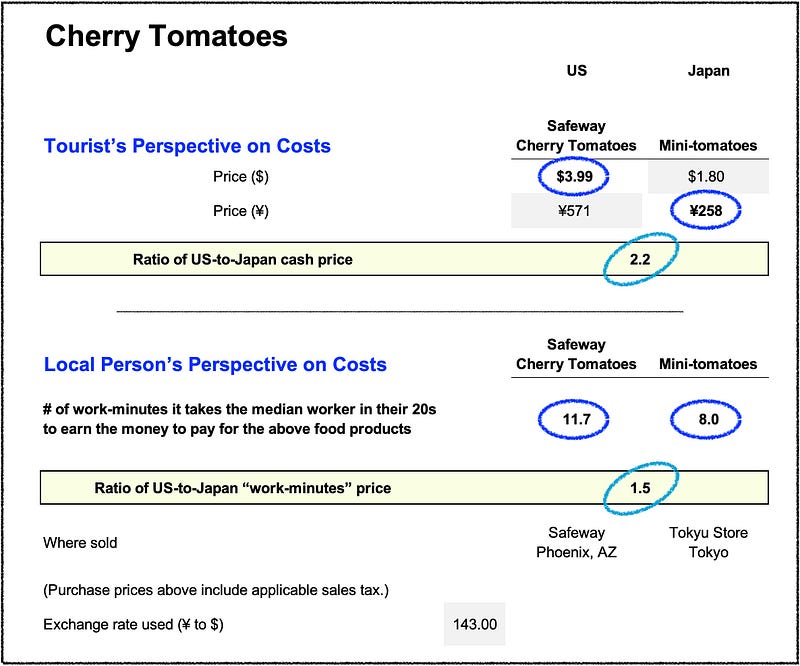
Analysis performed by author. Graphic created by author, August 2023. Currency exchange rate = ¥143/$1.

I compared Cherry Tomatoes from Safeway in San Francisco with “Mini-tomatoes” from Tokyu Store in Tokyo. Both had packages that were roughly 10 oz.

We can see that a 10 oz. package of cherry tomatoes in the U.S. is just over 2 times the price of a similar-sized (roughly 11 oz.) package of mini-tomatoes in Tokyo.

In terms of how many work-minutes it takes the median worker in their 20s in each country to buy their respective package of cherry tomatoes, it’s only 50% more in the U.S. than in Japan. (That’s the ratio of 1.5 that we see in the above table.)

But that means that the cherry tomatoes are still going to feel 50% more expensive to the median US worker in their 20s than it will to the corresponding Japanese worker when they go to buy cherry tomatoes in Japan.

50% more expensive is still 50% more expensive.

And that’s the smallest difference we’ve seen so far.

Comparison #4. Baked Goods — Scone vs. Rustique
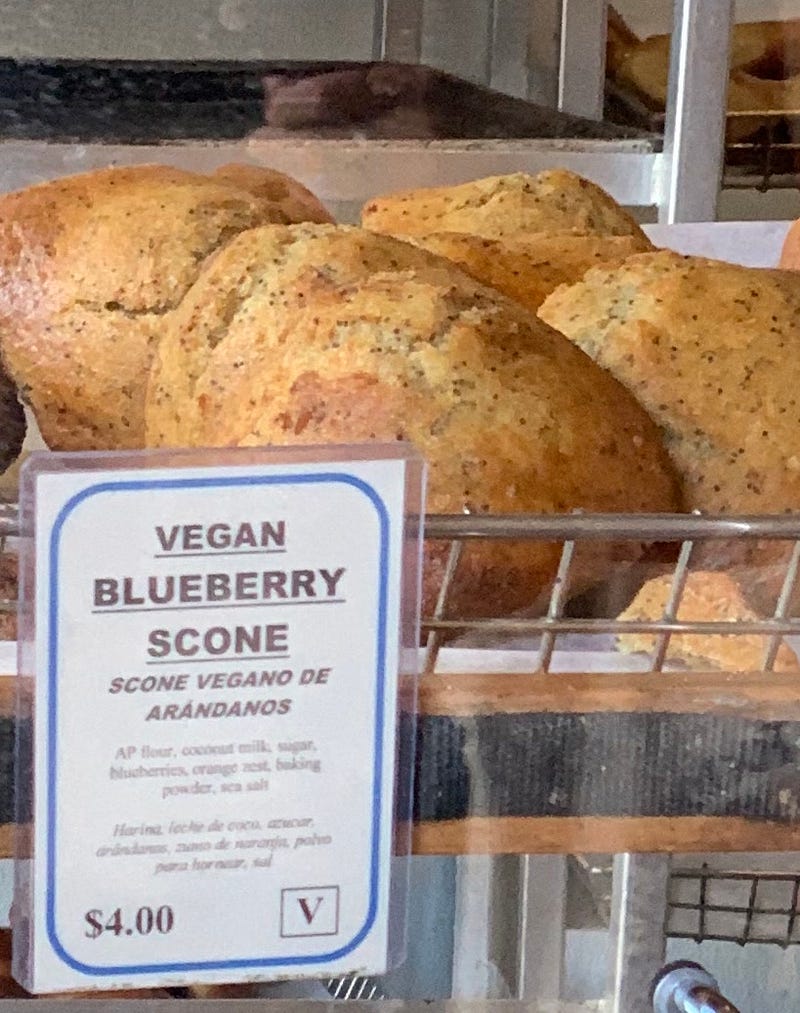
Photo taken by author in August 2023 in San Francisco.
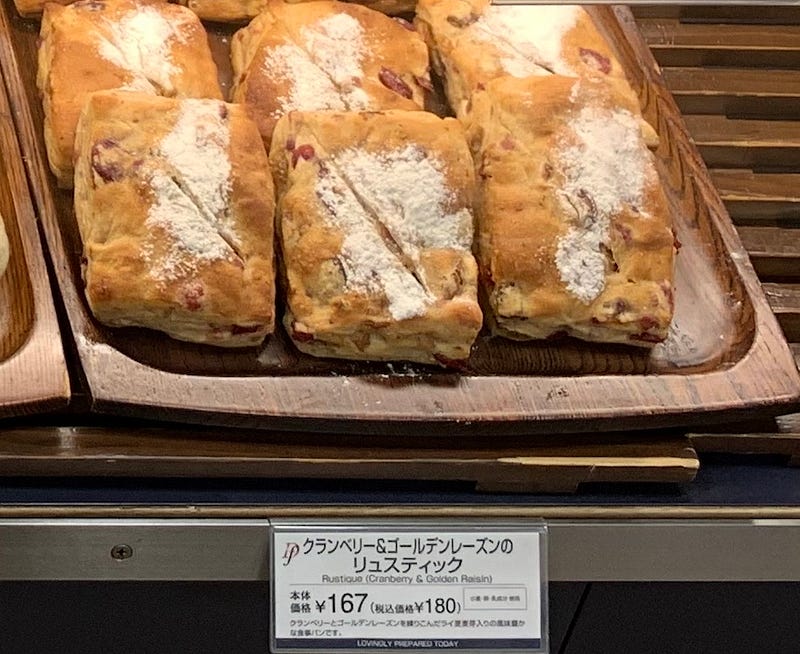
Photo taken by author in December 2022 in Tokyo, Japan.

Scones in San Francisco vs. rustiques in Tokyo — which one is going to feel more expensive to a local in the local currency?
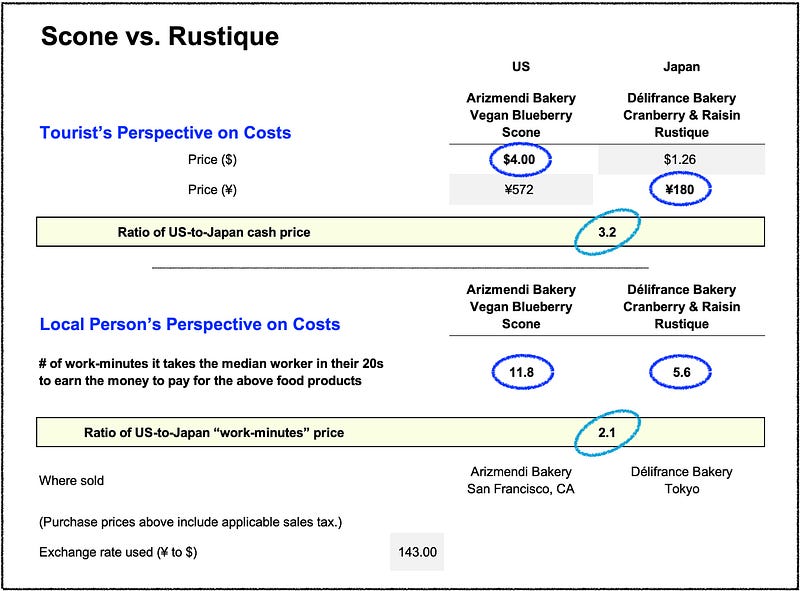
Analysis performed by author. Graphic created by author, August 2023. Currency exchange rate = ¥143/$1.

11.8 minutes to earn enough in the U.S. to buy the San Francisco scone vs. 5.6 minutes for a median earner in their 20s in Japan to buy the rustique in Tokyo.

It takes the U.S. median worker in their 20s about 2X as many work-minutes as it takes the corresponding Japanese worker.

Summary and Takeaways

  1. When we measure the price differences based on work-minutes (instead of doing a straight currency conversion), we see that it’s cheaper and easier for people in Japan making the median salary to buy food than it is for U.S. people in the U.S. to buy comparable food products when they earn a median salary in the U.S.
  2. It’s a common narrative in the U.S. to pound the table and beat our chests about how efficient American corporations are at producing world-class goods and services at competitive prices. In contrast to that, Japanese corporations are often portrayed as being slow and outdated and not being as smart or aggressive as U.S. corporations, and _that’s why_ prices are so high in Japan. As we see, though, when we actually look at data and do a commonsense analysis, one of those two statements above is not true. Perhaps both of them are not true. Otherwise, how do you explain U.S. food prices for Americans — at least, the ones we have looked at so far — taking SO MUCH MORE OF A BITE out of the American’s income than is the case with Japanese food in being so much more expensive than Japanese food prices?
  3. If you are a tourist, all you need to care about for comparing prices between your home country and the one you are visiting is the exchange rate. If you are a local in one country and wonder how the local people in another country are doing in terms of local prices in relation to their cost of living, you need to do something like a “work-minutes” calculation for how much things cost.

My personal sense of the situation is, there are structural factors in both countries making prices in each country look the way they do.

  • Japan is hyper-efficient and hyper-focused on driving down prices. While that does have the effect of making it hard for companies to raise salaries (and costs), it has also clearly had the effect of holding down prices in Japan over the past 30+ years. “…Even marriage ceremonies are on sale, with discount wedding halls offering weddings for $600 — less than a tenth of what ceremonies typically cost here just a decade ago….” New York Times, 10/17/2010.
  • By contrast, the U.S. is hyper-lenient when it comes to letting corporations gain monopoly or near-monopoly pricing power. And once corporations in the U.S. have pricing power like that, they wield it relentlessly and mercilessly by raising prices in order to maximize their own profits. For instance, we knew all the way back in late 2021 — courtesy of analysts like Matt Stoller — that corporate profit-gouging in the U.S. was responsible for around 60% of the inflation seen up to that point in the pandemic. By mid-2022, even mainstream news outlets like CBS News were reporting that “Companies use inflation to hike prices and generate huge profits.” So it’s no surprise that inflation in the U.S. over the past 30 years would have dramatically outpaced inflation in Japan.

Finally, from the personal perspective of someone who has lived in Tokyo, if I think back to how far ¥1,000 would go in Tokyo back in the early 90s, it did not feel to me at the time as though it went that far.

By contrast, today in 2023 in Tokyo, ¥1,000 feels as though it will buy a lot.

It’s the opposite here in the U.S.

In terms of how many minutes or hours or days I’d have to work to buy something, everything here seems more expensive than it did 30 years ago.

And it’s not just “a little bit more expensive” — things are crazily more expensive than they were back in the early 90s.

What do people think — what factors are driving this divergence in food pricing over the last few decades between Japan and the U.S.?

Related and recent articles

My Health Insurance Company Asked for Feedback on My Specialist. I Blew My Top. • Is this the Dirty Little Secret Why Americans See the Doctor Less Often Than Japanese? • Life Expectancy vs. Healthcare Costs in the U.S., Japan, Germany, etc. • My Top 1% Friend Was Floored by the Cost of His Family’s Health Insurance • U.S. or Japan, Part 1. Where Does It Cost More to Eat Healthy, Tasty Food? • U.S. or Japan, Part 2. How to Measure the Cost of Healthy, Tasty Food • U.S. or Japan, Part 3. Which Country’s Restaurants Are the Better Deal? • The Samuel L. Jackson Approach to Dealing with Centrist Democrats • The Money You Save by Paying Extra in ONLY Years 1–3 of Student Loan Repayments

Subscribe to receive email notifications when I post new articles.

Again, thank you for reading, subscribing, clapping, and sharing — I appreciate your time and attention!

Jeffrey Goodman

Japan
Inflation
Travel
Finance
Economics
Recommended from ReadMedium