avatarJeffrey Goodman

Free AI web copilot to create summaries, insights and extended knowledge, download it at here

6319

Abstract

nge rate of ¥143/1 — the exchange rate is trading slightly above the 143 ¥/ level as I write this on August 09, 2023.</p><figure id="9e8c"><img src="https://cdn-images-1.readmedium.com/v2/resize:fit:800/1*puvteQR0fPa9kWJIClDTtA.jpeg"><figcaption>Analysis performed by author. Graphic created by author, August 2023.</figcaption></figure><p id="5c54"><b>So the same pre-packaged meal costs 4 times as much in San Francisco as it would cost in Tokyo.</b></p><p id="0dd1">4 times as much.</p><p id="d7cb"><i>Wow.</i></p><p id="bcbe">Someone who visits Tokyo from the U.S. and buys that teriyaki chicken package would feel like it is <b>only 1/4th the price that they’d pay in the U.S. for the same thing.</b></p><p id="11b0">A friend’s daughter was visiting San Francisco last summer from Tokyo. <b>You should have seen her eyes pop when we walked through a grocery store here and she saw the prices for packages like these</b>. She couldn’t believe how expensive a single meal portion was when she converted the price back to yen.</p><h2 id="3ece">Let’s look at a few more food products from each country:</h2><ul><li>a package of sushi;</li><li>a container of cherry tomatoes; and</li><li>items from a bakery.</li></ul><h1 id="647e">Comparison #2. Sushi packages bought in supermarkets.</h1><figure id="9006"><img src="https://cdn-images-1.readmedium.com/v2/resize:fit:800/1*O7dS7Gr1TVxowxXA2CL3FA.png"><figcaption><b><i>Sushi photo from <a href="https://stopandshop.com/product/hissho-sushi-rainbow-roll-raw-avail.-11am-7pm-7-oz-pkg/257672">Stop&Shop in Providence, RI</a></i></b><i>. Total cost with tax is 14.03.</i></figcaption></figure><figure id="a3d5"><img src="https://cdn-images-1.readmedium.com/v2/resize:fit:800/1*VWOFYByVxHsBpz9o9pBC0w.jpeg"><figcaption><b><i>Sushi photo from Tokyu Store in Nakameguro, Tokyo.</i></b><i> Photos taken by author in December 2022. Total cost with tax is ¥861. This package, however, contains almost twice as much sushi as the package from Stop&amp;Shop. To make the comparison somewhat more fair, I’m going to discount the price on the larger package by 25% to ¥646.</i></figcaption></figure><p id="d29b">Sushi is of course popular in Japan. It’s also popular enough parts in the U.S. that you’ll find it in grocery stores from <a href="https://www.google.com/search?tbm=shop&amp;hl=en&amp;psb=1&amp;sts=13&amp;gl=us&amp;lsf=seller%3A324480278%2Cstore%3A11751769237728335679%2Cs%3Al&amp;ved=2ahUKEwjT-cjZ8cqAAxXCiH8EHTCLBjMQu-kFegQIABAD&amp;q=sushi&amp;oq=sushi&amp;gs_lcp=Cgtwcm9kdWN0cy1jYxADUABYAGAAaABwAHgAgAEAiAEAkgEAmAEA&amp;sclient=products-cc">Boston</a> to <a href="https://stopandshop.com/product/hissho-sushi-rainbow-roll-raw-avail.-11am-7pm-7-oz-pkg/257672">Providence</a> to <a href="https://www.publix.com/search?searchTerm=sushi&amp;srt=products">Greenville, NC</a> to <a href="https://www.publix.com/search?searchTerm=sushi&amp;srt=products">Atlanta</a> to <a href="https://www.publix.com/search?searchTerm=sushi&amp;srt=products">Tampa</a> to <a href="https://www.randalls.com/shop/search-results.html?q=sushi">Houston</a> to <a href="https://local.safeway.com/safeway/az/phoenix/340-e-mcdowell-rd.html">Phoenix</a>.</p><p id="09fd">Let’s compare sushi offerings from (1) the Stop&amp;Shop in Providence, Rhode Island and (2) the Tokyu Store supermarket in Tokyo.</p><p id="6ec3">You probably already noticed that the sushi package from Tokyo has<b><i> a lot more</i></b> more sushi in it than the Rainbow Roll package from Stop&amp;Shop. Around twice as much, as a matter of fact.</p><p id="2421">To be fair, I’m going to discount the price of the Tokyo package by 25% — not by 50% — just to nudge this back partially in the direction of making it a fair comparison.</p><p id="585b">Discounting the full price of ¥861 by 25% leaves us with a yen price of ¥646, and that is what I use for the price comparison here.</p><figure id="f785"><img src="https://cdn-images-1.readmedium.com/v2/resize:fit:800/1*kWGDqpgWNjKl6XioWfjyMQ.jpeg"><figcaption>Analysis performed by author. Graphic created by author, August 2023. Currency exchange rate = ¥143/1.</figcaption></figure><p id="d97b">Again,<i> wow</i>.</p><p id="305a">Think about it this way.</p><p id="a974">Someone from Tokyo visiting Providence, RI and buying a sushi lunch at a Stop&Shop there would feel —<i> correctly</i> — as though the sushi lunch in the U.S. is costing them at least 3 TIMES AS MUCH as a similar lunch would cost them in Tokyo.</p><p id="a43b"><i>That’s crazy.</i></p><p id="7627"><i>I thought we had best-in-the-world agriculture corporations, food production corporations, and transportation corporations that are supposed to enable U.S. consumers to inexpensively get tasty, high quality food.</i></p><p id="2862"><i>Is that maybe </i><b>not</b><i> the case…?</i></p><h1 id="0676">Comparison #3. Cherry Tomatoes, 10 oz. packages</h1><p id="7616">One type of fresh produce that is found just about everywhere in both countries is cherry tomatoes.</p><figure id="e5d9"><img src="https://cdn-images-1.readmedium.com/v2/resize:fit:800/1*cRStgg9CgTlE5oS90L0uWA.jpeg"><figcaption>Analysis performed by author. Graphic created by author, August 2023. Currency exchange rate = ¥143/$1.</figcaption></figure><p id="cc2c">I compared Cherry Tomatoes from Safeway in San Francisco with “Mini-tomatoes” from Tokyu Store in Tokyo. Both had packages that were roughly 10 oz.</p><p id="a545">We can see that a 10 oz. package of cherry tomatoes in the U.S. is <b>just over 2 times</b> the price of a similar-sized (roughly 11 oz.) package of mini-tomatoes in Tokyo.</p><h1 id="d668">Comparison #4. Baked Goods — Scone vs. Rustique</h1><figure id="1d30"><img src="https://cdn-images-1.readmedium.com/v2/resize:fit:800/1*KzsnK-FwvB6Lk7-xB8sMRA.jpeg"><figcaption><i>Photo taken by author in December 2022 in Tokyo, Japan.</i></figcaption></figure><figure id="51bf"><img src="https://cdn-images-1.readmedium.com/v2/resize:fit:800/1*3h6Ekpe06n9Oyk8Lc_37wQ.jpeg"><figcaption><i>Photo taken by author in August 2023 in San Francisco.</i></figcaption></figure><p id="87ba">Americans who haven’t visited Tokyo before are often surprised by how good the bakeries and baked goods are . . . as well as by the fact that there are bakeries<i> everywhere</i>.</p><p id="073f">Above is a photo of a “Cranb

Options

erry & Golden Raisin Rustique” — they are delicious, and they are one of my “go-to’s” when I stop in at any of the <a href="https://goo.gl/maps/XPqgn5cxuvUzo6k18">Délifrance Bakery</a> locations (like the one inside Kamiyacho Station, where I took this photo.)</p><p id="3442">And the blueberry scones at <a href="https://www.yelp.com/biz/arizmendi-bakery-san-francisco-2">Arizmendi Bakery</a> in The Mission in San Francisco are also delicious and similar to the rustique in size.</p><figure id="92f6"><img src="https://cdn-images-1.readmedium.com/v2/resize:fit:800/1*uyBc8XWwleti2M744vnIfg.jpeg"><figcaption>Analysis performed by author. Graphic created by author, August 2023. Currency exchange rate = ¥143/1.</figcaption></figure><p id="465a">As we can see, the rustique in Tokyo costs less than 1/3 of what the scone in San Francisco costs.</p><p id="6f72">A Japanese person visiting the U.S. would be shocked that a muffin or scone or rustique would cost 3.00–5.00 apiece depending on the coffee shop or bakery they are visiting.</p><p id="1478">And a person visiting Tokyo from the U.S. would be asking, “What’s the catch — how did I come to a big expensive city like Tokyo, and a delicious rustique (or melon pan or scone) ONLY costs me $1.00–2.00 each??”</p><h1 id="f663">Takeaways and Comments</h1><ol><li><b>What did we learn today?

First, on a currency conversion basis, it costs a lot more</b> — 2 to 4 times more! — to buy food at a supermarket or bakery in the U.S. than it does in Tokyo at the current exchange rate of 143 ¥/$. <b> Second, we have an open question as to why this is.</b> I have thoughts about this, but before I dive in there, I want to lay out additional context and information in the next couple articles. <b> In the meantime, I welcome your thoughts and opinions in the comments below as to why food seems to be so much more expensive here in the U.S. than in Japan.</b> Were you surprised by this? Are there other foods where you think the difference in consumer food pricing might be higher or lower than what we saw in today’s examples?</li><li><b>I’m writing this series to take a different kind of look at (1) the cost of living and (2) the quality of life in the U.S. </b>

Both of these have gone down very unhappy paths for a majority —<i> yes, a majority</i> — of Americans over the past 40–50 years.

But most mainstream media outlets — and just about all politicians and government officials — in the U.S. ignore this sad state of affairs.

Let’s have a real, data-driven and fact-driven conversation about this. And let’s figure out how we are really going to fix the things that need fixing.</li><li><b>For this series, I’ll focus on “the basics” of modern life</b> — including (but not limited to) jobs that pay you enough to live; housing; healthcare; food; education; and transportation. (<i>If you have suggestions about what should be included in “the basics,” please share them in the comments below.</i>)</li><li><b>It’s helpful to compare costs, types, and quality levels of these basic services between peer countries.</b> I’m starting with some U.S.-to-Japanese comparisons, but we’ll also compare other countries.</li><li><b>The next couple articles</b> will (1) walk through a different, more useful way of thinking about costs for the same thing in different countries; and (2) look at prices for typical meals at restaurants in Tokyo and at comparable restaurants in the U.S.</li></ol><h1 id="121c">Related and recent articles</h1><p id="ea88"><a href="https://bright52.medium.com/my-health-insurance-company-asked-for-feedback-on-my-specialist-i-blew-my-top-c212af65fb2b"><b>My Health Insurance Company Asked for Feedback</b></a> on My Specialist. I Blew My Top. • <a href="https://bright52.medium.com/is-this-the-dirty-little-secret-why-americans-see-the-doctor-less-often-than-japanese-25051a68d544"><b>Is this the Dirty Little Secret</b></a> Why Americans See the Doctor Less Often Than Japanese? • <a href="https://bright52.medium.com/life-expectancy-vs-healthcare-costs-in-the-u-s-2bc7ff1df621"><b>Life Expectancy vs. Healthcare Costs</b></a> in the U.S., Japan, Germany, etc. • <a href="https://bright52.medium.com/my-top-1-friend-was-floored-by-the-cost-of-his-familys-health-insurance-4ac481809595"><b>My Top 1% Friend Was Floored by the Cost</b></a> of His Family’s Health Insurance • <a href="https://bright52.medium.com/u-s-or-japan-part-1-where-does-it-cost-more-to-eat-healthy-tasty-food-6b0b905a3e7c"><b>U.S. or Japan, Part 1</b></a><b>. </b>Where Does It Cost More to Eat Healthy, Tasty Food? • <a href="https://bright52.medium.com/u-s-or-japan-part-2-how-to-measure-the-cost-of-healthy-tasty-food-7a96173e6883"><b>U.S. or Japan, Part 2</b></a><b>. </b>How to Measure the Cost of Healthy, Tasty Food • <a href="https://bright52.medium.com/u-s-or-japan-part-3-which-countrys-restaurants-are-the-better-deal-2cd802a79602"><b>U.S. or Japan, Part 3</b></a><b>. </b>Which Country’s Restaurants Are the Better Deal? • <a href="https://bright52.medium.com/the-samuel-l-jackson-approach-to-dealing-with-centrist-democrats-post-roe-and-pre-2022-midterms-cee963f28e72"><b>The Samuel L. Jackson Approach</b></a> to Dealing with Centrist Democrats • <a href="https://bright52.medium.com/the-money-you-save-by-paying-extra-in-only-years-1-3-of-student-loan-repayments-97aba0caba8e"><b>The Money You Save by Paying Extra in ONLY Years 1–3 </b></a>of Student Loan Repayments</p><p id="e79a">(<i>Want unlimited access to all Medium articles? <a href="https://bright52.medium.com/membership"><b>Become a member</b> <b>through this link</b></a>, and help support my writing. Please also <a href="https://bright52.medium.com/subscribe"><b>subscribe</b></a> to receive email notifications when I post new articles.</i>)s</p><p id="2771">Want unlimited access to all Medium articles? <a href="https://medium.com/@bright52/membership"><b>Become a member</b></a><b>!</b></p><p id="f315"><b>If you appreciate my writing, please share it on social media</b>.</p><p id="a0b3"><i>Again, thank you for reading, <a href="https://bright52.medium.com/subscribe"><b>subscribing</b></a>, clapping, and sharing — I appreciate your time and attention!</i></p><p id="f35c"><a href="https://bright52.medium.com/about"><b>Jeffrey Goodman</b></a></p></article></body>

U.S. or Japan, Part 1 — Where Does It Cost More to Eat Healthy, Tasty Food?

Why is there such a large difference in food costs between the two countries? Has it always been this way?
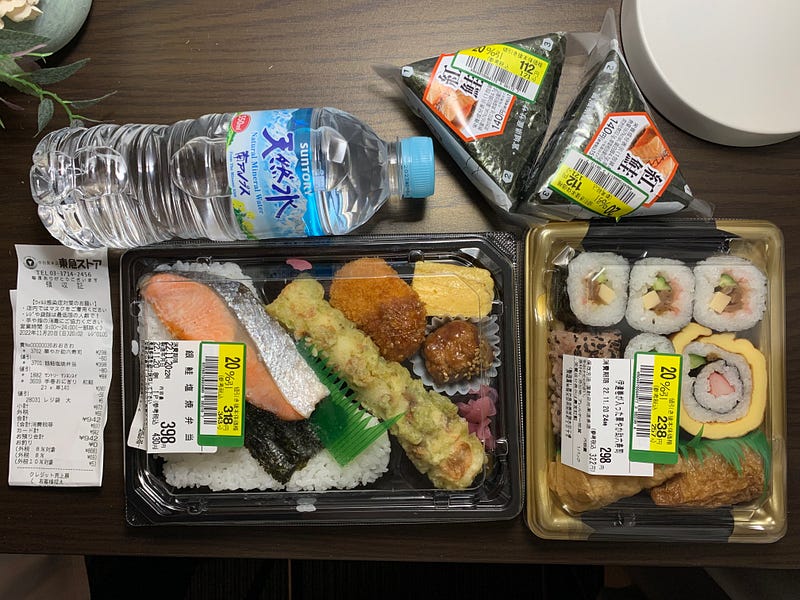
Photo taken by author in December 2022. The total bill for the grilled salmon bento box; the vegetarian sushi box; the 2 salmon onigiri (seaweed wrapped rice balls); and the bottle of water was ¥942 or just under US$7.00. This was enough food for dinner that evening and breakfast the next morning . . . with one onigiri still left over for a midday snack.

Related and recent articles

My Health Insurance Company Asked for Feedback on My Specialist. I Blew My Top. • Is this the Dirty Little Secret Why Americans See the Doctor Less Often Than Japanese? • Life Expectancy vs. Healthcare Costs in the U.S., Japan, Germany, etc. • My Top 1% Friend Was Floored by the Cost of His Family’s Health Insurance • U.S. or Japan, Part 1. Where Does It Cost More to Eat Healthy, Tasty Food? • U.S. or Japan, Part 2. How to Measure the Cost of Healthy, Tasty Food • U.S. or Japan, Part 3. Which Country’s Restaurants Are the Better Deal? • The Samuel L. Jackson Approach to Dealing with Centrist Democrats • The Money You Save by Paying Extra in ONLY Years 1–3 of Student Loan Repayments

(Want unlimited access to all Medium articles? Become a member through this link, and help support my writing. Please also subscribe to receive email notifications when I post new articles.)

There are plenty of true stories about expensive food products in Japan:

But these are special cases that we shouldn’t look at to get a sense of what regular Japanese consumers pay for the food they eat.

  • In some cases, these prices are expensive because the food is essentially being sold as a collectible.
  • In other cases — say, with the milk and beef examples above — there are “product feature” reasons that justify higher prices for certain consumer market segments.

What about prices that regular Japanese people pay for food at local supermarkets? How do these prices compare with U.S. prices for similar products?

Let’s start with side-by-side comparisons of foods that regular working Japanese and regular working Americans might buy on any given day.

Comparison #1. Teriyaki Chicken as a prepackaged meal from the supermarket
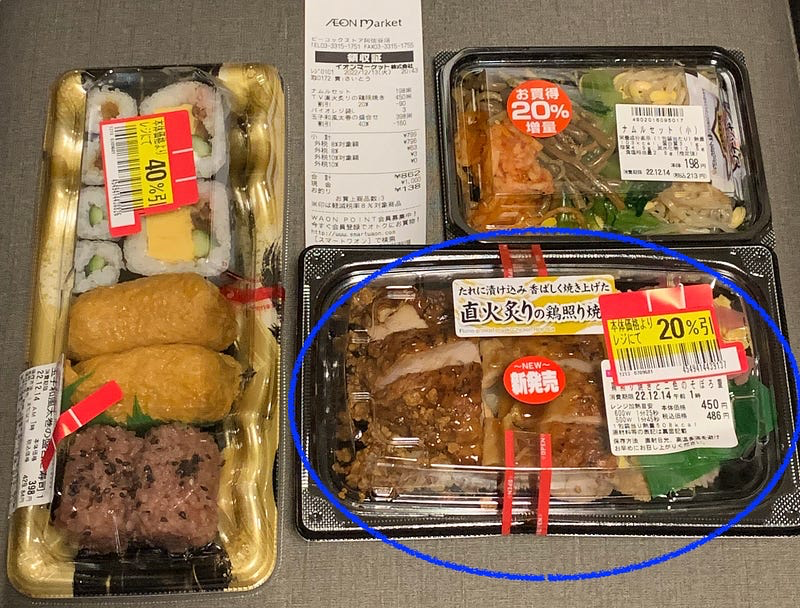
Photo taken by author in Tokyo in December 2022. Food purchased at Peacock Market in Tokyo.
Photo taken by author in San Francisco in July 2023. Food purchased at Safeway in San Francisco. (Note: this teriyaki chicken bowl as supplied by AFC is available in grocery stores across the U.S. — it is not a San Francisco-only product.)

Comparison #1. Teriyaki Chicken as a prepackaged meal from the supermarket
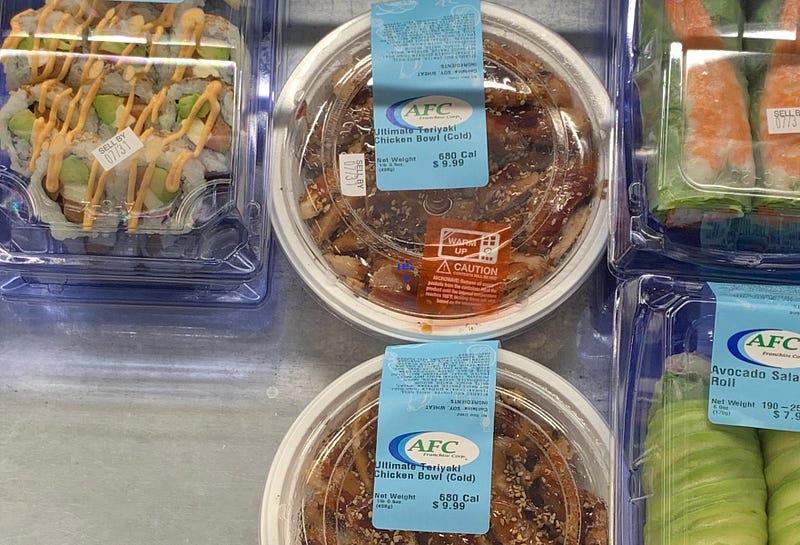
First, here are two prepackaged teriyaki chicken meals (1) from a Safeway in San Francisco and (2) from a mid-sized Japanese supermarket in Tokyo called Peacock Store.

The regular price of the teriyaki chicken package from Peacock Market in Tokyo was ¥450, but because I was shopping around 8:30pm that day, there was a 20% discount on this package of “food made fresh that day.” Japanese supermarkets and convenience stores often do this so that they can clear their fresh food shelves by the end of the day. My actual purchase price was ¥389 (= ¥360 + 8% tax.)

So now the question is, how much a comparable package of teriyaki chicken would cost in the U.S.

The teriyaki chicken bowl from Safeway in San Francisco (also above) was comparable in food volume with the chicken package from Peacock Market. The price at Safeway was 9.99 + 8.6% tax = $10.85.

Now convert currencies so we can make direct price comparisons.

I’m using an exchange rate of ¥143/$1 — the exchange rate is trading slightly above the 143 ¥/$ level as I write this on August 09, 2023.
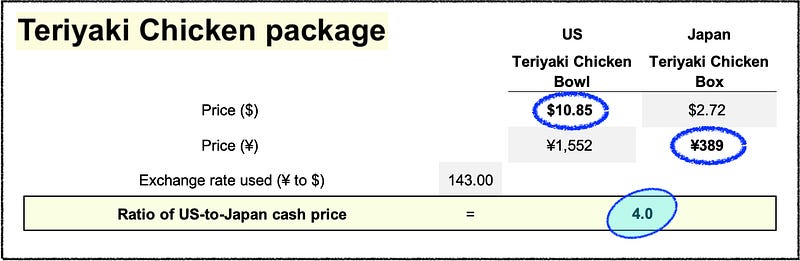
Analysis performed by author. Graphic created by author, August 2023.

So the same pre-packaged meal costs 4 times as much in San Francisco as it would cost in Tokyo.

4 times as much.

Wow.

Someone who visits Tokyo from the U.S. and buys that teriyaki chicken package would feel like it is only 1/4th the price that they’d pay in the U.S. for the same thing.

A friend’s daughter was visiting San Francisco last summer from Tokyo. You should have seen her eyes pop when we walked through a grocery store here and she saw the prices for packages like these. She couldn’t believe how expensive a single meal portion was when she converted the price back to yen.

Let’s look at a few more food products from each country:

  • a package of sushi;
  • a container of cherry tomatoes; and
  • items from a bakery.

Comparison #2. Sushi packages bought in supermarkets.
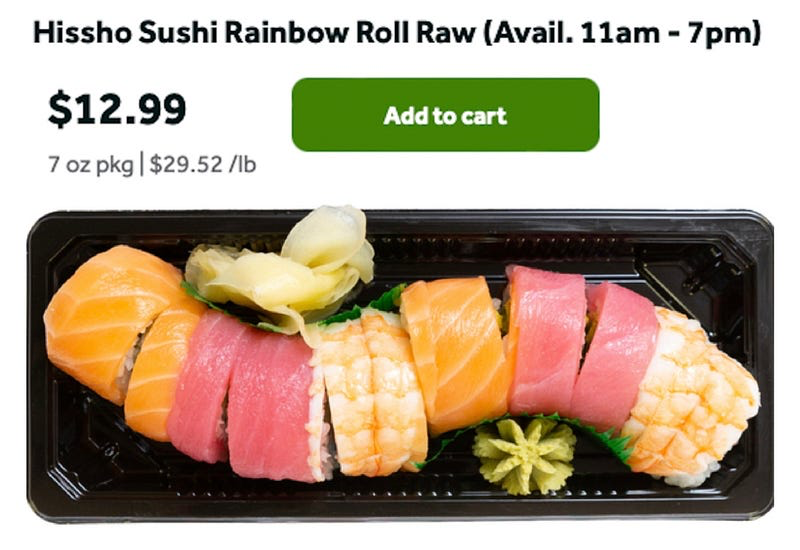
Sushi photo from Stop&Shop in Providence, RI. Total cost with tax is $14.03.
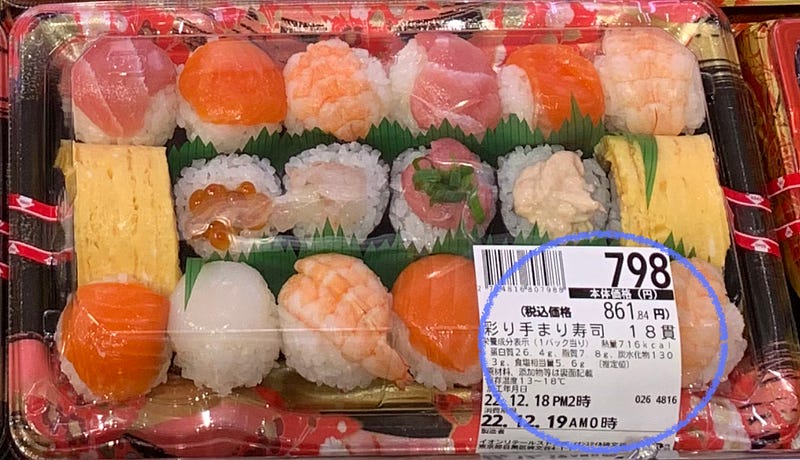
Sushi photo from Tokyu Store in Nakameguro, Tokyo. Photos taken by author in December 2022. Total cost with tax is ¥861. This package, however, contains almost twice as much sushi as the package from Stop&Shop. To make the comparison somewhat more fair, I’m going to discount the price on the larger package by 25% to ¥646.

Sushi is of course popular in Japan. It’s also popular enough parts in the U.S. that you’ll find it in grocery stores from Boston to Providence to Greenville, NC to Atlanta to Tampa to Houston to Phoenix.

Let’s compare sushi offerings from (1) the Stop&Shop in Providence, Rhode Island and (2) the Tokyu Store supermarket in Tokyo.

You probably already noticed that the sushi package from Tokyo has a lot more more sushi in it than the Rainbow Roll package from Stop&Shop. Around twice as much, as a matter of fact.

To be fair, I’m going to discount the price of the Tokyo package by 25% — not by 50% — just to nudge this back partially in the direction of making it a fair comparison.

Discounting the full price of ¥861 by 25% leaves us with a yen price of ¥646, and that is what I use for the price comparison here.
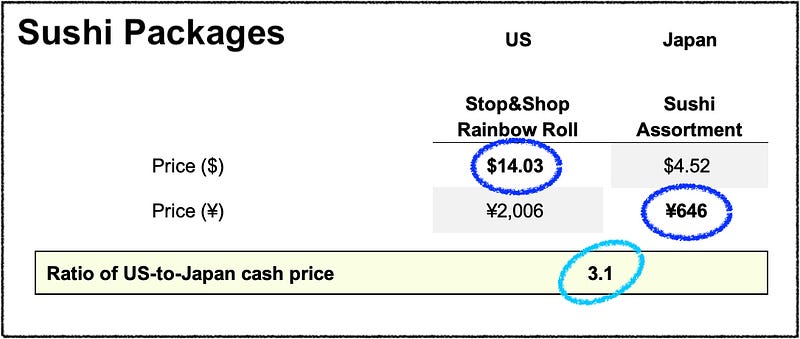
Analysis performed by author. Graphic created by author, August 2023. Currency exchange rate = ¥143/$1.

Again, wow.

Think about it this way.

Someone from Tokyo visiting Providence, RI and buying a sushi lunch at a Stop&Shop there would feel — correctly — as though the sushi lunch in the U.S. is costing them at least 3 TIMES AS MUCH as a similar lunch would cost them in Tokyo.

That’s crazy.

I thought we had best-in-the-world agriculture corporations, food production corporations, and transportation corporations that are supposed to enable U.S. consumers to inexpensively get tasty, high quality food.

Is that maybe not the case…?

Comparison #3. Cherry Tomatoes, 10 oz. packages

One type of fresh produce that is found just about everywhere in both countries is cherry tomatoes.
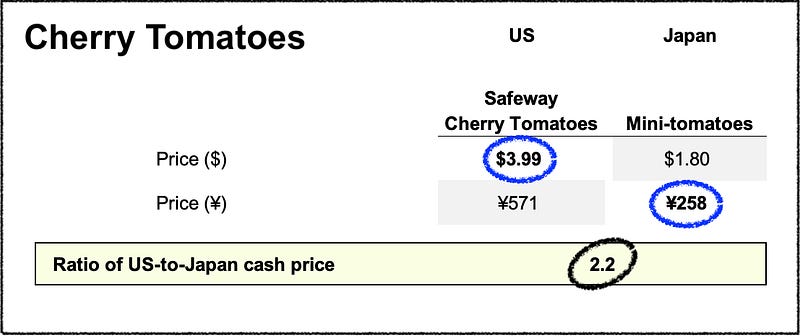
Analysis performed by author. Graphic created by author, August 2023. Currency exchange rate = ¥143/$1.

I compared Cherry Tomatoes from Safeway in San Francisco with “Mini-tomatoes” from Tokyu Store in Tokyo. Both had packages that were roughly 10 oz.

We can see that a 10 oz. package of cherry tomatoes in the U.S. is just over 2 times the price of a similar-sized (roughly 11 oz.) package of mini-tomatoes in Tokyo.

Comparison #4. Baked Goods — Scone vs. Rustique
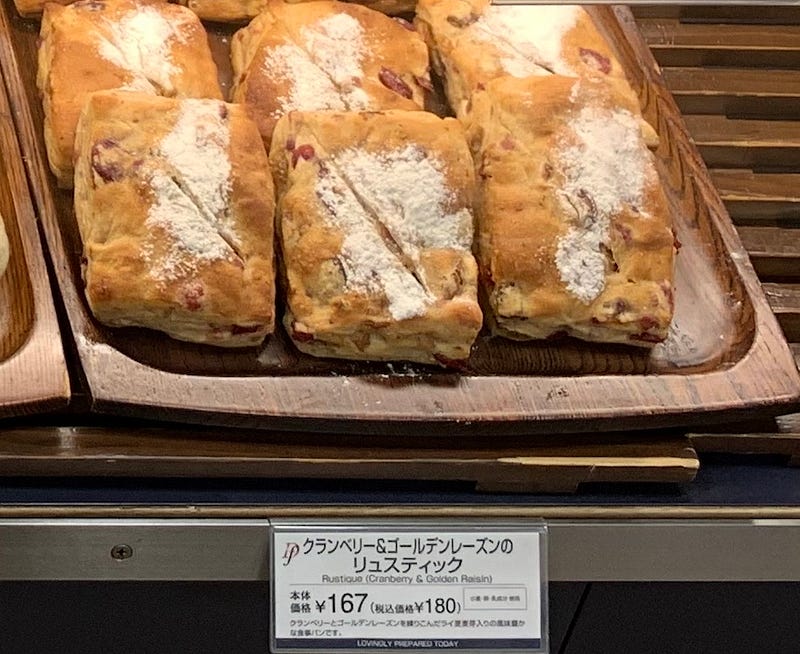
Photo taken by author in December 2022 in Tokyo, Japan.
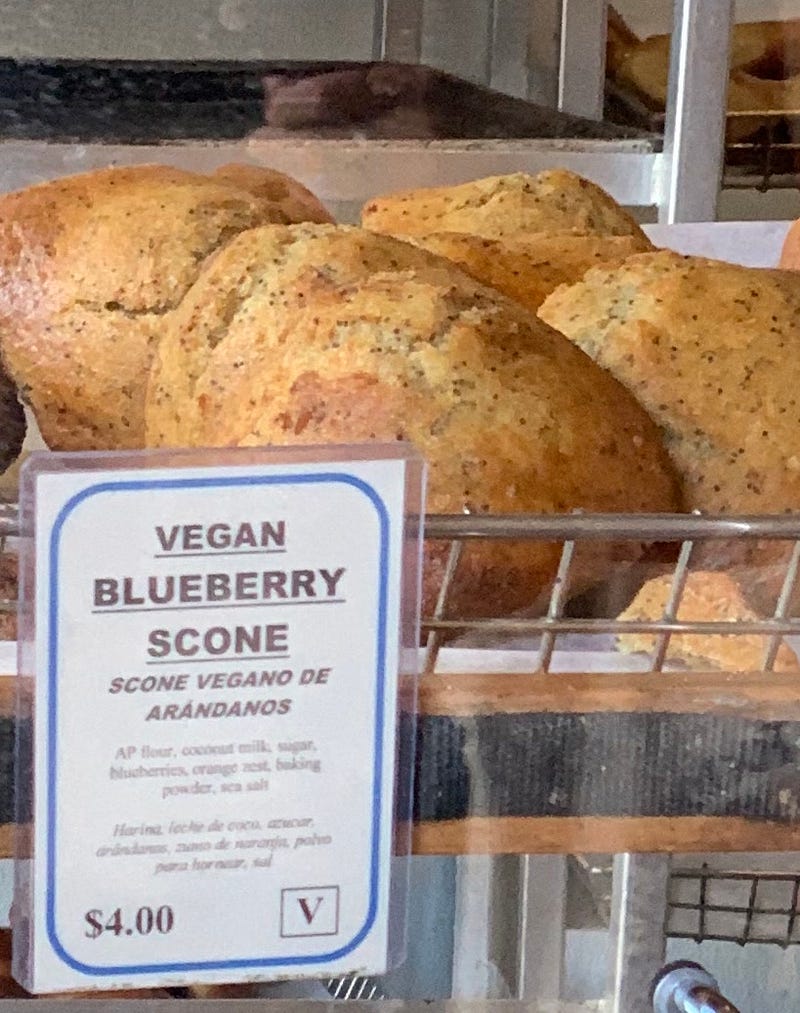
Photo taken by author in August 2023 in San Francisco.

Americans who haven’t visited Tokyo before are often surprised by how good the bakeries and baked goods are . . . as well as by the fact that there are bakeries everywhere.

Above is a photo of a “Cranberry & Golden Raisin Rustique” — they are delicious, and they are one of my “go-to’s” when I stop in at any of the Délifrance Bakery locations (like the one inside Kamiyacho Station, where I took this photo.)

And the blueberry scones at Arizmendi Bakery in The Mission in San Francisco are also delicious and similar to the rustique in size.
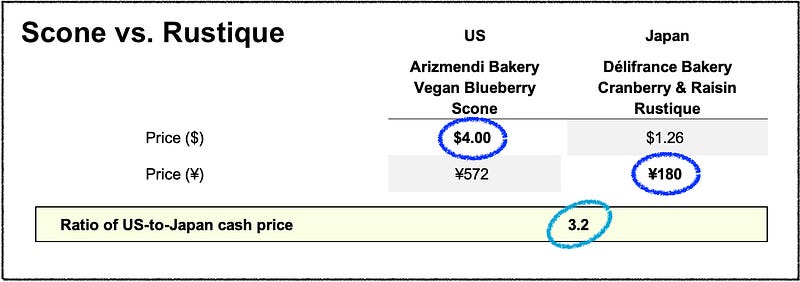
Analysis performed by author. Graphic created by author, August 2023. Currency exchange rate = ¥143/$1.

As we can see, the rustique in Tokyo costs less than 1/3 of what the scone in San Francisco costs.

A Japanese person visiting the U.S. would be shocked that a muffin or scone or rustique would cost $3.00–5.00 apiece depending on the coffee shop or bakery they are visiting.

And a person visiting Tokyo from the U.S. would be asking, “What’s the catch — how did I come to a big expensive city like Tokyo, and a delicious rustique (or melon pan or scone) ONLY costs me $1.00–2.00 each??”

Takeaways and Comments

  1. What did we learn today? First, on a currency conversion basis, it costs a lot more — 2 to 4 times more! — to buy food at a supermarket or bakery in the U.S. than it does in Tokyo at the current exchange rate of 143 ¥/$. Second, we have an open question as to why this is. I have thoughts about this, but before I dive in there, I want to lay out additional context and information in the next couple articles. In the meantime, I welcome your thoughts and opinions in the comments below as to why food seems to be so much more expensive here in the U.S. than in Japan. Were you surprised by this? Are there other foods where you think the difference in consumer food pricing might be higher or lower than what we saw in today’s examples?
  2. I’m writing this series to take a different kind of look at (1) the cost of living and (2) the quality of life in the U.S. Both of these have gone down very unhappy paths for a majority — yes, a majority — of Americans over the past 40–50 years. But most mainstream media outlets — and just about all politicians and government officials — in the U.S. ignore this sad state of affairs. Let’s have a real, data-driven and fact-driven conversation about this. And let’s figure out how we are really going to fix the things that need fixing.
  3. For this series, I’ll focus on “the basics” of modern life — including (but not limited to) jobs that pay you enough to live; housing; healthcare; food; education; and transportation. (If you have suggestions about what should be included in “the basics,” please share them in the comments below.)
  4. It’s helpful to compare costs, types, and quality levels of these basic services between peer countries. I’m starting with some U.S.-to-Japanese comparisons, but we’ll also compare other countries.
  5. The next couple articles will (1) walk through a different, more useful way of thinking about costs for the same thing in different countries; and (2) look at prices for typical meals at restaurants in Tokyo and at comparable restaurants in the U.S.

Related and recent articles

My Health Insurance Company Asked for Feedback on My Specialist. I Blew My Top. • Is this the Dirty Little Secret Why Americans See the Doctor Less Often Than Japanese? • Life Expectancy vs. Healthcare Costs in the U.S., Japan, Germany, etc. • My Top 1% Friend Was Floored by the Cost of His Family’s Health Insurance • U.S. or Japan, Part 1. Where Does It Cost More to Eat Healthy, Tasty Food? • U.S. or Japan, Part 2. How to Measure the Cost of Healthy, Tasty Food • U.S. or Japan, Part 3. Which Country’s Restaurants Are the Better Deal? • The Samuel L. Jackson Approach to Dealing with Centrist Democrats • The Money You Save by Paying Extra in ONLY Years 1–3 of Student Loan Repayments

(Want unlimited access to all Medium articles? Become a member through this link, and help support my writing. Please also subscribe to receive email notifications when I post new articles.)s

Want unlimited access to all Medium articles? Become a member!

If you appreciate my writing, please share it on social media.

Again, thank you for reading, subscribing, clapping, and sharing — I appreciate your time and attention!

Jeffrey Goodman

Japan
Economics
Finance
Inflation
Travel
Recommended from ReadMedium