
Two “Socialist” Policies that Ruined an Economy
It happened in my home country. It can happen anywhere.
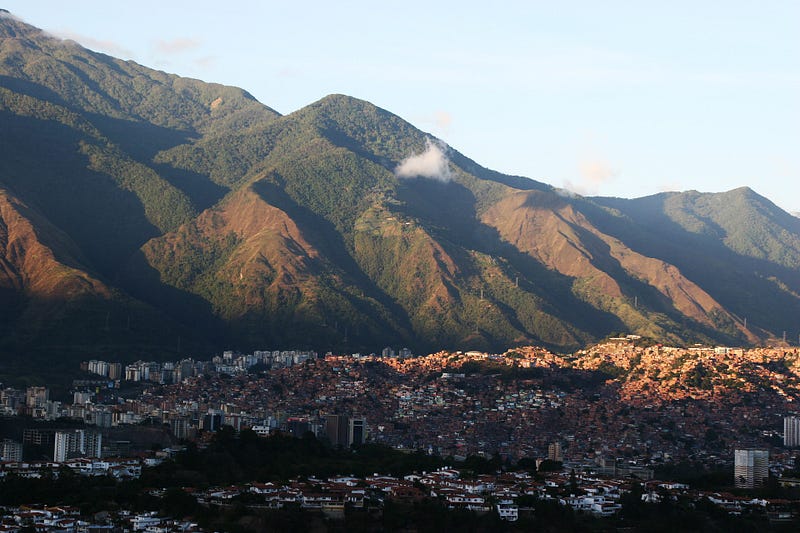
When the economic and political crises in Venezuela are covered by the US media, many people ask me: “What happened? Wasn’t Venezuela supposed to be one of the richest countries in Latin America? Did it not use to have one of the region’s strongest democracies?”
Well, yeah, in some ways, it did. But that was a while ago.
What accounts for Venezuela’s economic ruin? Many things. Here, I cover how two economic policies were central in the economic collapse.
The policies, typical of socialist planned economies, are foreign exchange controls (FX controls for short) and price controls. As you’ll see, when implemented widely, such policies eventually lead to:
- Massive corruption
- Business failures
- Scarcity of basic goods
*Note: By “Socialist” I mean public ownership and administration of the means of production (facilities, tools, machinery, raw materials and the like), whether through collective or government ownership. Socialism entails central planning of economic activity.
It happened in my home country. It can happen anywhere.
Foreign exchange controls
Very simply defined, FX controls are government restrictions on transactions in foreign exchange.
If you’ve ever travelled outside the US or needed to import anything from another country, then you know what foreign exchange is all about — at least normally, when the government doesn’t interfere too much.
Need to buy Brie cheese from France? You exchange your dollars into euros. Need spare parts from the UK? You trade dollars for pounds. The exchange rates fluctuate and are largely determined by the markets.
In Venezuela, the government decided to interfere completely in such transactions and to implement a crazy, tiered FX control system.
What did FX controls in Venezuela look like?
- The government set (based on quite random criteria) official dollar rates, that is, how many bolivars (the Venezuelan currency) got you one dollar.
- The government approved WHO got dollars.
At first, the central government had lots of dollars to allocate. Why? In one word, oil.
The price of oil — which made up 95% of exports — was really high, which translated into a reliable dollar stream. Because of high oil prices, the nefarious effects of the policy took some time to materialize. That they would materialize, though, was just a matter of time.
How exactly did FX controls lead to massive corruption, business failures, and scarcity of basic goods?
First, a dollar black market (which really just means an illegal, ruthlessly “free” market) arose because not everyone could get their hands on the official dollars.
The price of the official dollar was many orders of magnitude lower (i.e., cheaper) than the black market dollar:
Official rate: 10 bolivars = 1 dollar.
Black market rate 100 bolivars = 1 dollar
Black market rate = 10x the official rate
*Note: I’m making all the numbers multiples of 10, even if they weren’t, to avoid complicated math. The effects are equivalent.
Here’s one way businesses failed because of FX controls:
Consider this scenario:
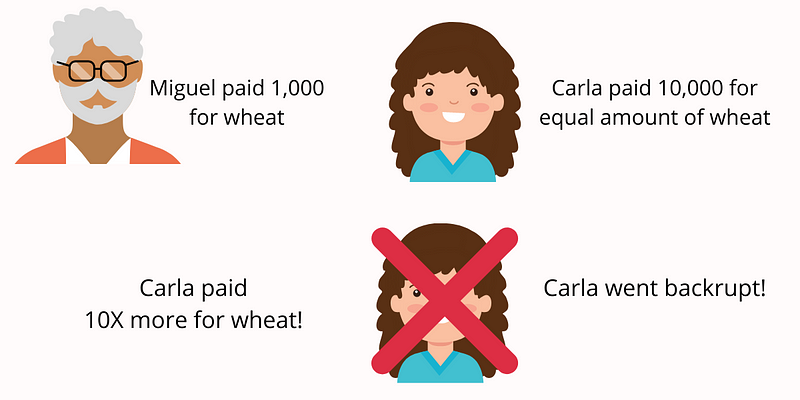
Miguel owned a pasta company. He asked the government for $100 to buy US wheat (not enough wheat grown in Venezuela), and his request was approved.
He gave the government 1,000 bolivars and got 100 dollars, and imported the wheat he needed.
For Miguel, 1,000 bolivars = 100 dollars
Carla owned a pasta company too. She was a critic of the government, or perhaps she couldn’t afford the “expert” to put her dollar request paperwork together, or the dollars set aside for wheat had been exhausted.
For whichever reason, the government didn’t approve her request for dollars. Carla still needed the dollars to buy wheat so she resorted to the black market, where she exchanged 10,000 bolivars for 100 dollars.
For Carla, 10,000 bolivars = 100 dollars
Note that, given the vast gap between the official and black market rates, for the same amount of dollars ($100 in this case):
- Miguel paid 1,000 bolivars.
- Carla paid 10,000 bolivars.
Eventually, Carla couldn’t compete with Miguel (who buys wheat 10 times cheaper) and she had to shut down her company.
Here’s a way corruption happens:
Pedro had a connection to a government official. He produced documents for a fake pasta company and requested $100 to buy wheat.
For Pedro, 1,000 bolivars = 100 dollars
Then he took these $100 straight to the black market (where the exchange rate was Bs100 / $1) and traded them right back into bolivars.
100 dollars x 100 bolivars/dollar = 10,000 bolivars.
Just shuffling papers, Pedro “invested” 1,000 bolivars and got back 10,000 bolivars — a 10-fold return!
Was Pedro done? Of course not! The model was so perfect and irresistible that Pedro repeated the exact same process with the 10,000 bolivars he made, magically turning them into 1,000,000. An on and on and on…
Here’s one way scarcity emerges:
Just the misallocation of dollars in the above examples was bound to produce scarcity. Add to this a drop in oil prices and a fall in Venezuela’s oil production due to mismanagement.
The result is that the government no longer had enough dollars to give out.
How did this affect the supply of pasta? Recall that Pedro’s company was imaginary, and that Carla had already gone out of business.
What about Miguel? He too had to shut down. Not only was he unable to get dollars to buy wheat, he could not buy any imported spare parts to keep his production line running.
Pretty soon, there was scarcely any pasta (whether locally produced or imported) in Venezuela.
Price controls
A policy of price controls involves setting a maximum price for given goods or services.
Venezuela’s government set price controls on hundreds of products, including some 400 basic foods — you know, things like rice, sugar and milk.
As you’ll see, the connection between this policy and business failures, corruption and scarcity is rather direct.
Business failures:
Betty produced sugar. Her production cost was, say, 11 bolivars per pound, and the maximum price she was legally allowed to sell it at was 10 bolivars.
The more she sold, the more money she lost. She stopped producing.
Corruption:
As domestic production dropped, importing sugar became necessary. Who got the dollars to import? Usually, those with the right connections. Remember the FX controls?
Scarcity:
Dollars were misallocated by central planners. Oil prices and production dropped. Therefore, there weren’t enough dollars to go around and sugar imports were no longer enough to meet demand.
Additionally, the artificially low price lead people to hoard or to sell the sugar they could buy at the artificially low price for a big profit in the ruthless — yet absolutely necessary — “free” market.
(Some people, including the government, will blame US sanctions for the economic crisis. Note, though, that all of this took place way before any sanctions were imposed.)
Now, I’d like you to imagine all these examples at a scale so enormous that billions of dollars were stolen, thousands of businesses failed, and not only pasta, but rice, cornmeal, beef, soap, toilet paper — you name it — all but disappeared from the supermarket shelves.
And then, the “predictably unexpected” happened: the economy became dollarized and the black market the primary market. But that’s a whole other subject…
Very related article:


