
Voting for the Democratic Party Doesn’t Make Me a “Socialist”
And voting for the Republican Party doesn’t mean you’re a “Capitalist”
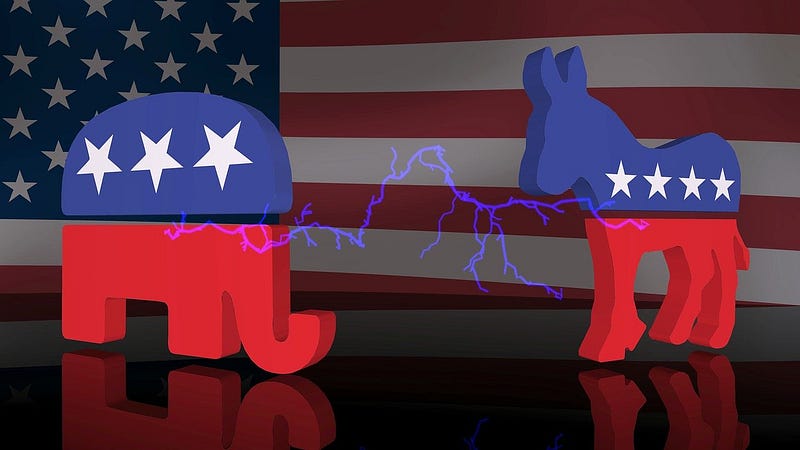
To some degree, the terms socialism and capitalism have always been confusing, divisive and loaded — more so during some periods than others. We’re living through one such period where the terms are wielded left and right for political gain without the slightest attempt to clarify who means what.
To have a meaningful discussion, then, I must first define what I mean, in this article, by Socialism and Capitalism:
When I write Socialism, I mean public ownership and administration of the means of production (facilities, tools, machinery, raw materials and the like), whether through collective or government ownership. Socialism entails central planning of economic activity.
When I refer to Capitalism, I mean the private or corporate ownership and administration of the means of production. In Capitalist societies, the market (lots and lots of private decisions) govern economic activity.
In this article, the upper case S and C will refer to the above definitions only.
No country is 100% Socialist — or 100% Capitalist
I can’t think of any country in the world whose economy is 100% Socialist or 100% Capitalist.
Even the most Capitalist countries have some level of central planning and public ownership of given goods or services. A few that come to mind are public education, health care, and roads and highway. In general, such goods and services are considered either human rights or central to the prosperity or interests of the entire nation.
When I say I’m not a Socialist, then, I don’t mean I never support collective ownership of (and access to) any good or service.
What I am saying is that I reject Socialism as defined above because it proposes widespread central planning and collective ownership of all — or at least most — goods and services.
I don’t reject Socialism because I’m an ideologue, but because it just doesn’t work. The countries which have most closely approached the cited definition of Socialism have all failed, and failed miserably for the people, not for those in power or closely connected to them.
Here, of course, I’m not talking about the Scandinavian countries, which are not Socialist. These countries largely rely on the free market to set production and pricing of goods and services. There is income redistribution through progressive taxation to provide public education (including higher education) and universal healthcare, among other public goods. Only some industries are centrally managed.
A failed Socialist country
In contrast with the Scandinavian countries, the economy of Venezuela, my home country, adheres closely to Socialism.
Policies are highly protectionist. The central government, not the market, determines the prices of many goods and services, who gets them and how much. Foreign exchange is highly regulated. Many industries and companies have been expropriated and taken over by the government.
Venezuela shows that, notwithstanding how ideal it may sound on paper, Socialism actually produces scarcity, poverty, massive corruption and enormous inequality. Socialism leads to perverse incentives that defeat the Socialist policies’ stated purposes.
This happens because we are, after all, only human, and we will take what we can, if we can, to improve our own livelihoods, especially as basic goods and services become scarcer and scarcer.
Socialism and black markets
Ironically, a market economy or sorts always ends up cropping up in Socialist countries, especially once basic goods become scarce as a direct result of Socialism.
It’s called The Black Market.
The black market becomes unavoidable for various reasons. What do you do if there’s no gas for you at the station? What if it has been weeks since you last saw flour, eggs or sugar at the store? What if you’re only allowed to buy one kilo of sugar every other month and you want or need one kilo every other day for your bakery business?
Humans get creative when they need or want things like flour, gas, sugar and eggs.
If you have a bit more than you need of such goods, or are somehow able to get your hands on them, you’ll sell them to the highest bidder in The Black Market. Huge schemes come out of this dynamic.
Currently, the black market for gas in Venezuela is the stuff of nightmares. On paper, gas may be almost free. In reality, it’s going for around 3 dollars per liter, if you’re able to find it.
Some people, like my friend Lila, who’s a doctor and actually works at a public hospital, has a so-called “safe-conduct” to buy gas. She has told me that, even with her coveted “safe-conduct”, she still has to wait hours in line and the amount she gets is at the discretion of the guard at the station. Yes, gas stations are guarded.
Free markets are essential and inevitable, but far from perfect
Free markets, with some level of regulation, are essential for prosperity because they best account for our human tendencies.
Recall that, even in the most Socialist economies, the free market never fully disappears. Instead, it gives way to the illegal and ruthless, yet more efficient, black market (which, by the way, usually affords the most gain to those with close government connections).
A 100% Capitalist economy is not the answer, though. As I wrote above, we’re only human, and we’ll take what we can, if we can, to improve our livelihood. This fact also renders unrestrained Capitalism and free markets dangerous.
Capitalism must be balanced out with some level of redistribution to ensure basic rights and to incentivize behavior leading to essential outcomes. And it always is, to various degrees.
The huge question is: Which rights are basic and what outcomes essential?
These are legitimate issues we must ponder and discuss. And we must be willing to hear the other side. Our views on such matters evolve, believe it or not.
Why we must move beyond the Socialism vs Capitalism debate
The job of policy makers is to create policies that promote the rights and outcomes society at large supports, and to improve such policies over time.
The exploitation of the words “socialist” and “capitalist” render this task vastly more difficult than it already is.
The aim of this article is not to establish which rights are basic and which outcomes essential. I will, however, offer my views to illustrate how the terms socialism and capitalism render productive discussion almost impossible.
Like most Americans, I consider education a basic right, so I support the existence of a public education system. This doesn’t make me a Socialist. However, unlike a lot of Americans, I consider health care a basic right, so I support the existence of some kind of public health care system. This doesn’t make me a Socialist either.
With regard to essential outcomes, like most Americans, I consider our interstate highway system essential. This doesn’t make me a Socialist. By contrast, unlike a lot of Americans, I consider addressing climate change essential. This doesn’t make me a Socialist either.
Furthermore, the best way to promote the rights and outcomes that I (or you) may favor is not through 100% Socialist or 100% Capitalist policies. Usually, something in between makes the most sense.
The terms Socialism and Capitalism have been irreversibly damaged
The words “capitalism” and “socialism” have been ruined for too many people, and the damage is irreversible.
Even if you tell people you don’t mean this or that by socialism or capitalism, for many, the former still conjures up repression and hunger, while, for others, the latter always means inhumanity and exploitation.
Furthermore, how are we to know what each person means by each term?
Either way, the fact remains that, if you say socialist you’ll instantly turn away most Venezuelan-American and many other voters, even if you mean you support progressive taxation or that health care is a human right.
In What’s So Scary About Socialism? (3/29/2019), David M. Perry states:
The truth is this: The Democratic Party has never been socialist, but rather its most progressive members promote a vision of regulated capitalism intended to stave off the worst depredations on the most vulnerable Americans. The realization, alas, is that the “socialism” tag keeps working as a way to trick Americans into voting against programs they might actually love.
(I concur with much of what Perry is saying here. It is my view, however, that a few Democratic Party politicians do have Socialism in mind when they call themselves socialist. I wouldn’t vote for these specific politicians.)
As is the case with the word socialist, many people will describe themselves as capitalist and not mean Capitalist. Such capitalists may still support more progressive taxation and view healthcare as a a human right. They will, however, be instantly rejected by the side that has a visceral negative reaction to the word capitalism.
Is it time to find alternatives to the words “capitalism” and “socialism”?
Politicians on both sides exploit the terms socialism and capitalism, using flawed slippery slope arguments against policies from the other side. Any step in either direction will, according to them, inevitably lead the country to a state of pure Socialism or pure Capitalism.
You think Trump’s policies are all Capitalist? His government’s trade barriers are protectionist policies, socialist in nature. Some consider the corporate and investor bailouts under way due to the pandemic “Corporate Socialism” (Corporate Socialism: The Government is Bailing Out Investors & Managers Not You, 3/25/2020).
Using loaded words to your advantage is a proven, destructive tactic. It’s based on the fact that most people will support or reject policies solely based on associations to such words.
It’s time to abandon the capitalism vs socialism arguments. I, for one, propose we adopt new nomenclature. How about a “humanitarian market economy,” for instance?
Articles cited: