avatarDr Ron Pol

Free AI web copilot to create summaries, insights and extended knowledge, download it at here

5755

Abstract

l leaders guided by advice from public health experts. Rightly so. Facing a pandemic, public health should be the lead discipline. However, with decision making driven by a single branch of science, focusing “first and foremost” on health outcomes makes it necessary actively to avoid a form of groupthink that risks poor economic outcomes, <i>and</i>, ironically,<i> </i>sub-optimal health outcomes. For example:</p><div id="753c" class="link-block"> <a href="https://readmedium.com/did-the-who-just-lock-in-the-cratering-of-the-global-economy-73d726b58690"> <div> <div> <h2>Did the WHO just Lock in the Cratering of the Global Economy?</h2> <div><h3>What they should have said: First, do no harm</h3></div> <div><p>medium.com</p></div> </div> <div> <div style="background-image: url(https://miro.readmedium.com/v2/resize:fit:320/1*veifkIn1-ndiMx5LSpJPXQ.jpeg)"></div> </div> </div> </a> </div><p id="ef59">Seeking to offer some small assistance, I published a series of stories with this fresh perspective, and collated them into a virtual book.</p><div id="d92b" class="link-block"> <a href="https://readmedium.com/covid-19-the-book-2b449352eb4b"> <div> <div> <h2>Covid-19: The Book</h2> <div><h3>A story of our times — of leadership, and outcomes</h3></div> <div><p>medium.com</p></div> </div> <div> <div style="background-image: url(https://miro.readmedium.com/v2/resize:fit:320/1*XncjGbjFOC_Vv7QDOWPMrQ.jpeg)"></div> </div> </div> </a> </div><p id="7e27">That was my first mistake.</p><p id="7da8">Not so much the book itself, or its contents. Nor my goal—to make it easier for readers to access relevant stories, arranged in easy to navigate chapters.</p><p id="ae34">From a writing perspective, the book didn’t achieve its intended objective because I failed to account for two key elements about how publication processes work — vitally important for curation, and readership.</p><p id="2eb5">For readers’ convenience, I sequentially numbered each ‘chapter’ in the usual way — using subtitles for that purpose. This means that some of the most important and substantive parts are sub-titled “chapter 15” and “chapter 16”.</p><p id="c544">But, for readers (and curators) who might view each story individually in its ‘native’ format instead, the subtitles add no value.</p><p id="9795">Worse, they don’t make any sense.</p><p id="f7b9">But, good titles and subtitles are crucial. Irrespective the value of its content, if the title and subtitle of any story don’t draw people into reading it, your work might as well be blank pages.</p><p id="f5ce">Bad subtitles disrespect readers, and curators.</p><p id="7d2e">Luckily, there’s an easy fix.</p><h2 id="9514">Fix #1 — collate a book, while keeping good subtitles</h2><p id="7b7d">To collate stories into a book on Medium:</p><ul><li>Publish your stories in the usual way, with meaningful subtitles;</li><li>When you’re ready to put your stories into a book format (after you’ve published them separately, or as you finish each one, adding a chapter at a time), edit each story by changing its title and/or subtitle (eg “Chapter 1”) and clicking “save and publish”;</li><li>Compile the book by pasting the URL for each chapter and pressing “enter.” Each image and its associated link appears as chapter headings — like those inside this book:</li></ul><div id="1f84" class="link-block"> <a href="https://readmedium.com/covid-19-the-book-2b449352eb4b"> <div> <div> <h2>Covid-19: The Book</h2> <div><h3>A story of our times — of leadership, and outcomes</h3></div> <div><p>medium.com</p></div> </div> <div> <div style="background-image: url(https://miro.readmedium.com/v2/resize:fit:320/1*XncjGbjFOC_Vv7QDOWPMrQ.jpeg)"></div> </div> </div> </a> </div><ul><li>Then, with your virtual book now published, edit each story again, returning their ‘proper’ subtitles. In your book, they’ll still be listed as chapters, but your individual stories will each have their ‘proper’ subtitles as well.</li></ul><p id="6192">For example, in the above book, the following are listed as chapters 15 and 16, but as standalone stories they appear with more meaningful subtitles:</p><div id="a32e" class="link-block"> <a href="https://readmedium.com/lockdown-ed354abde04a"> <div> <div> <h2>Lockdown</h2> <div><h3>Why lockdowns are necessary, and wrong — and what should happen next</h3></div> <div><p>medium.com</p></div> </div> <div> <div style="background-image: url(https://miro.readmedium.com/v2/resize:fit:320/1*XexPsHKfBoVxEfrPcaK1Mw.jpeg)"></div> </div> </div> </a> </div><div id="7f11" class="link-block"> <a href="https://readmedium.com/open-letters-to-prime-ministers-ardern-and-morrison-from-a-nobody-444d80b71c05"> <div> <div> <h2>Let’s Do This One Thing to Combat Covid-19, Globally</h2> <div><h3>A detailed picture of how it spreads will help all nations</h3></div> <div><p>medium.com</p></div> </div> <div> <div style="background-image: url(https://miro.readmedium.com/v2/resize:fit:320

Options

/1*XWDo5xf3nOhzZK1DUxlELg.jpeg)"></div> </div> </div> </a> </div><p id="da47">This means that your stories can add more value to readers — whether they prefer to read stories individually, or like to browse them thematically connected, in a virtual book.</p><p id="871e">It also means that each story makes sense for curators.</p><p id="089d">These tips will be most useful for writers with work that can be shaped into a book format, but my second mistake, I suspect, is much more common, in Medium and elsewhere.</p><h1 id="0dff">How not to attract more readers</h1><p id="f258">Medium’s workflow process makes publishing easy. For example, it reminds you to add tags when you hit the “publish” button, and invites you to select an appropriate publication to submit your finished work.</p><p id="45ef">However, one important element is easily missed.</p><p id="9858">Search engine optimization (<b>SEO</b>) helps improve the chances that your work will be seen by more people.</p><p id="3178">For independent publications like blogs this is the sole responsibility of writers. In newspapers and magazines it is typically the preserve of editors. Medium automatically adds an SEO description, so — if you’re like me — you might not have given it much thought.</p><p id="9279">That could be a mistake.</p><p id="01d5">Say you’ve created a great subtitle, perfectly complementing a story’s title. That works fine for people following you. They’ll see your stories as you intended.</p><p id="ea93">But, some prospective readers will see something different, and might choose not to read your work.</p><p id="3e0d">That’s because, as Medium explains, “the SEO Description is used in place of your Subtitle on search engine results pages.” This means that your great subtitle won’t even be seen by potential readers.</p><p id="a6fa">Other publications might do something similar. If you don’t know, it’s worth checking.</p><p id="af8d">After all, if your carefully crafted subtitles disappear, replaced with something else, you really should know what your SEO descriptions say — and, if necessary, add something meaningful.</p><p id="5f7b">For short pieces like Haiku, I found that Medium simply repeats the title, author and publication as the SEO description.</p><div id="2441" class="link-block"> <a href="https://readmedium.com/covid-19-collected-haiku-dca45ae0cc60"> <div> <div> <h2>Covid-19: Collected Haiku</h2> <div><h3>A story of our times, in chapters of 17 syllables</h3></div> <div><p>medium.com</p></div> </div> <div> <div style="background-image: url(https://miro.readmedium.com/v2/resize:fit:320/1*qDsr6JexSoi7tNrLc5Vwsw.jpeg)"></div> </div> </div> </a> </div><p id="fa5d">For most stories, however, Medium clips the first 150 or so characters of your story to use as its SEO description. This can work well, if the first sentence is short, and if it encapsulates the essence of your piece. Oftentimes, however, it makes your articles less interesting to prospective readers.</p><p id="3c15">I checked the SEO descriptions of my recent stories. Most were terrible. They often had truncated sentences, and missed the core essence of each story.</p><p id="8333">That’s not Medium’s fault, nor any other publication allowing writers the freedom to shape their content.</p><p id="0bdf">On any platform where writers can set the title, subtitle, and SEO description, that’s part of a writer’s responsibility.</p><p id="f9aa">If, like me, you overlooked it, again, there’s an easy fix.</p><h2 id="1162">Fix #2 — check SEO settings</h2><p id="15e1">Medium recommends that “good SEO descriptions utilize keywords, summarize the story and are between 140–156 characters long.”</p><p id="7e6c">That advice is from “SEO settings,” accessible in several ways:</p><figure id="f261"><img src="https://cdn-images-1.readmedium.com/v2/resize:fit:800/1*-SzT5R_xbtOUkG_cOjHzkQ.jpeg"><figcaption>Source: Author’s collated image</figcaption></figure><p id="4166">From “SEO settings” you can check and, if necessary, improve, the SEO description for any of your stories — before or after publication.</p><p id="96bd">It is worth checking similar settings on other platforms.</p><h1 id="ea25">Conclusion</h1><p id="55cf">I hope these tips help add more value for readers, avoiding some easily made — and easy-to-fix — mistakes.</p><p id="3211">— — —</p><div id="e991" class="link-block"> <a href="https://readmedium.com/browserclaps-improving-mediums-read-ratio-25fa1494a442"> <div> <div> <h2>Improving Medium’s Read Ratio with #BrowserClaps</h2> <div><h3>Saying thanks with a little time that takes no time at all</h3></div> <div><p>medium.com</p></div> </div> <div> <div style="background-image: url(https://miro.readmedium.com/v2/resize:fit:320/1*8eJN9gw2Tfed_FNw8UwyWg.jpeg)"></div> </div> </div> </a> </div><div id="d258" class="link-block"> <a href="https://readmedium.com/introducing-ron-pol-62d1a192643d"> <div> <div> <h2>Introducing: Ron Pol</h2> <div><h3>Better outcomes, by design</h3></div> <div><p>medium.com</p></div> </div> <div> <div style="background-image: url(https://miro.readmedium.com/v2/resize:fit:320/1*ElRIaD5xUkkUaPEY0OMBPA.jpeg)"></div> </div> </div> </a> </div></article></body>

Two Mistakes That Prevent Curation and Reduce Readership — and How to Fix Them

Practical tips to avoid a fatal error and a common mistake
Photo by hannah grace on Unsplash

This story shares serious mistakes that I made, so that you can avoid them.

I suspect that one error is common. The other is a trap for anyone with a body of writing suitable for collation as a book.

Both mistakes are easy to avoid, and fix.

Immediate success, undone by two mistakes

Since I became a member (February), three of my first four stories were curated:

An article published the previous month was also curated:

Several stories were republished in mainstream publications, I was accepted as a writer in seven Medium publications, honored to be invited to be an editor in Illumination, and named a ‘Top Writer’ in Finance, and Poetry.

Then the proverbial wheels fell off.

In March and April, I published a series of stories on a globally important topic, and collated them into a virtual book to give more value for readers.

None of those stories was curated, and reading levels were disappointing.

I think I know why.

Here’s how you can avoid my mistakes. (If you’re not interested in compiling some of your stories into a book, skip to the next main heading).

How not to write a virtual book

First, a little context, as to how I learned these lessons.

My specialty expertise is well suited to a topical issue — the global coronavirus pandemic — with collected stories suitable for a book.

My political science doctorate is framed in policy effectiveness and outcomes — a discipline uniquely capable of complementing public and private sector endeavor in many areas. This field of science is concerned not so much (in this case) with specialist health activities and effort, but whether those activities achieve, or are likely to achieve, intended outcomes — clearly critical at a time like this.

With some notable exceptions (like Brazil, where the president recently fired the country’s health minister), the response to Covid-19 is generally driven by political leaders guided by advice from public health experts. Rightly so. Facing a pandemic, public health should be the lead discipline. However, with decision making driven by a single branch of science, focusing “first and foremost” on health outcomes makes it necessary actively to avoid a form of groupthink that risks poor economic outcomes, and, ironically, sub-optimal health outcomes. For example:

Seeking to offer some small assistance, I published a series of stories with this fresh perspective, and collated them into a virtual book.

That was my first mistake.

Not so much the book itself, or its contents. Nor my goal—to make it easier for readers to access relevant stories, arranged in easy to navigate chapters.

From a writing perspective, the book didn’t achieve its intended objective because I failed to account for two key elements about how publication processes work — vitally important for curation, and readership.

For readers’ convenience, I sequentially numbered each ‘chapter’ in the usual way — using subtitles for that purpose. This means that some of the most important and substantive parts are sub-titled “chapter 15” and “chapter 16”.

But, for readers (and curators) who might view each story individually in its ‘native’ format instead, the subtitles add no value.

Worse, they don’t make any sense.

But, good titles and subtitles are crucial. Irrespective the value of its content, if the title and subtitle of any story don’t draw people into reading it, your work might as well be blank pages.

Bad subtitles disrespect readers, and curators.

Luckily, there’s an easy fix.

Fix #1 — collate a book, while keeping good subtitles

To collate stories into a book on Medium:

  • Publish your stories in the usual way, with meaningful subtitles;
  • When you’re ready to put your stories into a book format (after you’ve published them separately, or as you finish each one, adding a chapter at a time), edit each story by changing its title and/or subtitle (eg “Chapter 1”) and clicking “save and publish”;
  • Compile the book by pasting the URL for each chapter and pressing “enter.” Each image and its associated link appears as chapter headings — like those inside this book:
  • Then, with your virtual book now published, edit each story again, returning their ‘proper’ subtitles. In your book, they’ll still be listed as chapters, but your individual stories will each have their ‘proper’ subtitles as well.

For example, in the above book, the following are listed as chapters 15 and 16, but as standalone stories they appear with more meaningful subtitles:

This means that your stories can add more value to readers — whether they prefer to read stories individually, or like to browse them thematically connected, in a virtual book.

It also means that each story makes sense for curators.

These tips will be most useful for writers with work that can be shaped into a book format, but my second mistake, I suspect, is much more common, in Medium and elsewhere.

How not to attract more readers

Medium’s workflow process makes publishing easy. For example, it reminds you to add tags when you hit the “publish” button, and invites you to select an appropriate publication to submit your finished work.

However, one important element is easily missed.

Search engine optimization (SEO) helps improve the chances that your work will be seen by more people.

For independent publications like blogs this is the sole responsibility of writers. In newspapers and magazines it is typically the preserve of editors. Medium automatically adds an SEO description, so — if you’re like me — you might not have given it much thought.

That could be a mistake.

Say you’ve created a great subtitle, perfectly complementing a story’s title. That works fine for people following you. They’ll see your stories as you intended.

But, some prospective readers will see something different, and might choose not to read your work.

That’s because, as Medium explains, “the SEO Description is used in place of your Subtitle on search engine results pages.” This means that your great subtitle won’t even be seen by potential readers.

Other publications might do something similar. If you don’t know, it’s worth checking.

After all, if your carefully crafted subtitles disappear, replaced with something else, you really should know what your SEO descriptions say — and, if necessary, add something meaningful.

For short pieces like Haiku, I found that Medium simply repeats the title, author and publication as the SEO description.

For most stories, however, Medium clips the first 150 or so characters of your story to use as its SEO description. This can work well, if the first sentence is short, and if it encapsulates the essence of your piece. Oftentimes, however, it makes your articles less interesting to prospective readers.

I checked the SEO descriptions of my recent stories. Most were terrible. They often had truncated sentences, and missed the core essence of each story.

That’s not Medium’s fault, nor any other publication allowing writers the freedom to shape their content.

On any platform where writers can set the title, subtitle, and SEO description, that’s part of a writer’s responsibility.

If, like me, you overlooked it, again, there’s an easy fix.

Fix #2 — check SEO settings

Medium recommends that “good SEO descriptions utilize keywords, summarize the story and are between 140–156 characters long.”

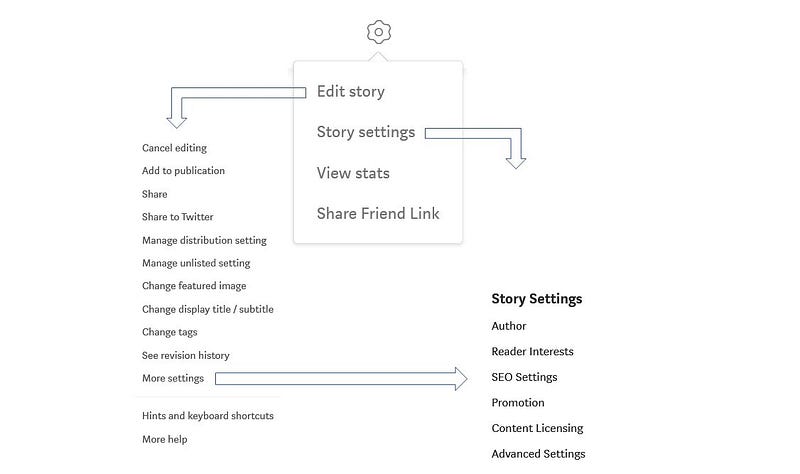
That advice is from “SEO settings,” accessible in several ways:
Source: Author’s collated image

From “SEO settings” you can check and, if necessary, improve, the SEO description for any of your stories — before or after publication.

It is worth checking similar settings on other platforms.

Conclusion

I hope these tips help add more value for readers, avoiding some easily made — and easy-to-fix — mistakes.

— — —

Writing
Writing Tips
Headlines
Books
Finance
Recommended from ReadMedium