
Two Elegant Proofs of the Pythagorean Theorem

Although one of the most well-known names in the mathematics world, we know very little about Pythagoras. Even though we named one of the most popular math theorems after him, we don’t even know if he was a brilliant mathematician or the leader of a terrorism-based cult, completely against innovation. Because we lack knowledge any deeper than legend from before 6 B.C., these traits will likely remain unknown.
Regardless, when we trace the past of the Pythagorean Theorem or a²+b²=c², i.e., the addition of the squares of the base and side of a right triangle equals the square of the hypotenuse, all clues lead to the time of Pythagoras and his cult. Modern discoveries, however, show that the Pythagorean Theorem was not unique to ancient Greece and was also used by the largest civilizations of the time, namely ancient China. To gain detailed information about the topic, you can read Frank Swetz, and T. Kao’s Was Pythagoras Chinese? An Examination of Right Triangle Theory in Ancient China.
But who first used the Pythagorean Theorem, and when? It is completely normal for you to first think of Pythagoras, but we don’t have any proof of that. We first see the Pythagorean Theorem and its proof in the 46th proposition of the father of Geometry, Euclid’s, Elements. In his book about Euclid, Proclus: A Commentary on the First Book of Euclid’s Elements, another Greek philosopher named Proclus comments that Euclid’s proof is incredible and that he deserves more recognition than Pythagoras himself.
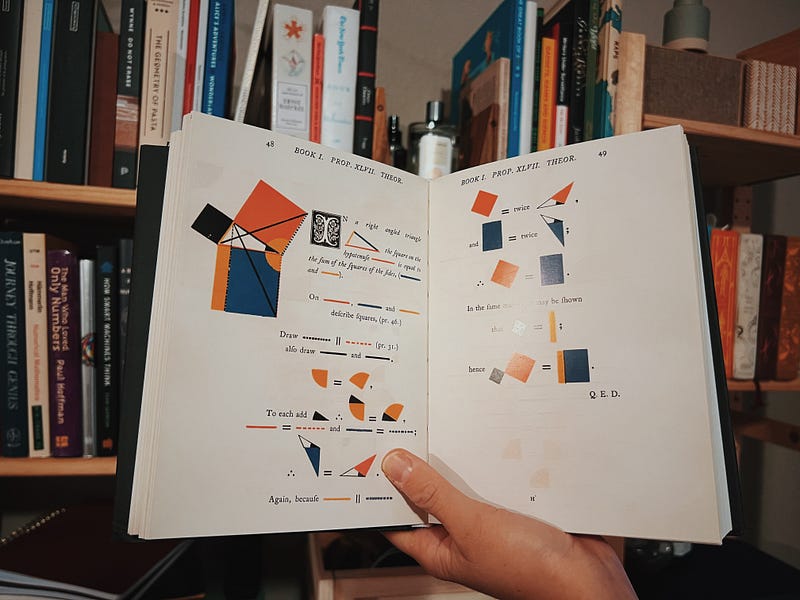
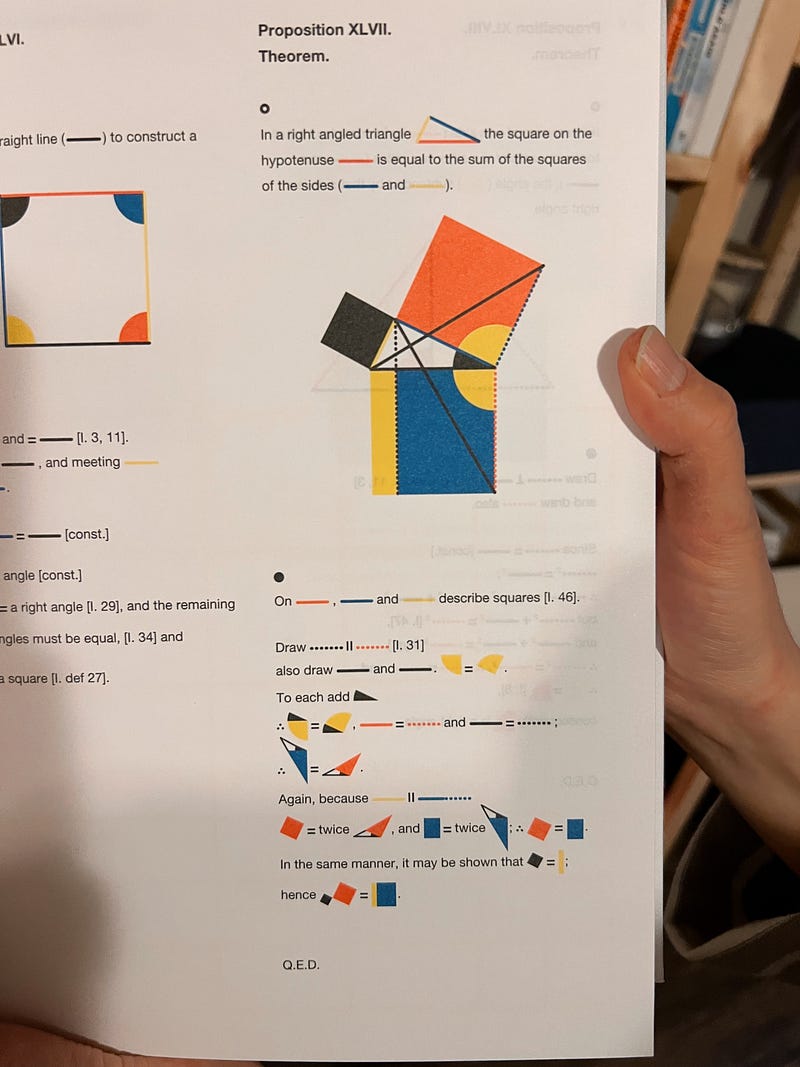
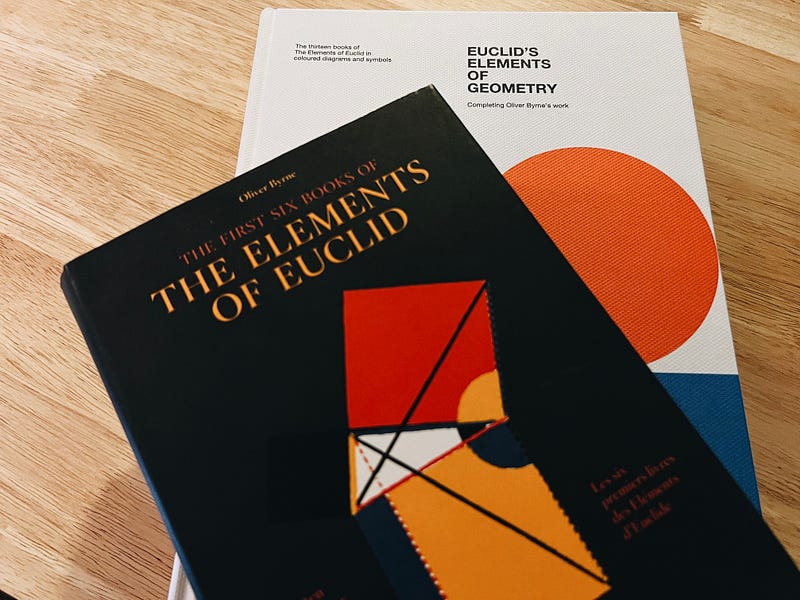
You can find my article about the great Euclid below.
Since then, hundreds of bright minds have proven the Pythagorean Theorem. However, you might be asking yourself if the theorem has already been verified, how can someone else confirm it? If a hundred people find a hundred different proofs of the same theorem, all one hundred of them will own the theory similarly. As a matter of fact, if you take a pen and paper and uniquely prove the theorem, you too will hold it similarly to everyone who has proven it before you.
That is why I want to share my favorite proofs of the Pythagorean Theorem with you.
Euclid’s Proof of the Pythagorean Theorem
It is best first to give the mic to Euclid. However, I won’t get into the details of the proof here as I plan to address that in another, more detailed article.
First, let’s draw a right triangle ABC. We then draw squares ABJK, ACHI, and BCDE on the AB, AC, and BC sides of triangle ABC. Then we draw a right-angled line from A to ED. Where it intersects BC, we name it G, and where it intersects ED, we call it F. This line also splits the BCDE square into two quadrilaterals, BEFG and CDFG. If you look closely, you will notice that KBC and ABE are similar triangles. Therefore, the area of square BAJK will be double the area of triangle KBC and square BEFG will have an area double that of triangle ABE.Furthermore, rectangles BAJK and BEFG will have equal areas, and likewise, square ACHI will have an area equivalent to rectangle CDFG. All of this information will then have proven to us that adding the area of squares BAJK and ACHI will equal the area of BCDE. Now, let us please applaud Euclid for this proof.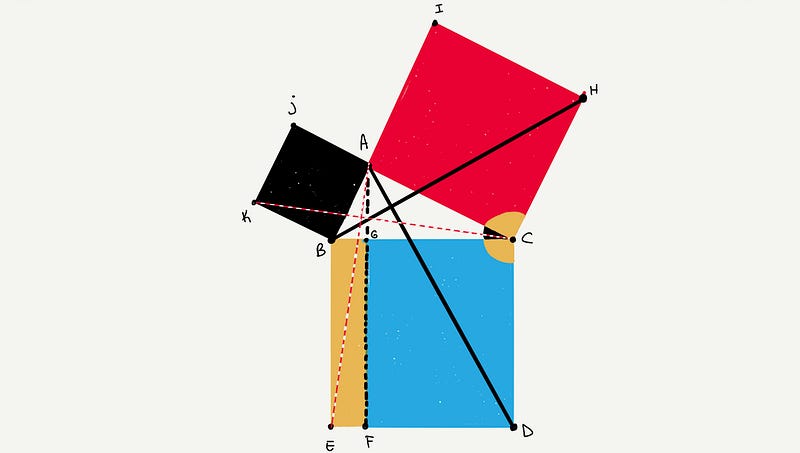
James A. Garfield’s Proof of the Pythagorean Theorem
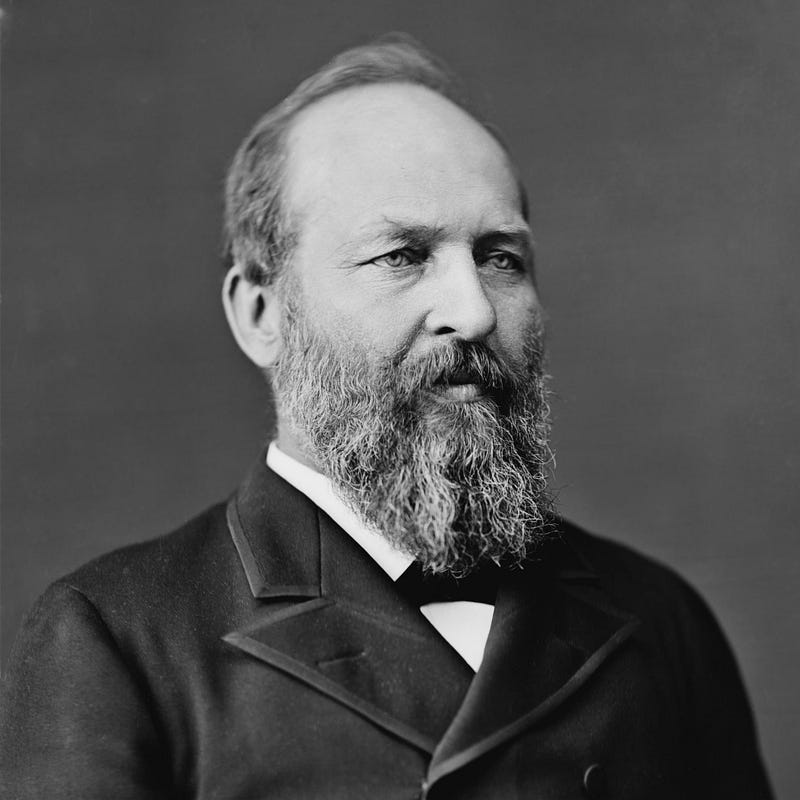
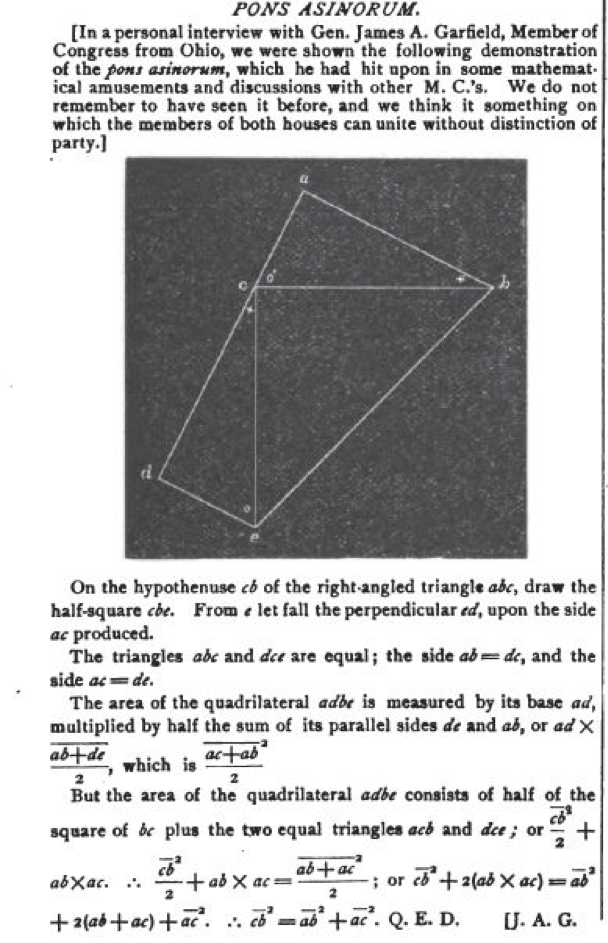
It comes with no surprise if I tell you that a thinker interested in mathematics proved the Pythagorean Theorem. HOWEVER, if I tell you that a politician sat down, away from political issues, and confirmed the Pythagorean Theorem, it is extremely surprising. Yes, the 20th President of the United States, elected in 1881, who served four months in office before his assassination, was incredibly fond of mathematics. This fondness and intrigue even led him to develop a proof of the Pythagorean Theorem.
Anyways, let’s return to President Garfield’s proof.
Garfield starts by drawing a right triangle BDE, similar to right triangle ABC. He then connects points AE, making the right triangle ABE. From these three triangles, Garfield then derives trapezoid ACDE. Finally, he calculates the area of trapezoid ACDE using two different methods.Then, he defines |BC|=a, |AC|=b, and |AB|=c, and since triangles ABC and BDE are similar, the following must also be true |DE|=a, |BD|=b, and |BE|=c. After defining the lengths of the sides, Garfield states that the area of trapezoid ACDE is equal to (a+b)²/2. Furthermore, he states that the area of the trapezoid must equal the combination of the areas of triangles ABC, BDE, and ABE. When he writes down the areas of the three triangles algebraically, he gets; ab/2 + c²/2 + ab/2. At the end of the day he gets, (a+c)²/2 = ab/2 + c²/2 + ab/2, and when he solves this equation, he gets a² + b² = c².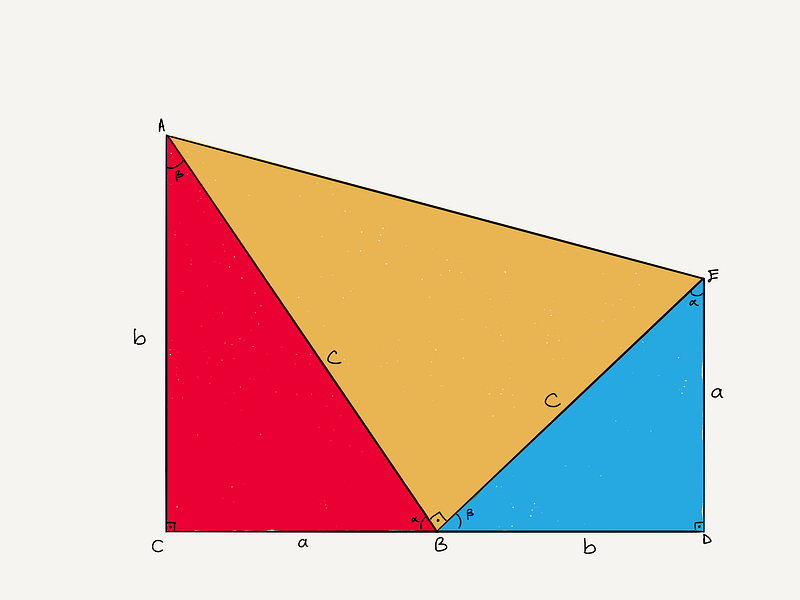
** Note: I might get commissions for purchases made through links in this post.


