
Understanding Euclid: A Simplified Approach to Mathematical Thinking
I remember that my mathematical education has started with numbers. First, my father, then later, my elementary teacher, taught me how to count as my elementary math education. However, 2400 years ago, everything was utterly different, and kids were taught geometry first.
Before Jesus, geometry was more important than numbers. For instance, when the founder of the first institution of higher education in the Western world, Plato, came back to Athens, he decided to found the “Academy” where it would be the intellectual center of the world (Wikipedia, “Plato”). For that purpose, instead of taking a nonrefundable application fee, he engraved “ΑΓΕΩΜΕΤΡΗΤΟΣ ΜΗΔΕΙΣ ΕΙΣΙΤΩ” (Translated from Greek as “Let no man ignorant of geometry enter here”) at the door of his academy to eliminate those who were opposed. Plato’s idea of the ideal world had a strong connection with beauty and intelligence, which were both well taught in mathematics. Later, a young man, Euclid of Alexandria, entered that door and became a mathematician and philosopher, and wrote a geometry book, The Elements, which went on to be the most famous textbook of all time and the most widely printed text after the Holy Bible and the Holy Quran (History of Information, “Euclid’s Elements”).
The Elements was so influential because it contained a comprehensive collection of important works in mathematics up until Euclid’s time (College of Education, “Eudoxus’ Influence on Euclid’s Elements”). Most of Euclid’s ideas came as revelations and laid the foundation for Euclidean Geometry. These ideas became the core of the teaching and understanding of geometry from over two thousand years up until today. For a long time, you were not viewed as educated if you had not read The Elements. Even today, when you read The Elements, it contains modern theories that remain relevant even today, which makes it extraordinary.
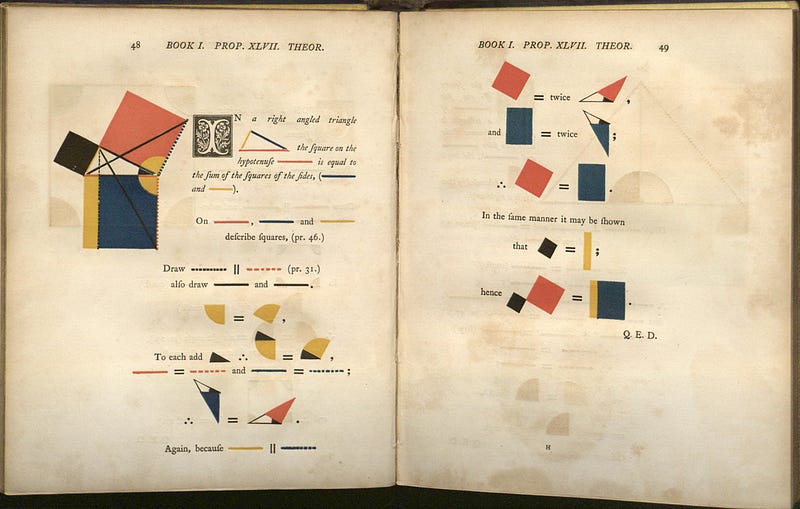
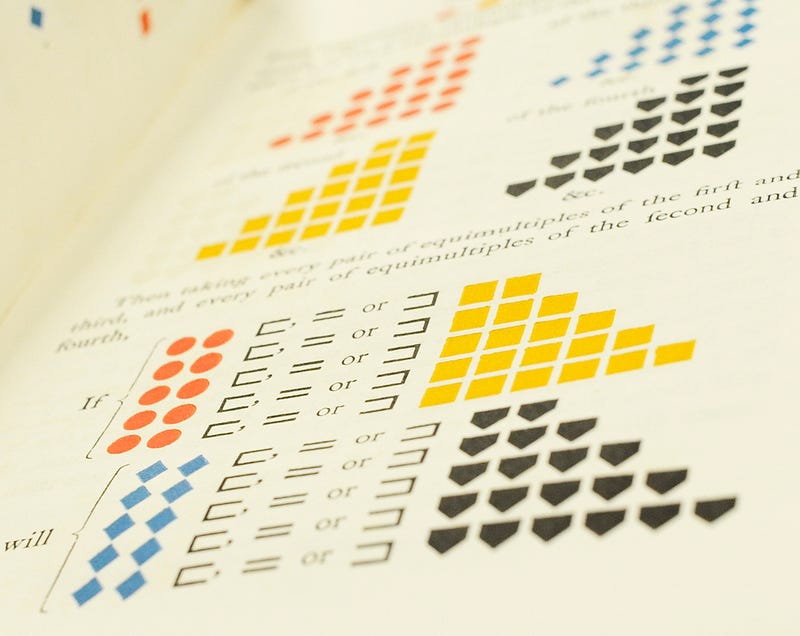
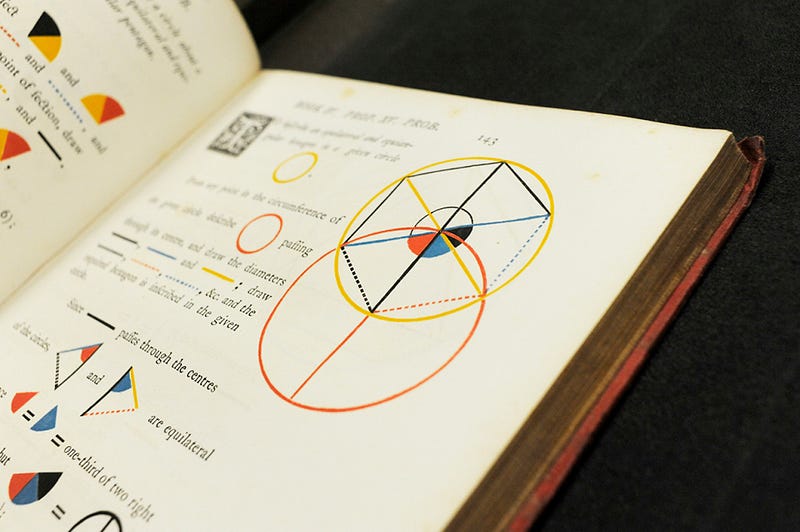
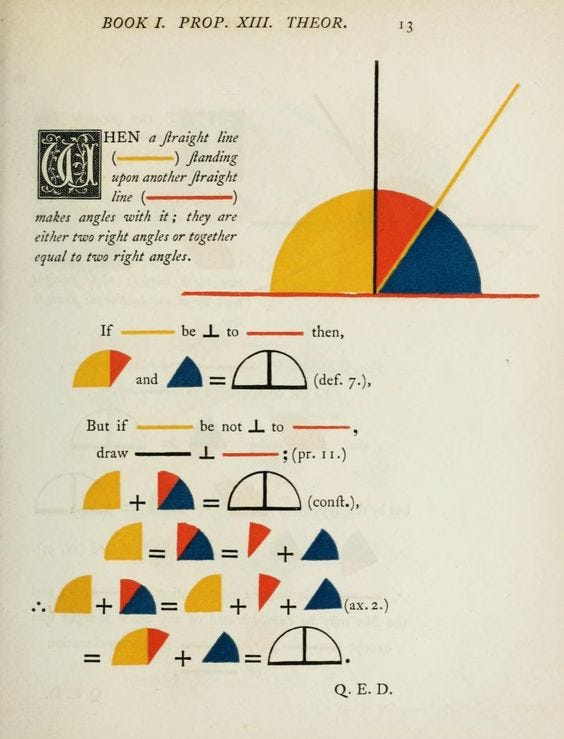
Euclid lived about 300 years before Christ. He was an adept example for those interested in mathematics. After his death, his ideas and published works that he produced became a converging point for genius minds. Learned persons were going to read his books to discover the power of their intellect even if they weren’t mathematicians.
For instance, more than 2,000 years after it was first written, Abraham Lincoln was reading Euclid’s Elements by lamplight to enhance his reasoning after everyone had gone to bed at the dormitory (Wikipedia, “Euclid’s Elements”). When he became president, he was still reading the same book to deduce its logic and give the right political decision while he was governing America.
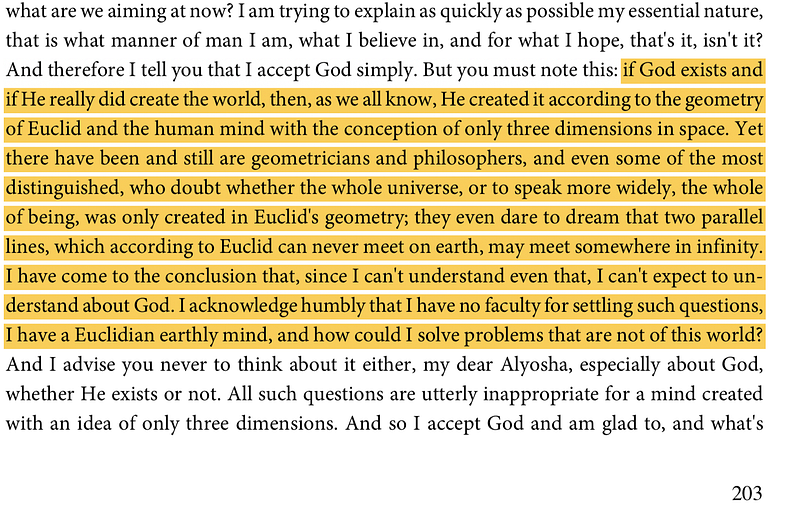
Similarly, novelist and philosopher Fyodor Dostoyevsky mentioned Euclid in his book, The Brothers Karamazov[highlighted below]:
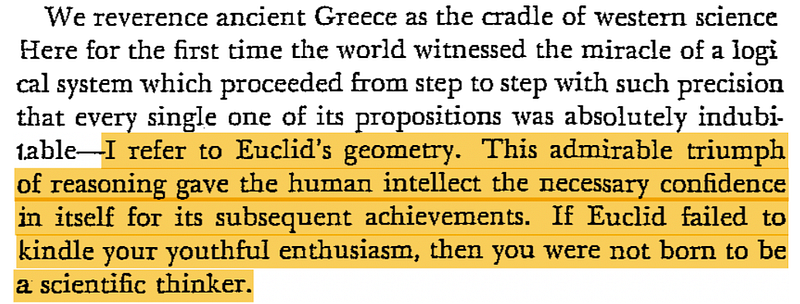
And a century after that, one of the greatest minds of all time, Albert Einstein, gave an even stronger endorsement to Euclid and his book in his essay On The Method of Theoretical Physics [highlighted below]:
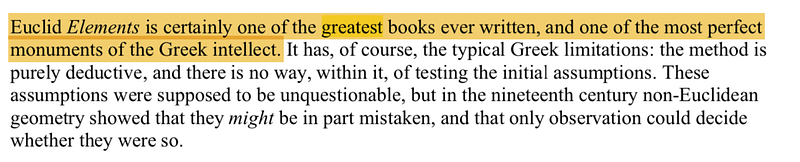
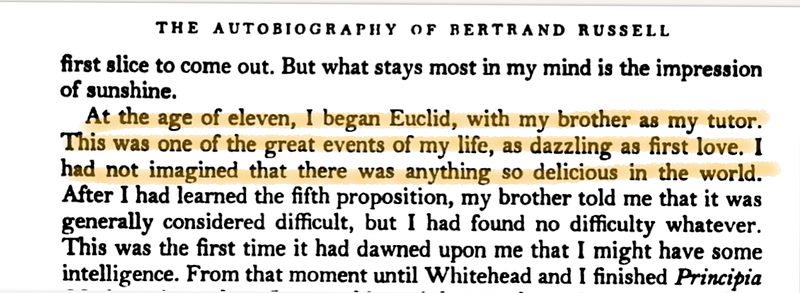
In Bertrand Russell (1872–1970) words, an elite philosopher of our time, we find a clear and concise assessment of Euclid: “Euclid’s Elements is certainly one of the greatest books ever written and one of the perfect monuments of the Greek intellect.” He also says in his autobiography: “At the age of eleven, I began Euclid, with my brother as my tutor. This was one of the great events of my life, as dazzling as first love. I had not imagined that there was anything so delicious in the world.”
Euclid was different from other people. We know almost nothing about his personal life, family, and non-mathematics curiosity; however, the one thing that we do know was that he was one of the most respected teachers of his time in the city of Alexandria. While others were working to afford food and shelter, Euclid was dealing with abstract ideas. He wasn’t interested in building and creating cities as much as he was in mathematical concepts. He realized that society was changing, and people needed a logical way of thinking to rule cities. That’s why this era saw a surge in theoretical ideas of mathematics.
He was a wandering man who freed himself from trivial problems, who discovered the truths that we can confirm today with satellite photographs, as he was sitting by the sea pondering the questions about the world we live in. He started his journey with nothing but a straightedge and a compass. These were the only tools that Euclid used for the whole of The Elements. First, he used his tools to draw two points and a line, from which he derived lots more exciting stuff for us to learn from. If we define mathematics as an intellectual journey, Euclid’s ideas are definitely the first steps. The view from Euclid’s window was a revolution that would be extended into space.

Indeed, in Euclid’s eyes, mathematics was so crucial because it is purely truth-oriented, and it has the beauty of art and value of abstract thought. His mathematical approach still stands as a perfect model of reasoning. He did something special that had not been done before. We may say his works were the beginning of the consideration of mathematics as an analytic deductive subject. He taught us a valuable lesson; that when we feel something intuitively is true, we need to prove that it is always true for everyone. He showed us the power of proof and a logical path that help us find universal truths. He turned mathematics into a subject that proves things with a hundred percent certainty and can be applied in diverse situations.
When you read Euclid’s Elements, you will notice that Euclid’s mathematical approach is unique and straightforward. He starts with basic assumptions such as if this is true, then this must be true, or if this is wrong, then the opposite of it has to be true. Then he either proves or disproves his assumptions, and concludes by writing the results as a theorem. What is important here is that Euclid chose to go for universality. He didn’t find temporary solutions for specific issues. He made a remarkable change and made the solutions universally applicable.
Let’s take a look at Euclid’s proof about prime numbers. There’s nothing particularly striking about prime numbers other than the fact that there are infinitely many of them. We are not 100% sure but have reason to believe that Euclid was the first human to prove there are infinitely many primes. His proof was also, most probably, the first proof ever in mathematics. However, it is essential to mention that Euclid never explicitly wrote, “there are infinitely many primes”; instead, he wrote: “prime numbers are more than any assigned multitude of prime numbers” (Clark University Mathematics, “Proposition 20”). The reason for this strange wording was since the idea of infinity was different than it was today and was a developing concept. [Translate from book IX]
I’m sure you’ve all come across prime numbers. Before giving Euclid’s unique proof, we should talk about prime numbers a little because the definitions are important parts of understanding mathematics. So, what is a prime number?
Definition: A prime number is a whole number bigger than one that’s divisible only by 1 and itself.The number 1 is an exception to this rule. Although 1 satisfies all the conditions to be prime, we don’t assume that it is a prime number for a good reason. It is because mathematicians need to make practical definitions. If one is considered a prime number, you encounter a problem when you apply a prime factorization for any number. For instance, if you do prime factorization for 15, you need to write:
18=2x3x3x1x1x1x1x1x1x1x1x1x1x1x1x1x1x1… .
I think this is a good enough reason to say one is not prime.
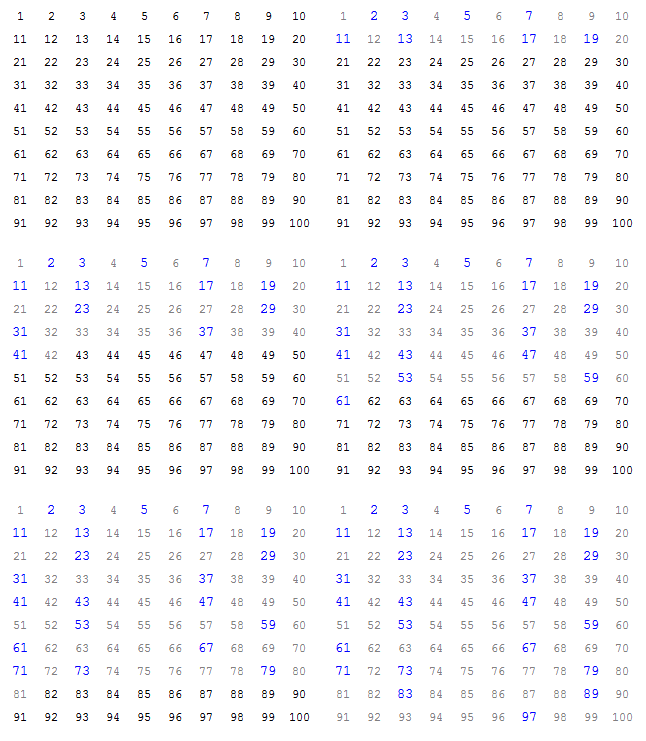
When Euclid discovered these intriguing numbers, he researched them and decided to reveal some mysteries. To begin with, he wrote the first few prime numbers on a parchment paper. For the sake of example, let’s say he wrote up to 100. Then he started looking for patterns because all mathematicians are interested in patterns. For instance, he saw that 2 is the only even prime number because all other even numbers larger than two were divisible by 2. Likewise, 3 was a prime number, but multiples of 3 couldn’t be prime because he could divide them by 3.
Then he asked himself: “If I continue writing, will I ever stop?” He hoped to have infinitely many prime numbers because otherwise, life would be tedious for him or any other mathematician after him. It was a very challenging question because he had to painstakingly check each number to see whether it was prime or not. There were no computers to do the calculations for him. Yes, it is quite easy to calculate whether 13 is prime or not, but each digit would take days or weeks after a certain point. Even if we had the chance to donate the most powerful computer in the world to Euclid’s institution, it still wouldn’t be enough to quell his curiosity. The computer could find a vast prime number, but we yet wouldn’t know whether that’s the biggest prime number. So, asking a computer to find big primes for us will never resolve the question of the biggest prime number.
Euclid had found numerous truths just by using the mathematics of his time. Since believing something was not enough to convince people, he had to look for perfect certainty one more time. Only then could Euclid could approach a mathematical way to do it. He just needed a brilliant idea and ended up with an elegant proof. That’s why he defined a theorem at first.
Theorem: Prime numbers are more than any assigned multitude of prime numbers.he proof was of great significance to Euclid because his theorem needed to be sound. He planned to use a thought experiment, which is a mathematical technique called proof by contradiction. First, he imagined that he lived in a parallel universe where there are finitely many prime numbers. Thus, he could write them on a list. It might be a very long list, but prime numbers are finite in his universe. He didn’t know the largest prime exactly, so he called it “p.” He got a huge piece of paper and wrote all the primes in the world. His list started from 2, 3, 5, 7 to up to “p,” which is [theoretically] the largest prime number. Euclid then came up with a fantastic idea: “I will multiply all those numbers together and add 1”.
He didn’t know what that number was, but it was a product of all the primes in his new world plus 1. He already knew that that number had to have a prime factor because every number bigger than 1 has to have a prime factor. [The Fundamental Theorem of Arithmetic] There remains the possibility that this number was itself prime.
The Fundamental Theorem of Arithmetic: Every integer greater than 1 can be expressed as a product of primes in an essentially unique way.In other words, they are the building blocks from which all numbers are made. Teachers like to say, "Primes are the atoms of mathematics."So, Euclid needed to check. Could that prime factor be 2? The answer was no because that number was two times some other number plus 1. So it had to leave the remainder 1. Could that prime factor be 3? The answer was no again because that number is three times some other numbers plus 1, and it leaves a remainder of 1. Could that prime factor be 5? No, because that number is five times some other numbers plus 1, it leaves a remainder of 1. For each prime, the same thing was going to happen. Euclid’s act of genius made his new number always indivisible by any of the primes on his list. Euclid’s number still left a remainder of 1 when he divided by any of the prime numbers he found. However, that number had to have a prime factor, as mentioned earlier. Thus, his logical argument reached an absurdity that this cannot happen. There was a contradiction in his parallel universe that cannot exist- there must be infinitely many primes.
What Euclid did a long ago was so beautiful because our finite mind could reach infinity with this approach. He expanded our horizons of knowledge. As I said above earlier, the view from Euclid’s window was a revolution that would be extended into space. For us, the possibilities of expanding the mathematical frontier should be thrilling.
Note 1: Beyond Euclid! is my weekly newsletter that brings you only high-quality math and science stuff to ensure you are having a good week. Please do yourself a favor by subscribing to Beyond Euclid and enjoy it! And if you can be a member and support my work, that would be awesome! Thank you!Note 2: I get commissions for purchases made through links in this post.


