
Why Writing Twitter Threads Helps Your Blogging Go Through The Roof
One Twitter thread has over 29,000 impressions.

You must have read some top writers here swear that LinkedIn is the best place to write today. Of course, there will always be a 'new' place to write but before you do, be sure that you're not spreading yourself too thinly, be on platforms that you are already using, and for me, it is Twitter.
I don't use Facebook a lot, but I have always been on Twitter, and if you check my Twitter handle, I have been on the platform since 2010.
It is a great place to practice getting your message across as a writer. From its humble beginnings when the character limit was 140 characters, now a tweet can have as many as 280 characters.
And if that isn't enough, then you have Twitter threads. I have shared this writing tool that I use to make Twitter threads, and with the update, it even converts it to a blog post.
How to create a thread on Twitter
A Twitter thread is like a series of tweets. Some call it a Twitter storm. You can write a collection of tweets directly on the app or the web. You can also make a previously published tweet into a thread by adding a new tweet.
But if you want to use a thread as a blog post, it is best to write your content first, or for writers, look for a writing prompt and use a Twitter thread writing tool to separate your content into several tweets.
You can read more information on the Twitter help page here.
One Twitter thread has over 29,000 impressions.
You can check my pinned tweet. It was a Twitter thread from which I wrote about a trending topic —'Elon Musk Reveals Satoshi Nakamoto Identity on Twitter.'
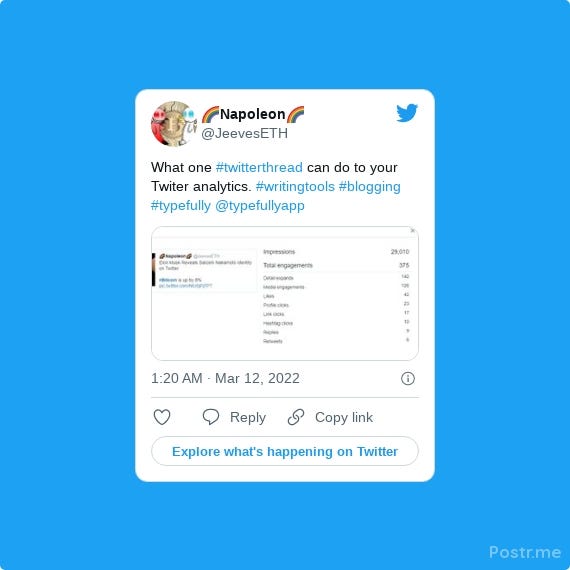
The screenshot has over 29,000 impressions and a few hundred engagements, including likes, retweets, and clicks to links.
And this is the secret sauce of a Twitter thread. Not only can you add GIFs, videos, and photos like on an ordinary tweet, but you can also add links.
And as a blogger, adding links to your website or blog means web traffic, and the only way you can grow your blog is with traffic.
And the beauty of Twitter is that it is a place where conversation happens in real-time. So even if people aren't your followers, people can find your tweets, or your tweets can find their way on their timeline.
Again, with traffic and engagement, people can start following you, especially if they check out your profile, something that you can add at the end of a Twitter thread, an invitation to click your profile where they read your pinned tweet.
Reading Time
While every social media platform has pivoted to short-form content in line with the minimal attention span of its audience, as a creator, you would like your audience to spend more time with your content.
If it is a video, you can only increase the watch time by making your videos longer, and in the same way with your blog posts or articles, longer stories mean longer reading time; long-form content still wins.
The only way to do that on Twitter is with Twitter threads.
Using more Twitter threads on my account, I gained more followers; I now have 2,184 followers. The metrics are also uptrend, from impressions to profile visits, mentions, and new followers.
In conclusion
As a blogger, the measure of success comes in different forms, but if you want to make money online, the primary metric to measure your success is the amount of traffic on your blog.
And there are many ways to bring in traffic. For example, you can pay for traffic, guest blog, or use social media.
If you are already on Twitter, use Twitter threads to amplify your blog posts, find new audiences, and increase traffic.
I once wrote, If no one reads your story: did it ever happen? The same is true on Twitter. Your tweets are just random unless other people see it or become a catalyst for meaningful conversations or if it can help your blog gain traffic, and Twitter threads can increase the chances of your tweet soaring high in a space that can be so fleeting.