
Turning a Hated Assignment into Fun Games
You might have heard that children in Finland don’t get homework from school. I was quite surprised when I heard about it for the first time.
Even more surprised was I to learn that the school my son attends in Aalborg, Denmark, changed their approach to become 99% homework-free. Their method is to motivate children to finish all of their assignments at school. If they haven’t accomplished them by the end of the week, they can take the textbooks and tasks home for the weekend. Parents then decide whether the children should do it that weekend or not. In the case of travel or otherwise busy weekends, the parents do not need to overload their children by making them do the assignments.
Such a system was both surprising and pleasant for all of us in the family. We didn’t have to fret and sit up until late at night for Niklas to complete his homework. Instead, he could relax, read, play inside and outside, do sports, watch movies and videos, or play on the iPad.
But at some point, a day came when Niklas brought an unfinished assignment home. An additional challenge to admitting that he hadn’t managed to complete what was asked of him, was the fact that he resented the exercise deeply. He thought it was absolutely and entirely BORING.
On top of that, it was for one of his favorite subjects, math. The exercise consisted of doing a large number of sums. That in itself wasn’t a problem. The problem was that the resulting numbers were attributed to different colors. And he had to color in an A4-sized illustration accordingly, to find out what the picture was of.
Coloring was for small kids, and not for a big seven-year-old school-boy, right?
My attempt to remind Niklas that he loved drawing didn’t bear any fruit because he immediately dismissed it by telling me that he enjoyed drawing something new of his own, not coloring in something predefined by others.
I could see myself in this reasoning and showed him my understanding. But there was no other choice: he had to do the task.
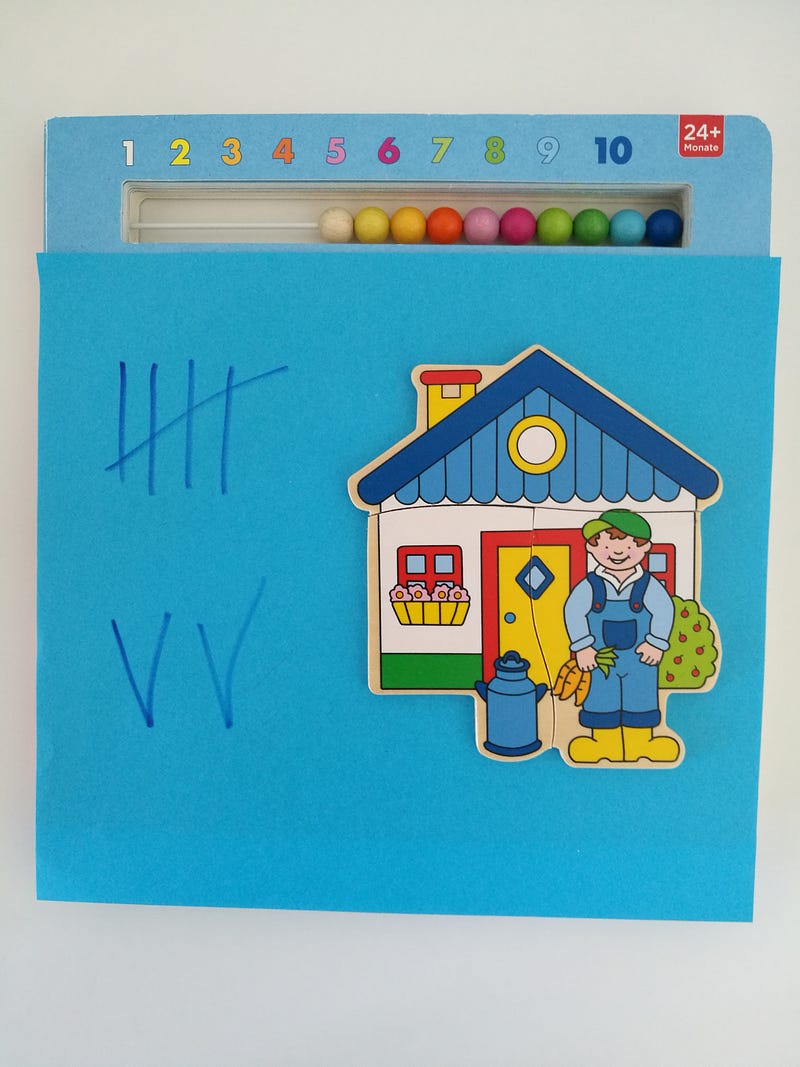
But how? I called on Self-Gamification for help. I shared the 5 Minute Perseverance Game with him, and my simple scoring system. “Let’s record a little line, or a check-mark or a cross, or any shape you like on a piece of paper for each segment you finish coloring,” I said.
Niklas’ eyes sparkled, and he agreed. He chose the check-mark sign to record his score for each point. But soon this wasn’t fun enough, and the recording of the score soon bored him too.
Intuitively and without much thinking, I suggested that I take an assignment I had to do but which I thought I didn’t like, sat alongside him, and recorded a point for each piece I had to accomplish. In the end, we could see who was faster and had gathered the highest score.
Now that was interesting! Niklas had some competition in me. He did spend some time checking out how my score was progressing and got a little nervous when it grew, and I started to gain on him (he was leading initially since I started gathering points later than he did). But this approach did help him forget most of the resistance and complaints that had initially prevented him from making any progress at all (once the gathering of points had become dull).
Two hours’ work on this assignment, including all the complaints and discussions, was taking its toll by the time Niklas had finished coloring forty out of the fifty segments (which I later counted out of curiosity). He started to moan again.
Then my husband — caught up with our gameful spirit — proposed a new little game to Niklas. Michael suggested that Niklas took an abacus — of which we have a few in our house, some of them integrated into fun books for children — and moved a bead to the left as soon as he managed to color one segment. In such a way he would see how many remained and that the number was decreasing with each he did.
Niklas was washed by a new wave of motivation, and he smiled brightly at this new possibility, and especially with the realization that he was close to the finish line.
And finally, Niklas had a surprise for us that he kept secret until he had finished the assignment. He had invented a game of his own. Or rather a feedback system of his own. He had made a drawing of a house which he drew line-by-line as he progressed with his coloring assignment segment-by-segment.
The results were terrific, in terms of both short and long term benefits for all of us.
The immediate results were a great atmosphere, the pride that the assignment was done, that he had managed to work for almost three hours in a row, and had fun for at least some of it.
Once the carrying out of the assignment became less stressful, Niklas had the chance to look at the reasons for the situation he was in non-judgmentally. He realized that if he talked less during school hours and hadn’t resisted the assignment so much, he would have managed to do all the work at school.
Since then (and this was over a year ago [over two years in 2020]), Niklas has managed to finish most of his assignments at school. After that fateful day, there have only been a few occasions when he has had homework to do. Even when he has had to bring homework with him on a Friday, such as after an illness at the beginning of that week or the occasional distraction and inattention, he has resisted the tasks much less and completed them much more quickly, and with barely any involvement from my husband or myself.
That day, when he turned his assignments into games for the first time, contributed to teaching him to take responsibility for his actions, without any feelings of guilt.
As I contemplated the main factors in Niklas’ success at gamifying his homework, I came up with the following conclusions:
- He needed the will to play and see the homework as a game. And he was intrigued by that possibility.
- He needed a co-player and a competition to compare his score to someone else’s. My work and my willingness to face a similar challenge to him served this purpose well.
- He needed to see the finish line. Each game requires a definition of the finish line, of a goal, and to be able to see how far it is from where the player stands. It might be defined by a time limit, reaching a specific score, or exhausting resources. His father’s suggestion with the abacus helped Niklas to see the finish line and how much effort he needed to invest to reach it.
- He needed to be in control and plan his own moves. He also needed to be creative and be the designer of his own game. Designing his game and coming up with his own solution, in addition to those suggested by us, was an essential factor. Creating his own games (and its components) was a critical component and condition for my son to practice Self-Gamification.
These four factors resulted in success and in a win-win situation for all players (my husband and I were players in this too through our active involvement and interest).
I also believe that this memorable experience was only made possible by the thread that ran through all of it — namely, concentration on the fun factor. We were on the look out for tools and solutions that would make the task at hand fun. This is what we do when we want to play games: we are looking for fun. And it is simply a gift if we apply the same approach to everything in our lives.
With our help and his own will to play, Niklas managed to concentrate on the possibility of having fun, rather than on his complaints and dismay at having to do something he didn’t want to.
That was an excerpt from my book Self-Gamification Happiness Formula: How to Turn Your Life into Fun Games. I hope you enjoyed reading it, and it gave you ideas on how you can support your children during homeschooling or with homework after re-opening and with turning the assignments into fun, for them, activities. I invite you to check out the other resources on Self-Gamification here: victoriaichizlibartels.com/gameful-life/.

Are you struggling to motivate yourself to start the day, to work on a project, or maintain a healthy habit? Do you think that happiness is hard earned and reserved only for the ”chosen ones”?
This book will show you that happiness is close by and available to everyone. It will show you how to not take life too seriously and still be excellent in all you want or have to do.
Read the book and learn how to motivate yourself by practicing Self-Gamification — a unique self-help approach to implementing game design elements into your life.
Master three skill sets to be successful in your self-motivational game design, your projects, and your life:
- See yourself, the world around you, and your thought processes non-judgmentally, as an anthropologist would do.
- Identify your dreams and goals, and take action, one small and effortless step at a time, the kaizen way.
- Apply gamification, that is see and treat whatever you are up to as a game: design, play, and improve your (life) games, and learn to appreciate every step on the way by giving yourself points, badges, stars, and other small symbolic rewards.
Answering the questions and completing the various exercises in the book will allow you to practice the three skill sets of Self-Gamification as you go along.
Apply anthropology, kaizen, and gamification together to practice Self-Gamification, a unique approach that will help you turn happiness into a lifestyle.