avatarYury Erofeev

Free AI web copilot to create summaries, insights and extended knowledge, download it at here

1480

Abstract

olar generation ranged from -0.08 to -0.14. In this way, wind-solar hybrid power plants can maintain a more stable generation profile because the output from one source is relatively higher while the other produces less electricity.</p><figure id="5be9"><img src="https://cdn-images-1.readmedium.com/v2/resize:fit:800/0*gR3nwV5F2O9uRiQ6.jpg"><figcaption>Ember’s data can be found on their website <a href="https://ember-climate.org/insights/research/turkiye-can-expand-solar-by-120-gw-through-rooftops/"><b>here.</b></a></figcaption></figure><p id="066a">Turkey is going to install 5 gigawatts of solar and wind energy capacity every year, said the country’s Energy Minister Alparslan Bayraktar, speaking at the Russian Energy Week in Moscow in October 2023. That is, in total, by 2035, Turkey plans to build 60 GW of solar and wind power plants.</p><p id="f749">In January of this year, the Turkish government published the National Energy Plan. According to the document, in 2035 the installed capacity of solar energy will reach 52.9 GW, and wind energy will reach 29.6 GW, and they will generate more electricity than coal and gas.</p><p id="499d">Europe’s largest solar power plant with a capacity of 1.35 GW was opened in Turkey last May.</p><p id="298f">Read more updates about the global energy markets and energy transition strategies in the publication <a href="https://medium.com/areas-producers"><b><i>Areas & Producers</i></b></a>.</p><div id="67a5" class="link-b

Options

lock"> <a href="https://readmedium.com/investments-in-energy-transition-reach-record-levels-in-2023-d7c1aa2c3ac7"> <div> <div> <h2>Investments in energy transition reach record levels in 2023</h2> <div><h3>Research firm BloombergNEF (BNEF) has published the latest edition of its annual new energy investment report, ‘Energy…</h3></div> <div><p>medium.com</p></div> </div> <div> <div style="background-image: url(https://miro.readmedium.com/v2/resize:fit:320/0*UcWPfOF9YndpcrSY.png)"></div> </div> </div> </a> </div><div id="722b" class="link-block"> <a href="https://readmedium.com/energy-news-cop-28-president-sultan-al-jaber-praises-energy-leadership-at-world-government-319ce1db0ea0"> <div> <div> <h2>Energy News — COP 28 President Sultan al-Jaber Praises Energy Leadership at World Government…</h2> <div><h3>COP28 President Sultan al-Jaber, who is also chief of the UAE’s oil and gas giant ADNOC, stated his positive outlook on…</h3></div> <div><p>medium.com</p></div> </div> <div> <div style="background-image: url(https://miro.readmedium.com/v2/resize:fit:320/0*7eLR1h-C-8F_yMXo)"></div> </div> </div> </a> </div></article></body>

Turkey’s installed solar energy capacity reached 12.2 GW at the end of 2023

Photo by Fatih Yürür on Unsplash

According to official statistics, by the end of 2023, Turkey’s installed solar power capacity reached 11.7 GW, and wind power capacity reached 11.8 GW. However, according to think tank Ember, this data does not include solar capacity installed in hybrid power plants. Turkey had installed 510 MW of such “secondary” solar capacity as of early 2024, according to the Turkish Energy Market Regulatory Authority (EMRA) database.

Thus, the total solar energy capacity was 12.2 GW. This is more than the wind power capacity operating in the country at the end of last year (11.8 GW).

As for the main generating resource of hybrid power plants, wind power plants dominate here. 63% of the “secondary” solar capacity is installed in 14 power plants, and the main source of energy of which is wind.

Solar and wind energy are complementary resources due to the inverse relationship between their hourly generation. In Turkey, between 2021 and 2023, the hourly correlation of wind and solar generation ranged from -0.08 to -0.14. In this way, wind-solar hybrid power plants can maintain a more stable generation profile because the output from one source is relatively higher while the other produces less electricity.
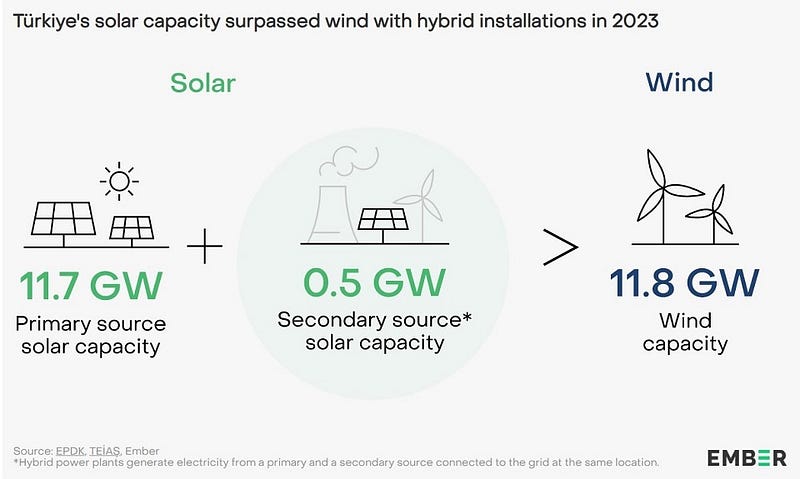
Ember’s data can be found on their website here.

Turkey is going to install 5 gigawatts of solar and wind energy capacity every year, said the country’s Energy Minister Alparslan Bayraktar, speaking at the Russian Energy Week in Moscow in October 2023. That is, in total, by 2035, Turkey plans to build 60 GW of solar and wind power plants.

In January of this year, the Turkish government published the National Energy Plan. According to the document, in 2035 the installed capacity of solar energy will reach 52.9 GW, and wind energy will reach 29.6 GW, and they will generate more electricity than coal and gas.

Europe’s largest solar power plant with a capacity of 1.35 GW was opened in Turkey last May.

Read more updates about the global energy markets and energy transition strategies in the publication Areas & Producers.

Turkey
Energy
Solar Energy
Technology
Climate Change
Recommended from ReadMedium