
Trump’s New Conspiracism
I thought I had a “natural instinct” for science, just like Trump. I was every bit as wrong.
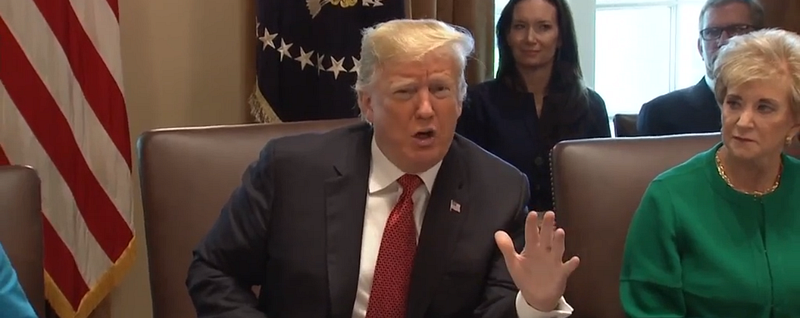
Donald Trump at a meeting of his cabinet on October 17:
“I have a natural instinct for science.”
In early 2006, paleontologists Edward Daeschler, Neil Shubin, and Farish Jenkins published their formal description of Tiktaalik roseae, a 375-million-year-old four-limbed fish closely related to the ancestor of all land animals.
I was rather annoyed.
Like our current president announced last week, I believed I had a natural instinct for science. I knew a lot of details about, natural history, and I was well-practiced at explaining away any evidence that didn’t fit my belief in a recent creation, a global flood, and a young universe. I had all the basic answers taught in creationism: radiometric dating is inconsistent, entropy somehow prevents evolution from working, and fossil layers only form quickly.
What’s more, I was pretty good at coming up with new explanations on the fly. The formula was simple:
- Ask a thoughtful-sounding, probing question with no immediate answer;
- Express vague suspicions about science in general; and
- Repeat the standard creationist talking point with a knowing smile.
The trick was doing all of the above with as much confidence as I could muster.
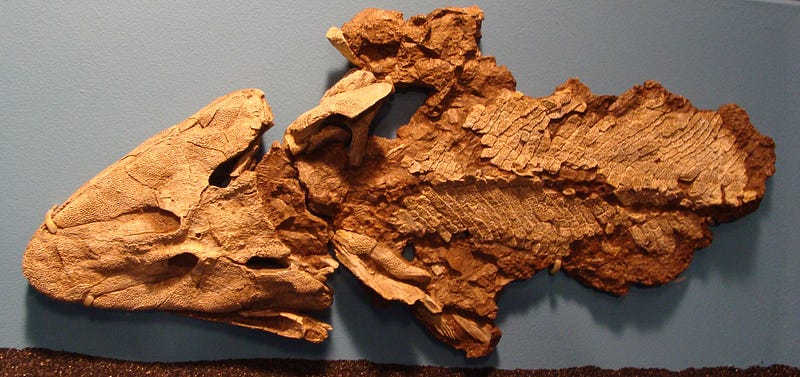
But the 2006 announcement of Tiktaalik was really annoying. Even though I didn’t fully grasp just how important this discovery was, there was something about the little four-limbed “fishapod” that I couldn’t readily explain away. That posed an immediate problem; if I didn’t have a quick explanation, could I really claim confidence about my beliefs? Was my faith really strong? Feeling much less confident than I sounded, I typed out a short response on my personal blog:
In the Enquirer article, Tiktaalik was called “the” missing link in the line between land and sea. But if evolution is true, we should find an unbroken path between all “transitions”. And we have no transitional form “between land and sea” now, so how can this be “the” missing link? Shouldn’t we find hundreds? Unfortunately for the evolutionists, all the missing links are still missing.
At the time, it was the best I could do on short notice. Some answer, even one I knew really didn’t make sense, was better than no answer at all. It was the only way I could continue buttressing my belief that it was reasonable of me to reject evolution, climate change, and everything else that challenged my beliefs.
Trump’s claim of “a natural instinct for science” comes from the same region of ignorance. Of course, the GOP’s war on science is nothing new; conservatives have opposed environmental initiatives from the very beginning, and so this administration is simply following a long-established trend by pulling out of the Paris Agreement and disbanding the EPA advisory panel on air pollution. Bowing to pseudoscience and conspiracism has long been the unwritten rule for the right. What makes this president different?
Science denial usually couches itself in terms designed to appear as reasonable as possible. The goal is not to convince, but to delay decisions and obscure consensus. Deniers use arguments intended to create the illusion of uncertainty:
- “Teach the controversy.”
- “Let’s hear from both sides.”
- “You know, there are scientists who have other interpretations.”
- “We only want an honest debate.”
- “That’s just one possible theory.”
Pseudoscience survives the court of public opinion by maintaining a false sense of controversy. It doesn’t need to persuade anyone that it is true; it only needs to sow doubt. Science denial is designed to provide a veneer of respectability for its adherents, concealing its ideological and political ends in the guise of “reasonable disagreement” and “free speech”. As long as science deniers can portray themselves as rational skeptics earnestly seeking the truth, they have done their job.
Like those before him, Trump cites imaginary dissent and promotes science by anecdote. His Twitter is replete with glaring examples:
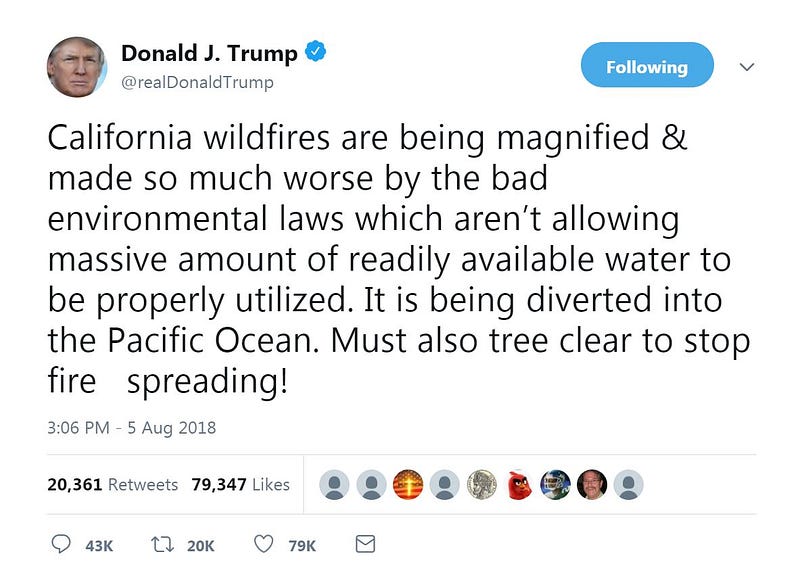
But Trump goes beyond the conservative norm by displaying the real, underlying basis of his science denial:
“Some say [climate change is becoming irreversible] and some say differently, I mean you have scientists on both sides of it.
“My uncle was a great professor at MIT for many years. Dr. John Trump. And I didn’t talk to him about this particular subject, but I have a natural instinct for science, and I will say that you have scientists on both sides of the picture.
“I agree the climate changes, but it goes back and forth, back and forth. So we’ll see.”
Is this self-aggrandizing nonsense yet another delusion of grandeur by an increasingly unhinged would-be dictator? Well, yes. But it’s also a poignant example of the thought process underlying science denial everywhere. I know this, because I had the exact same conviction. Like Trump, I just somehow knew that the consensus had to have a fatal flaw somewhere. If I puzzled through it long enough, an alternative explanation would surely reveal itself.
I told myself the same story I’d always heard: “mainstream” scientists only interpret data a particular way because that’s what they’d been taught to look for. I wasn’t tied down to the preconceptions of the mainstream dogma, so my “natural instinct” for the truth would win out every time. In a classic display of rugged American individualism, I could pick the science I wanted to accept and discard the rest.
Fortunately, my confidence wasn’t quite enough to leave it at that. I wanted to understand, to know more, to prove what I believed. And so, in my pursuit of proving science denial, I discovered actual science. I found, over the course of years, that my “natural instinct” was actually not that good at spotting the difference between science and science fiction.
Sadly, Trump doesn’t appear anywhere close to reaching a similar revelation.
David MacMillan is a freelance writer, paralegal, and law student in Washington, DC and features in the 2019 independent documentary We Believe In Dinosaurs, now streaming on demand. His upcoming book explores the impact of science denial in America and what it took for him to leave it behind.


