
A Tale of Two Pandas and One Creationist
Adapted from my forthcoming book on how I left science denial
I’m often asked whether there was a single defining moment when I realized young-earth creationism was a lie. The answer is yes: one breathtaking image of a distant barred spiral galaxy plowing deep into the heart of a galaxy cluster.

I always explain, however, that this dramatic conversion moment was only made possible by a long and often frustrating series of slow, incremental steps toward the truth. The image I saw would have failed to convince me just a few years earlier. It took a long time before I was comfortable enough with science to follow the evidence without bias or filters.
I believed, as creationists like Ken Ham taught relentlessly, that “historical science” was somehow different than the rest of the scientific method, and was inaccessible apart from a sweeping set of biases — either creationist and biblical, or evolutionary and atheistic — that defined conclusions in advance. Ham’s organization, Answers in Genesis, often cautioned followers like me that science alone could never prove creationism true.
This dramatic conversion moment was only made possible by a long and often frustrating series of slow, incremental steps.
I mostly accepted Ham’s cautions about proving creationism, but I still wanted to try. I knew evolutionary biology had an impressive record of demonstrating nesting hierarchies in the tree of life, using independent evidence from genetics, morphology, and paleontology, and I wanted to understand why. If common descent wasn’t true, I reasoned, the young-earth creationist paradigm should be able to provide an even more compelling and complete explanation for the evidence.
I came to realize that the mainstream narrative was compelling because of the way Answers In Genesis strove to provide answers for everything. I had grown up immersed in reasons to reject evolution, from genetics and information theory to design and missing links. But in their efforts, they’d unintentionally tripped themselves up.
I remember reading the following passage in an old copy of Creation magazine. It was republished in 1995 from an earlier printing of Creation ex nihilo in 1986:
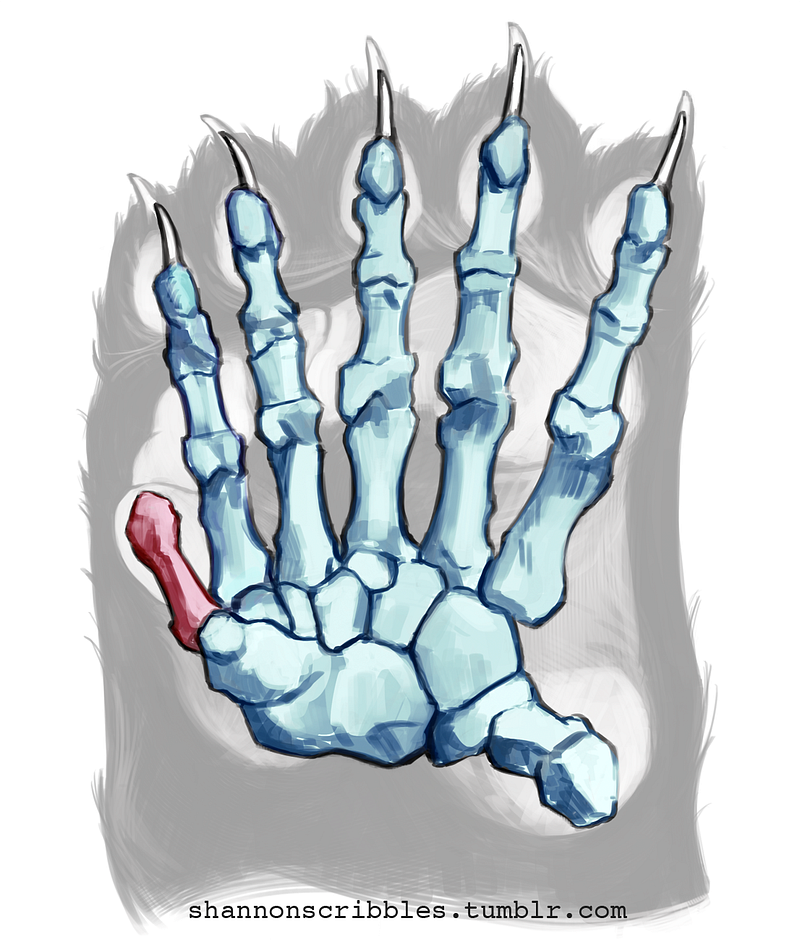
The raccoon-like Red Panda is supposed to show us good proof of evolution. We are told it is a meat-eater that no longer eats meat; it has razor-sharp claws and a vicious bite that it rarely attacks with; and it has supposedly evolved a small ‘sixth finger’ on its front paws from the wristbone.
How can we creationists answer this evidence for evolution? Simple. The panda is classed as a meat-eater (carnivore) mainly by its jaws, teeth and feet. And while pandas will eat some meat, they prefer bamboo, fruit and plants.
Yet we find there is no evidence their ancestors were anything but vegetarian pandas. (In fact, zoologists still can’t agree after more than a century on what pandas evolved from.) The Red Panda’s sharp claws and vicious bite are not left over from a time when their ancestors attacked and defended themselves from other animals. They have no enemies other than man. Their claws simply help them climb trees easily. And their strong jaws and teeth are needed to snap and crunch their huge daily meals of bamboo.
The ‘sixth finger’, or pseudo-thumb, is simply an enlarged radial sesamoid — a wristbone that helps the panda grasp the bamboo stems it eats. This ‘thumb’ is larger in the Giant Panda because it eats larger bamboo stems.
These traits don’t show us evolution. They show us that pandas are a unique creation of of God — perfectly adapted for the life God intended for them.
This remains on the Answers in Genesis website to this day.
The sixth digit shared by red pandas and giant pandas is considered a uniquely obvious instance of parallel evolution. Despite their shared name and common lifestyles, the two species are no more closely related than cats and hyenas. Yet, because they are both members of Carnivora, their shared ancestry means they share the same genes for expression of the radial sesamoid bone. Both the red panda and the giant panda experienced mutations to that gene set which caused enlargement of the radial sesamoid like an opposable thumb, enabling them to grip and manipulate their diet of bamboo.
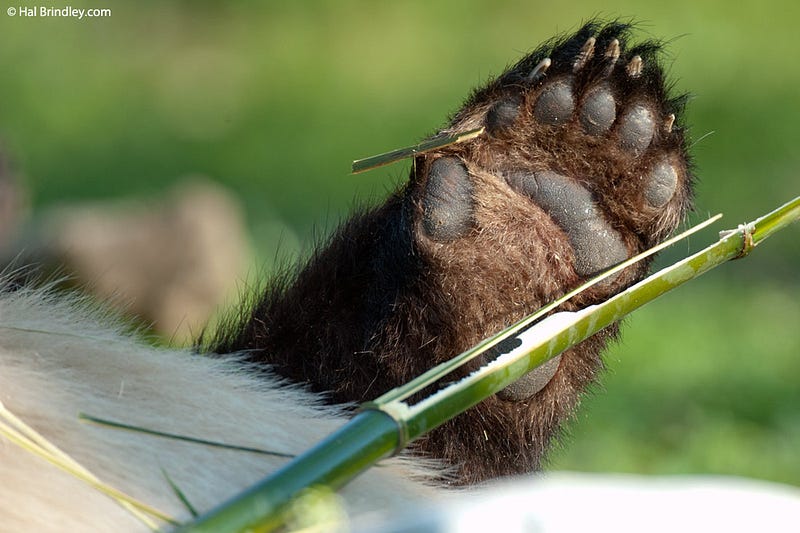
I’ve written before about how the push to reduce the population onboard the Ark has dramatically blurred lines that used to be held sacrosanct by creationists. In 1986, when this article was originally penned, no creationists ever dreamed of admitting that giant pandas might share a common ancestor with other bears. Even as late as 2001, an article in Creation explained:
It stretches belief that random mutations could have produced such a wonderfully useful appendage as the panda’s thumb, complete with working muscles all in the right places.
My assessment therefore is that giant pandas were originally created as their ‘own kind’, already endowed with their distinctive characteristics that suit them superbly to their specialized mode of life.
While Creation Ministries International still has this article on their website, Answers in Genesis has carefully scrubbed it. In 2012, AIG’s Jean Lightner wrote:
There are five genera and eight species of bears. Some have questioned the inclusion of the giant panda in this family because it has some unique characteristics. However, morphological and molecular evidence support its inclusion here. …based on the extensive hybrid data and strong cognitum, the family seems to correspond to a kind.
As a result, the Answers in Genesis website is now in the awkward position of arguing that the slightly-enlarged radial sesamoid in red pandas is clear evidence of design, but the larger and more pronounced radial sesamoid of giant pandas is ordinary microevolution within the “bear” kind.
Gaffes like these led me to look closer at the evidence for evolutionary biology. Aided by Ken Ham’s ever-shrinking Ark manifest, I came to realize that there really were no barriers to evolutionary change. Creationists argued that the long neck, rough tongue, and specialized anatomical features of the giraffe were evidence of special design:
Lamarck and later Charles Darwin proposed that a giraffe evolved a long neck by inheriting traits acquired through use and disuse. A modified idea suggests that the long neck evolved through mutation and natural selection, which favored those giraffes that could reach higher branches. Such an idea raises the question: What did the younger giraffes eat, and why do giraffes even today often eat at shoulder height and below? More importantly, the proposed progression from short to long-necked giraffes is absent from the fossil record.
How many giraffes blew their brains to pieces when bending down-how many passed out as they lifted their heads, becoming food for the lions-until the special features somehow evolved? It’s obvious that the very first giraffes had to have these special features right from the beginning.
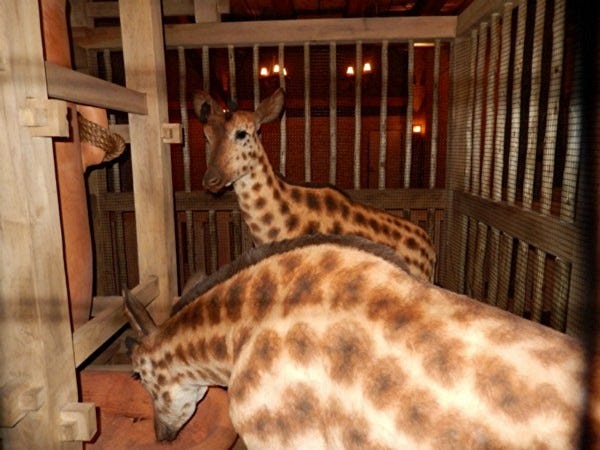
Yet when the Ark Encounter opened in 2016, they displayed a hypothesized giraffe-okapi hybrid, admitting that the two species shared a common ancestor.
I maxed out my university’s inter-library loan allowance to download as many biology papers as I could. If giraffes and okapis, giant pandas and black bears, saber-toothed cats and cheetahs could each share common ancestors, what would stop all carnivorans from sharing a common ancestor? What would stop carnivorans from sharing a common ancestor with ruminants? Why not go all the way back?
In time, I realized that evolutionary biology just…worked. I was still a creationist, believing that the universe was young and that the Flood myth was true, but I accepted that evolution was a valid paradigm. In 2011, I read an article by fellow creationist Todd Wood that resonated deeply with me:
Evolution is not a theory in crisis. It is not teetering on the verge of collapse. It has not failed as a scientific explanation. There is evidence for evolution, gobs and gobs of it. It is not just speculation or a faith choice or an assumption or a religion. It is a productive framework for lots of biological research, and it has amazing explanatory power. There is no conspiracy to hide the truth about the failure of evolution. There has really been no failure of evolution as a scientific theory. It works, and it works well.
I say these things not because I’m crazy or because I’ve “converted” to evolution. I say these things because they are true. I’m motivated this morning by reading yet another clueless, well-meaning person pompously declaring that evolution is a failure. People who say that are either unacquainted with the inner workings of science or unacquainted with the evidence for evolution. Creationist students, listen to me very carefully: There is evidence for evolution, and evolution is an extremely successful scientific theory.
It made far too much sense.
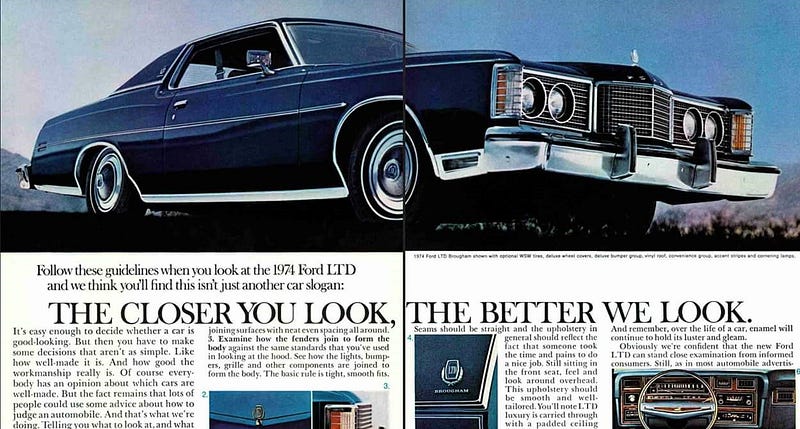
In the 1970s, Ford ran an ad campaign around the slogan “The Closer you look, the Better we look.” I found that the closer I looked at all the research surrounding evolutionary biology, the more convinced I became of its validity. There was no “information barrier” to prevent new attributes or mechanisms from arising. The tree of life made sense. I was still a young-earth creationist, but I came to realize that evolution could be true, if only the world was old enough.
When I finally saw evidence for the true age of the universe, I was ready to accept it.
David MacMillan is a freelance writer, paralegal, and law student in Washington, DC and features in the 2019 independent documentary We Believe In Dinosaurs, now streaming on demand. His upcoming book explores the impact of science denial in America and what it took for him to leave it behind.
Originally published at https://pandasthumb.org on June 22, 2019.


