
Transportation in India
The daily adventure of getting from Point A to Point B!
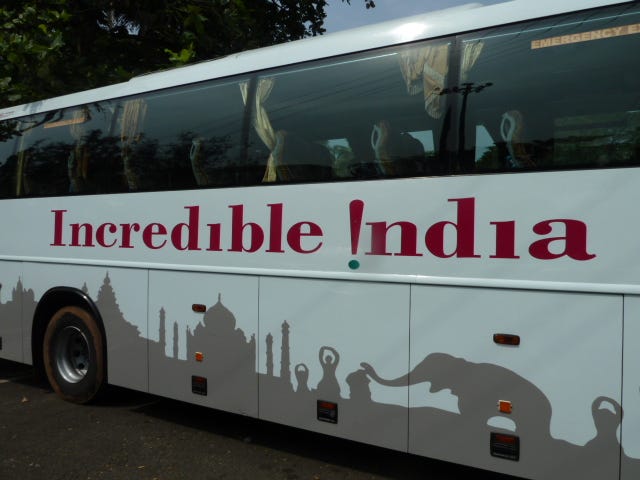
I have been to India twice: in 2006 and in 2013–2014, approximately three months for each trip, covering predominantly different areas for each trip, with minimal overlap (Delhi, Dehradun, and Rishikesh on both visits).
I will cover these modes of transport in the order in which I used them as an independent traveler on both trips. If you are going on a tour of some sort, it is highly unlikely that you will have to use anything but your private deluxe tour bus.
Taxi from the airport: a quick intro to driving techniques
Upon contemplating my departure from DEL (Indira Gandhi International Airport, Delhi) I was besieged by men who exhorted me to hire them to drive me into town in their taxi. Fortunately, I had already been given a heads-up about the best departure tactic: a prepaid taxi. The prospective passenger goes to a ticket window in the airport, buys a voucher for a fixed price, and then “pays” the driver with it upon reaching the destination. I opted for that as a means of avoiding the hassle of haggling over price.
My driver, Ashok, was very helpful on the ride from the airport to my hotel. As we weaved in and out of the heavy traffic, he was able to answer a lot of questions about what I was seeing.
One of the first road signs to make an impression on me declared LANE DRIVING IS SAFE DRIVING. This is the suggestion to the millions of madmen behind the wheels that it may be a good idea to stay in your delineated lane of traffic, rather than scoot around others by traveling between the lanes. It is a suggestion that very few drivers appear to take seriously, which results in a four-lane road having as many as six or sometimes even seven vehicles stretched across it. The scale diminishes as the roads narrow, but the same principle always applies: if you see a free space, head into it. Think about the free-for-all of bumper cars at your hometown state fair.
This is the relative luxury of a private taxi, complete with air conditioning. Why not arrive in style? At the cost of 750 INR (Indian rupees), it was probably one of the more expensive ways to go, but with the exchange rate of 44 rupees to the dollar, $17 was not so bad.
[Note about prices in rupees: during my first trip, 2006, the exchange rate was 44 to the dollar; at this writing, 2022, it is 80 to the dollar. Please take that into account. On my second trip, the prepaid taxi was 385 INR = $6.12 US]
I chose to sit in the front with Ashok, and since the cars are designed for driving on the right-hand side of the road, I was in what would be the driver’s seat back at home, which is always a bit disorienting for me.
Many commercial vehicles bear signs painted on their rears, admonishing other motorists, KEEP DISTANCE. Those are easy to understand, but I did need to ask Ashok what it meant on the back of a vehicle when somebody paints on it HORN PLEASE.
This is a request for the passing driver to honk the horn so that the driver in the vehicle being passed knows he is being passed. Now, THIS is a suggestion that all drivers are all too happy to follow. There is lots of horn honking here!
One sign needed a bit of explanation for me: USE DIPPER AT NIGHT. What’s a dipper? This is the request to other drivers to flash headlights between high and low beams if they pass a driver at night.
On subsequent highway excursions, I observed another convention that would be sure to drive any US motorist crazy: no such thing as slow-moving traffic staying in the lane closest to the shoulder of the road. In the USA, that would be the lane closest to the right; here it is the lane closest to the left. No way! Farmers in their donkey carts, as well as other slow vehicles, drove in any lane they wanted to! It didn’t even faze the driver of any car I was riding in: he just made his way around them without exhibiting any need to cuss them out or show any frustration.
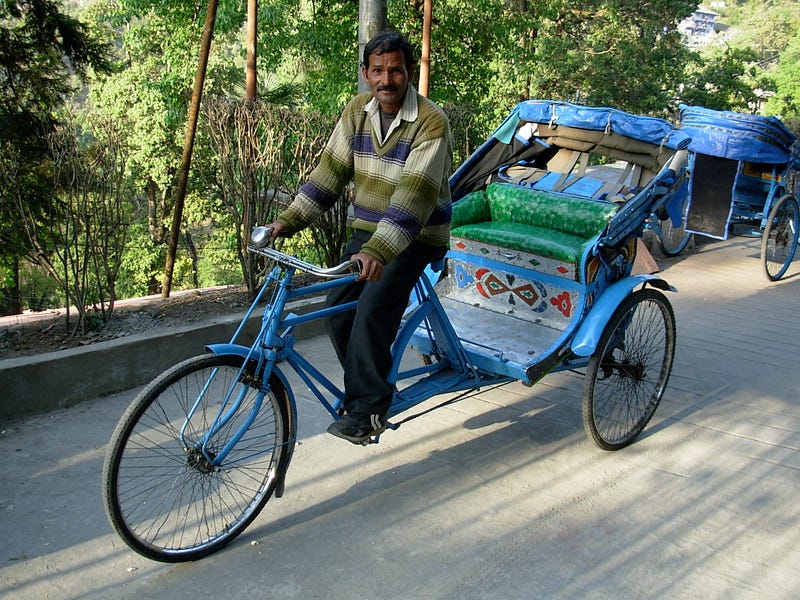
Pedal rickshaws and autorickshaws
The pedal rickshaw depends 100% on the footpower of the guy who is doing all the footwork for you.
Note that there is a possibility to unfold a covering so that the passenger is shielded from the sun.
The autorickshaw is a motorized three-wheeled affair with the driver in the front and space for a variable number of passengers behind him; most commonly three, but I have seen up to six or so, depending on their size. Over the course of my visits, I have observed a great variety of these, which brings me to the conclusion that they are like snowflakes: no two are alike.
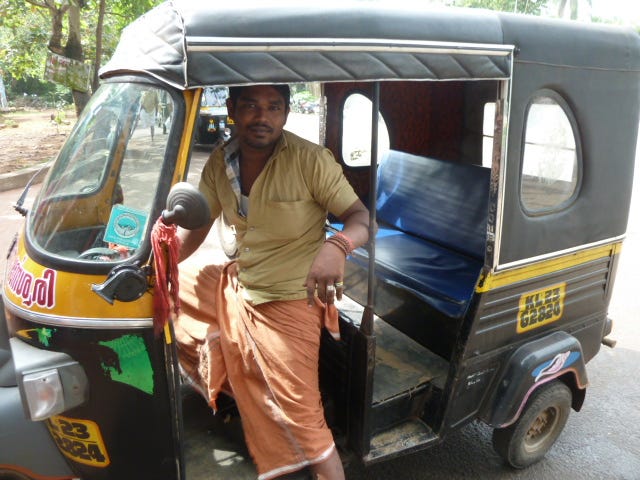
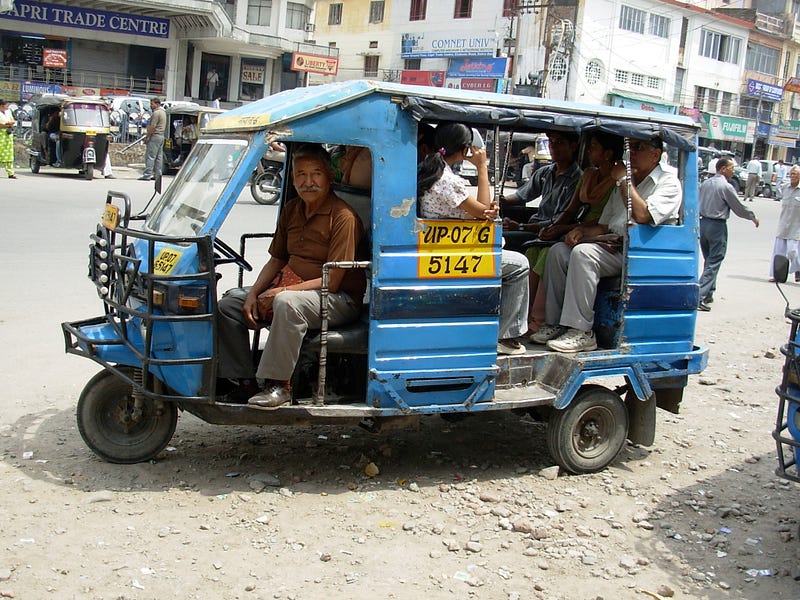
These are covered, so as to shield the passenger from the sun. I have taken these for a few fair distances, and the prices have been anywhere from 30 to 50 INR, depending on the distance of the journey.
Riding in these can often be accompanied by a request that I have not experienced in any other country: the driver asking the passenger to make a short visit to a shop of some sort.
In all the cases where this has happened to me, the driver has explained that if I enter the shop the driver will get help from the shop owner in getting some petrol for his vehicle, and that that can happen for him whether I buy anything or not in the shop.
Most of the time, I was not in any hurry, so I told that driver two things: that I would enter the shop for him and that I was absolutely not going to buy anything. This always served to appease the driver.
I was never sure if this statement on the part of the driver was true or not, but just in case it was, I was willing to help out.
Trains
Trains in India are their own mini-world(s). I have written a separate post about trains, so I need to refer you to that if you want more details.
Buses
There is a great variety of buses in India. My visits in 2006 and 2013–2014 were very different with regard to highway travel.
In 2006, I had this one-of-a-kind bus ride. My guess is that because of new highway construction, this kind of trip does not exist any longer.
In fact, on my second visit, I traveled from Dehradun to Delhi by plane, which was an option that hadn’t existed in 2006 because the Dehradun airport opened in 2008.
Flights
Flying is a good way to go if you have the means to pay for it. You can save a lot of time this way!
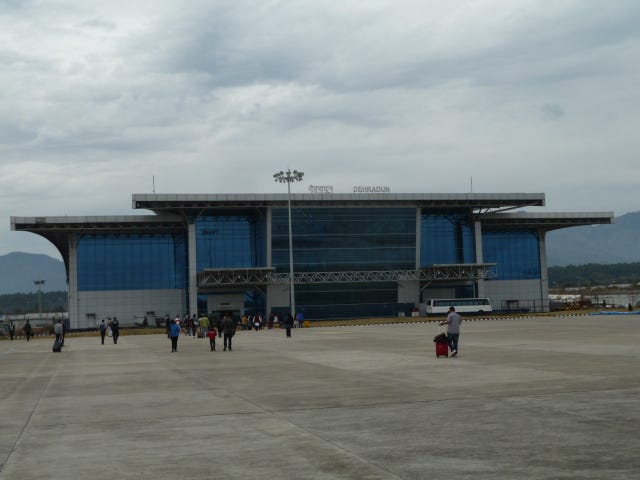
I have done several flights: Chennai to Delhi, Mysore to Hyderabad, Hyderabad to Mumbai, Mumbai to Jaipur, Jaipur to Dehradun (Jolly Grant) via Delhi, Dehradun (Jolly Grant) to Delhi.
There is an important bit of information to remember about airports, especially if Delhi is involved: there may be more than one airport in that city! If you are planning to make a flight connection, you may need to factor in transportation from one airport to another.
Delhi Metro
Fares on the Delhi Metro are based on distance traveled. The cost for a speedy and efficient trip of only four stops was 8 INR. The metro system has only a few lines and doesn’t seem to have an extensive network, but the stations that I have seen are spacious, with high ceilings and very wide public areas. They apparently have been built to handle the masses and are comfortable doing that.
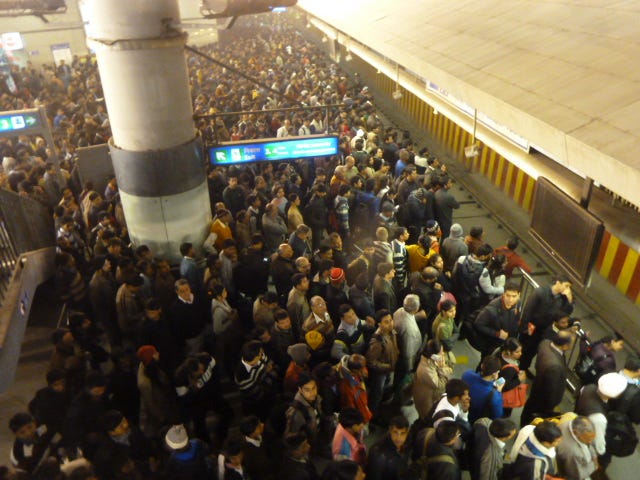
Visitors need to be aware that some conventions of transport that we are used to at home may not be observed here. Some examples:
- When trains stop at their platforms, people struggle against each other to board and de-board at the same time, which can be quite a challenge. There is no such custom as letting people off before you try to get on.
- Nobody on a crowded train is going to move temporarily to the platform as a means of making anyone else’s egress easier. They just stand there in the doorway, in everyone’s way.
- There are women-only cars, as a means of helping to ensure safe conditions for women who are traveling alone.
In the main parts of town, the roads are paved and in good condition. There are a few potholes, but not many. Once off the beaten path, however, the condition deteriorates.
Pedestrians
Pedestrians can have a tough time negotiating streets all over the country. There are some sidewalks but most people seem to prefer to put themselves in the roadway itself. Crossing the street is hazardous, as the traffic seems never to let up. In some instances, iron fences have been erected either along the sidewalk, as a means of keeping people from wandering into the street, or in the center of the median, to keep them from crossing the roadway in that spot. Just as they can be erected, they can be climbed over, and that is exactly what people do.
In addition to conventional cars, buses, and trucks, there are lots of motorcycles and mopeds, as well as the aforementioned autorickshaws and rickshaws. All share the roads with the pedestrians and — yes, it’s true — the cows.
Our bovine friends are smart enough to stay off the four-lane highways, which means that their domain is largely the narrower alleyways where they are in constantly in the way of people, rickshaws, autorickshaws, pushcarts, and other vehicles.
The market street near my hotel should probably be a one-lane one-way street. There is about enough width for a vehicle, the pedestrians, and the shop displays that spill out from the vendors. It makes for tight quarters, and I have already had a minor skirmish.
I was walking down the street, trying to be aware of my surroundings, when a rickshaw driver came toward me on the left, driving in the opposite direction. Something from his bike snagged me as he passed me, which resulted in tearing my jeans in the area between my left front pocket and my left rear pocket. The latter was all but torn off, and the area behind it was exposed. It’s true: you really should always wear clean underwear, because you never know who is going to be seeing it!