
An eight-hour bus ride in India
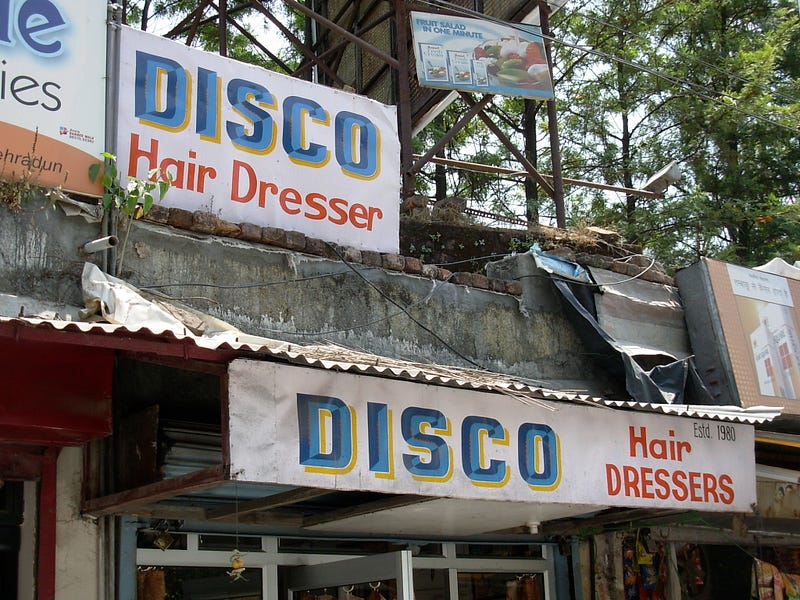
I called it the Disco Dash from Dehra Dun to Delhi
I had two main choices with regard to making the 256-kilometer/159-mile trip from Dehra Dun [sometimes written as Dehradun] to Delhi: the train or the bus. The train itself offered two options, neither of which appealed to me: the Shatabdi Express, leaving at 17:00 and arriving at 22:45 (too late) or the Mussoorie Express, leaving at 21:30, traveling overnight, and arriving at 6:55 the next morning.
[Mysteriously, the Mussoorie Express is named after a city that is more than 45 kilometers from the Dehra Dun station. Additionally, I would be loath to call it “Express” since it takes almost four hours longer than the Shatabdi Express.]
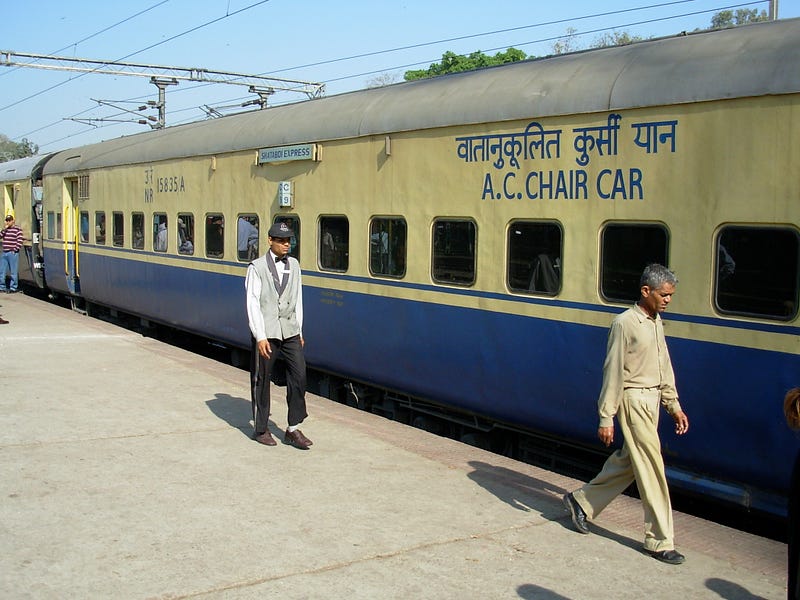
I immediately ruled out the Mussoorie Express, as I need near laboratory conditions in order to sleep. That is to say dark, still, quiet, temperate, horizontal, private, and clean. Even six out of seven — a solid 86%, or a B+ — will not do, and we all know that a train is certainly not still, dark, quiet, or private.
The previous week, when I had been in Dehra Dun, I asked my friend Sudhir about the bus options. He told me that there was a “super deluxe” departure at 10:00 that would arrive at 16:00. The cost, at Rs 400, was just a little over $9, so it was certainly affordable. He said that the bus was air-conditioned and very comfortable, which sounded good to me. “It’s a Volvo!” he added as if that were enough to clinch the deal. As luck would have it, he could even make the purchase for me, as he knew the way things worked, and I didn’t!
Anticipating that there might be an assigned-seat system, I told him that I wanted an aisle seat so that I would have a place in which to put my long legs during the trip.
When I saw Sudhir the following weekend, the day before my departure, he gave me the ticket. I had been assigned seat number 10. I checked with him to be sure that it was on an aisle. Whoops! He forgot! He called his friend at the bus station and told him that I needed a change of seats.
I arrived at the bus station shortly after 9:30, only to find that the actual departure time was going to be 10:30, not 10:00. The steel-slat bench in the station’s waiting area was uncomfortable, but I spied some comfier plastic chairs in a small room nearby. I didn’t know what the function of the room was, since all the signage was in Hindi, but I decided that rather than ask if I could use one of the chairs, I just went in there and snagged one. It was much more comfortable, and nobody made a fuss about my using it for the time being.
As I sat reading, I encountered in my book a story that I wanted to photocopy so that I could send it to a few people. I told the man in the information booth that I was leaving to find a photocopy place. I had every confidence that my luggage, left out in the open and in his sight, was totally safe.
Shortly after I returned with my copies, the bus pulled back to the waiting area, allowing us to stow our luggage in the compartments made for it underneath, and then board. Ignoring my assigned seat, I installed myself right behind the driver, which I could see was a good place for my legs, but as soon as he beeped his shrill horn I knew that it was going to be a bad place for my ears. Drivers here are constantly beeping, and this close proximity would not be a peaceful place for this long journey.
What to do? As I sat there figuring out how to make a change in my seating, two guys boarding tripped my gaydar. I gave them a moment to get settled; when I turned around to see how many available seats there were, the one in the aisle seat was looking at me, smiling.
As the engine was revving up, an employee at the bus station came to me with his cell phone, announcing that I had a call. As the only foreigner on the bus, I was easy to find. It was Sudhir, calling to make sure that I had made it all right and that I was well situated. I have been continually impressed with the personal care and attention I get from people once we have established any kind of relationship. Sudhir was showing me the hallmark of Indian hospitality: taking care of a friend, especially since this friend was a visitor to his country. I had seen that time and time again.
Two signs were posted next to the driver: “Snack will be provided by UTC during the journey” (What could that be?) and “Please do not return your ticket to the conductor after the journey.” (Why would I?)
I turned around to see that the last three rows of the bus were empty. Especially appealing was the center seat in the last row, with legroom that stretched the entire length of the aisle in the center of the bus! This would be my seat! I decided. I would just move there, say nothing, and not budge, no matter what anyone said.
As we made our way out of Dehra Dun, somebody came by with the promised snacks: bottles of water and bags of Lay’s potato chips. The driver’s helper — the man occupied with ticket sales and seating — came to me and shrugged his shoulders. Using a combination of hand gestures, sound effects, and phrasebook Hindi, I showed my hands in a pushing motion, said, Beep! Beep! and then Mujeh sardard heh, meaning “I have a headache.” He got the idea.
After fewer than twenty minutes on the road, we pulled into yet another bus station, where we stayed for forty minutes to allow other people to board. The bus began to get more crowded in the back. Fortunately, nobody questioned me about my choice of seat.
One would think that during a stretch of roadway this long, there would be something like a freeway, a parkway, or some sort of highway that was wider than two lanes. But no. As we began the journey, I could see that we were traveling on a two-lane road. As a result, the driver was performing a constant slalom as he passed motorcycles, slow-moving cars, horse-drawn carts, trucks, and bicycles. The culture of passing includes beeping. You pass, you beep! That’s the way it works.
Those who learn to meditate in India learn how to incorporate that serene practice into their lives. It does NOT mean, however, that India is a calm and quiet country. Maybe meditation was started so that people could escape the constant din around them.
The driver turned on his music. It was a radio station whose jingle, in English, repeated dozens of times, “Dis-CO sta-SHUN dis-CO! Dis-CO sta-SHUN dis-CO!”
First up on the Disco Station was a Hindi version of “Love is in the Air,” which accompanied the curvaceous road as the driver weaved and honked, weaved and honked. I asked the man sitting next to me if the road was like this all the way to Delhi. He told me that it was straighter after about fifteen kilometers. Fortunately, he was right.
“Beep! Beep!” I started to think of our driver as Road Runner. More Hindi disco — tunes that I did not recognize. Not that I was expecting Sibelius or Sondheim, mind you. I was expecting a road trip to Delhi, but not a time travel journey to the seventies.
It wasn’t too long before the bus had to stop and pull over into what narrow shoulder was available for it — which is to say, not much of one. We were experiencing mechanical difficulties!
Fortunately, it was not for the bus itself. The driver’s assistant was having trouble getting the VCR to work. He kept pushing buttons and getting nothing. The screen, mounted above the front windshield, was far enough away from me that I would not be able to see much of the movie anyway, but I was hoping for some sort of fascinating international combination, such as what I had once seen on a Thai bus: a Hindi movie dubbed into French with Thai subtitles.
No luck. The VCR was not going to work.
“Hello? Hello?!” Everyone around me had cell phones. The network was evidently not very strong, which caused people to check with their parties on the other end as a means of ensuring that they were still connected to each other.
“Hello?! Hello?!” The man in the left aisle seat in front of me had two phones. Across the aisle from him, each man had one. To my right, the man had two. That’s six phones for four men. The couple to my left, obviously throwbacks to another place and time, had only one phone between them. What was their problem?
The men with the two phones were constantly shifting between them, making and receiving calls. I could easily see the screen on the phone belonging to the man in front of me on the left. Each time he got off the phone he went to check his screen and found that he had just missed three or four calls, which necessitated his calling again. Busy guy!!
The man to my left told me that his daughter was going to the airport in Delhi so that she could travel to the United States. This led to our in-depth interviews with each other. When he told me that her early morning plane was first going to Frankfurt, I took out my itinerary and we realized that she was taking the same two flights that I would be taking in five weeks when I left India: Delhi to Frankfurt and Frankfurt to San Francisco.
Her husband is in San Francisco, the man told me, which led me to ask him if it was really San Francisco itself or could it possibly be another community nearby? This sort of thing happens all over the world, with people using the better-known city as a reference point rather than their point of residence. You’ll meet somebody who says he’s from Brighton and then when you probe a little further you find out that he’s from “Hove, actually.”
Not knowing the answer to my query, he got out of his seat to ask his daughter, who was sitting several rows ahead of us. He returned and told me, “Salinas.” Right! San Francisco, Salinas. I get them mixed up all the time! [Note: Salinas is more than 100 miles southeast of San Francisco.]
Beep! Beeeeeeeeeeeeeeeeeeeeeeeeeep! Beep! With the pitching and weaving we were doing, I couldn’t sit still in my seat. I was in a constant back-and-forth movement that kept me fighting to stay in place. Joining the fight was my underwear. As the Brits say, “Don’t get your knickers in a twist.” It was a struggle to keep them untwisted.
Rock the bus, don’t rock the bus, baby. Rock the bus, DON’T TIP THE BUS OVER! (Apologies to The Hues Corporation) So I’d like to know where I got the notion that taking this bus was a good idea!
No, this was not your yoga-yogi-meditation-mantra-maharishi-Kamasutra-Buddha-Bhagavadgita-bagwan trip to India. There was not to be a guru on the Ganges. It was just daily life, down and dirty with the Indian people, apart from the fact that I was not actually getting dirty, since the air-conditioned bus was traveling with all its windows sealed shut.
And yet, after a few hours of this, the thought of sitting in an ashram and not speaking for a week was starting to sound like a good idea.
“Beep! Beep!” Painted on the rear of most trucks and other large vehicles is the legend “HORN PLEASE” or “USE HORN.” Road Runner was only too happy to oblige.
Suddenly we were blissfully stopped. All I could make out was that there was a tremendous traffic jam. As people got off the bus, I thought I may as well join them. I only had an inkling of the need for a tinkling, but with no toilet provided on the bus, I thought I’d may as well go now since I didn’t know when the next stop might be. I can’t say that I am exactly getting used to the idea of ambling over to the side of the road to have a pee, but in many instances, there is just no other option available, so off I went.
Once off the bus, I could see that the reason for the delay was the lowered gates at a railroad crossing. All sorts of street peddlers were having a field day with the stalled traffic. The most popular and ubiquitous item for sale was cucumber. Several of the peddlers’ carts contained peeled cucumbers in plastic bags. Quartered lengthwise, the salesmen were sprinkling some sort of salt and other spices inside the bag. I thought it would be safe to eat, and certainly more nutritious than potato chips. Just to be sure, I got back on the bus, got my water bottle, and gave the cucumber a good rinsing with my mineral water. Better safe than sorry.
As I sat there, eating my cucumber, I had the opportunity to play one of my favorite travel games with an obliging young lad of about six years old who was in an aisle seat about eight rows ahead of me. There’s no need to speak the local language to play this game! When he made eye contact with me, I made a silly face, which made him smile. What happened next is what ALWAYS HAPPENS NEXT in situations like this: he tapped the person next to him (in this case, his mother), to tell her to look at the silly man making goony faces. But by the time she turned around to look at me, I was sitting there “normally,” gazing off to the right, with the boy and his mom in my peripheral vision, so I would know when she turned the other way, just in time for me to grimace again at the kid.
This usually goes on for several minutes — my face, the tap-tap-tap, the turn-around, and then me, just sitting there pretending that nothing had happened. Hey, it passes the time!
As long as we were stopped, I thought there was no need to sit any longer than absolutely necessary, so I got off the bus again. Passing the two guys I thought might be gay, I smiled at them and paused long enough for one of them to ask me, “You belong to what country?” That’s the way they ask it here.
I don’t know that I “belong” to the United States, but I guess that’s what people always want to know when they ask this question. I told him that I was from the United States. His reply made two syllables out of “USA,” as he raised his voice in excitement and said, “You say!”
I don’t usually say “America,” inasmuch as “America” is two entire continents that contain many countries. It’s a pity that Frank Lloyd Wright’s term “Usonian” to describe a citizen of the United States by using a word other than “American” never caught on much beyond the one street so named in Pleasantville, New York.
At 15:05 we pulled off the road and slowed into a parking lot. At this point, most of the passengers had closed the curtains on their windows. What I could see through the bus’s windshield were hedges that had been manicured to look like the bottom row of teeth in a jack o’lantern. As I descended from the bus, relieved to have a break from the lunging and lurching, it was immediately apparent that this was not your typical roadside restaurant. The first tip-off was that there were gleaming stainless steel wastebaskets strategically placed throughout the parking lot. (In most places in India, it is difficult to find wastebaskets (locally referred to by the holdover British word “dustbin”), as people generally pitch their trash into the street, where it will later be swept up by those belonging to one of the lower castes.
A signpost displayed the directions and distances to various destinations. According to it, we had come 140 kilometers from Dehra Dun and had 100 to go in order to reach Delhi. In the three hours and forty-five minutes of road time, then, we had managed to come only 140 kilometers!? As I figured it, that worked out to a mere 23 miles per hour. As fast as it seemed we were going, with all that speed knocking me around in my seat, was that our total speed? Or were my math skills as hopelessly bunched up as my underwear?
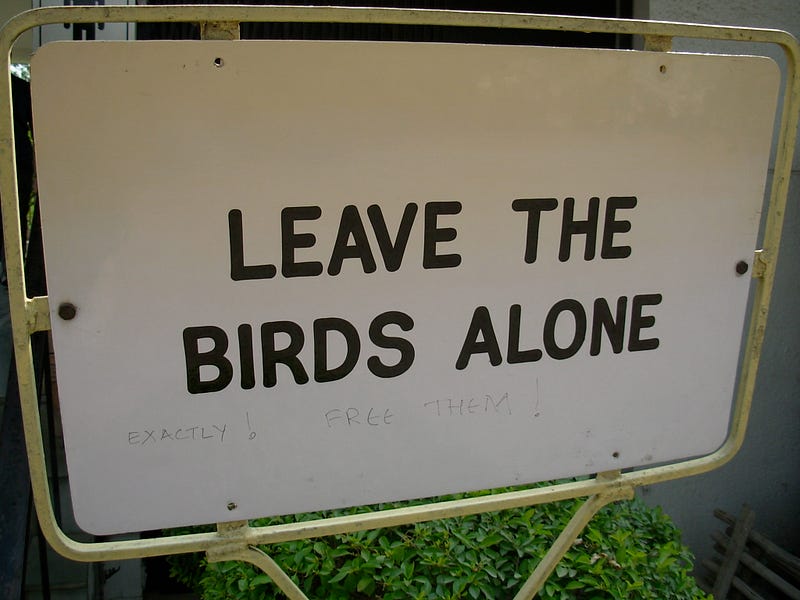
We were at a place called Cheetal Grand. Signs were posted all over the place, and they were of two varieties: the directing and the admonishing. We were directed to the restrooms (“toilets”), the restaurant, and the outdoor picnic areas. We were admonished about any number of things: EAT WHAT YOU BUY HERE; WHAT YOU BRING FROM HOME KINDLY EAT AT HOME; WE APPRECIATE YOUR NOT LOITERING AROUND; PLEASE LEAVE OUR CUTTLERY BEHIND; TREASURE CLEANLINESS. Near the restrooms (“toilets”) there were several rows of birds in cages. The sign adjacent to them read LEAVE THE BIRDS ALONE. That was the sole sign that a visitor had defaced, writing underneath, “EXACTLY! FREE THEM!”
As I made my way to the restroom (“toilets”) the maybe-they’re-gay couple was right behind me. One of them said to me, “You are looking very nice, sir.” Did that clinch his sexuality? Not necessarily.
I was delighted to have access to a clean and well-stocked restroom (“toilet”). I was particularly impressed that the management had seen fit to pay attention to the finer details, in that they had done what I had noticed in many establishments here that aspire to greatness and class: they had placed several mothballs in the drain areas of each of the sinks. I had never associated the smell of mothballs with this touch of class before, but I imagine that it is preferable to what one might otherwise smell in a restroom (“toilet”).
If Road Runner had announced how long we had to eat, it was in Hindi and I missed it. So I just decided to get some food as quickly as possible in order to be ready to board the Disco Dash again. Having eaten my vegetable chow mein (Rs 50, just a little more than $1), I walked around the grounds and took a look at the floral displays in the most scrupulously maintained garden I had seen so far in India.
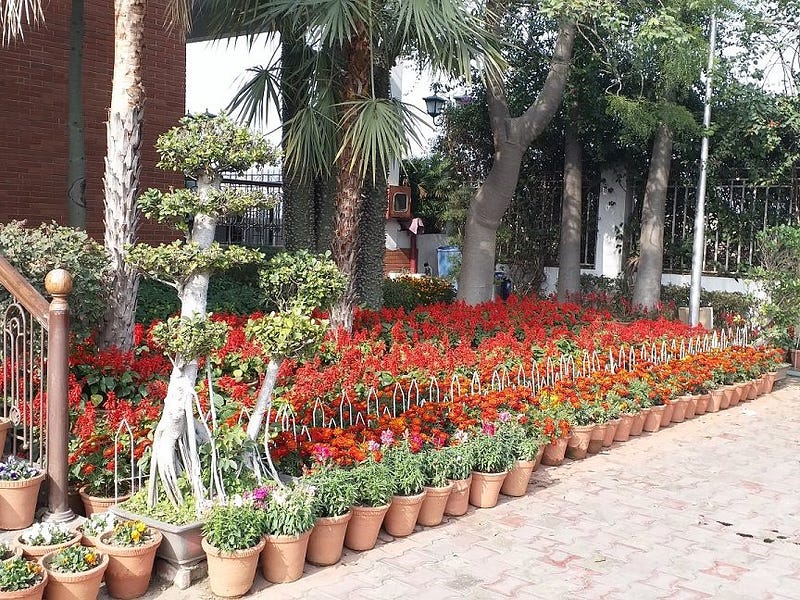
If the flowers aren’t roses, tulips, irises, geraniums, or one of those easily-recognized species, I am at a loss as to how I should identify it. We’ll just say that there were lovely red, white, pink, blue, and purple flowers on display, and leave it at that.
Road Runner gave us his signal — beeping, of course — and I recognized his unique blast in much the way a juvenile jackass penguin discerns its mother’s call from among all the other seemingly identical birds in hearing range.
Pulling onto the road, we slowly passed the Rosette Inn (“Vibrant new world of food and fun”), and then we were on the highway again, having stopped for all of thirty-five minutes.
The entire route was what the signs in and around Hingham, Massachusetts refer to as being “THICKLY SETTLED.” Were these villages or were we simply traveling along a road that had lots of people alongside it?
At 16:45 the radio went on, which made me realize that it had been off since we had left the Cheetal Grand. I looked out the window to see that we were now on a divided highway, with two lanes of traffic traveling in each direction. It felt like we had made real progress, in that we must be getting closer to our destination. By imposing my own culture on the Indians, I further reasoned that there would be a “slow lane,” probably on the left (since we were traveling on the opposite side of the road than we do in the US) and a “fast lane,” probably the right. This meant, I had hoped, that we had come to the end of the honking and leap-frogging. But no. There doesn’t appear to be this kind of road etiquette or rule.
As we hurtled forward, the “fast lane” was simply not fast enough for Road Runner. We continued to share the road with all manner of vehicles, many of which were crawling along. The beeping and weaving continued.
The man to my left began an extended conversation with the man in front of me to my right. Since the first man was a little hard of hearing, he continually had to lean across me to hear better. Catching on that he needed some amplification, the man in front obliged him by raising his voice. I was caught in this verbal crossfire and invasion of airspace for about an hour. They seemed oblivious to the fact that I was even there, let alone that this may be annoying to me.
We arrived in Delhi at 18:30, two and a half hours later than scheduled. As I reckoned it, our total travel time was just about eight hours. Calling the distance 250 kilometers (by striking a round figure between the 240 and 256), we had traveled the equivalent of a mere 155 miles. That meant we had been traveling at barely 24 miles an hour, and I am subtracting all time in which we were sitting still at the bus station, rest stop, and railway crossing. We must have been going faster at times, inasmuch as this is an average that was brought down by the standstill traffic in which we stood for stretches of time once we approached the Greater Delhi Metropolitan Area.
Aaaaaah! Time to get off the bus and straighten out my underwear!