

CRYPTO SCALABILITY
Transition to Ethereum 2.0 begins
Deployment of “The Beacon Chain” sets in motion Phase I of the transition to a more scalable, secure & sustainable network
It has been an amazing few weeks for the Crypto market, with Bitcoin leading the way — now within touching distance of its all-time high. BTC dominance touched almost 67% before receding as money started to flow towards Alt. coins. Ethereum (ETH) is the second biggest crypto by market cap, owing to its smart contract platform which is widely used for dApps development and now also as the launchpad for the booming DeFi market.
Although ETH is the most widely used platform, it is not very scalable. The strong & robust development team behind the project has been working on moving the platform to a more scalable version. Last year, they implemented five Ethereum Improvement Proposals (EIPs) as a precursor to the transition of the blockchain to a more scalable Proof of Stake (PoS) network. The eventual aim is to move to Ethereum 2.0.
The newer version of the network is the shift from energy-intensive Proof of Work (PoW) algorithm, like the one used in Bitcoin blockchain, to a more secure & scalable Proof of Stake (PoS), where the latter requires block validation by stakeholders rather than block miners performing complex computations to earn rewards.
The shift is expected to change Ethereum’s economic model, resource usage, and governance. The Ethereum Foundation had previously set a soft launch date for Dec. 1, assuming the deposit contract saw 524,288 ETH staked by Nov. 24. As it turned out, Ethereum 2.0 deposit contract, which was released in early November, accrued more than 540,000 ETH (worth over $325 million) by November 23.
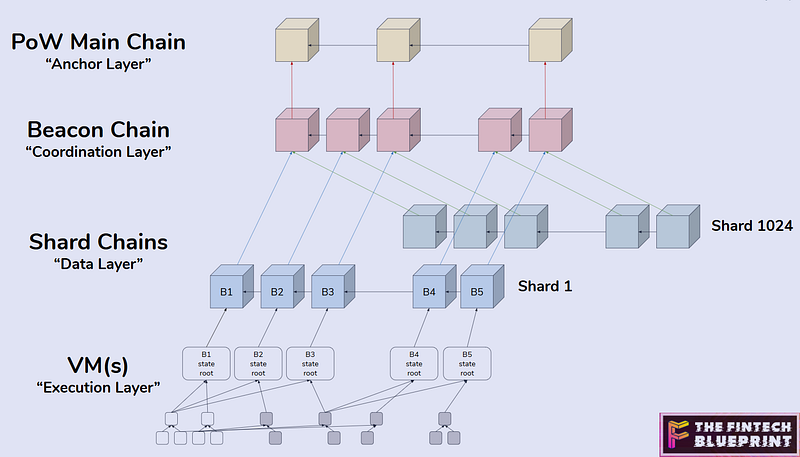
This, in essence, has ensured that the “beacon chain” for Ethereum 2.0 will launch in accordance with the deadline set earlier. The process formally begins the shift of the second-largest cryptocurrency to a more scalable proof-of-stake consensus. The target of staked ETH was hit after 150,000 ETH were deposited in a 24-hour period.

Just to clarify, the full PoS network isn’t launching yet. “The beacon chain” will run in parallel alongside the existing Ethereum network (figured above). However, the initial phases of its development will not impact existing users and dApps on Ethereum. According to the ETH2 website, the following is the tentative timeline for the upcoming transition.
- The Beacon Chain (Dec. 1, 2020) — It will coordinate the new system, bring staking to Ethereum & lay the groundwork for future upgrades. Validators will replace miners & earn rewards on the network in exchange for processing transactions and creating new blocks. A user must stake a minimum of 32 ETH through the deposit contract to become an Ethereum 2.0 validator.
- Shard chains (estimated 2021) — will expand Ethereum’s capacity to process transactions and store data. The shards will gain more features over time and will be rolled out in multiple phases.
- The docking (estimated 2022) — Mainnet Ethereum will “dock” or “merge” with the beacon chain at some point, enabling staking for the entire network and signaling the end of energy-intensive mining. This would also mark the full transition of all users and dApps to the new network.
Early validators are expected to earn roughly a 20% annualized reward on their staked ETH with more than 21,000 validators securing the network at launch. Ethereum 2.0 also offers security and sustainability apart from increased scalability. ETH has just touched $600 for the first time in two years and this transition could greatly enhance the intrinsic value and use case portfolio of Ethereum.
