
Train Your Mind To Pursue Wholeness
4 guiding principles to help you live the life you want.
When you order a pizza, what do expect? A whole pie. No pieces eaten by the server or the delivery guy. The same thing applies to life.
No one wants to live a mediocre life with pieces missing.
We want to feel good, succeed at what we do, and be happy. In other words, we want wholeness. Nothing missing.
Here's what the dictionary has to say about wholeness.
Wholeness: The state of forming a complete and harmonious whole. Unity. The state of being unbroken or undamaged.
Something in me warms up reading that description.
I want wholeness in my life, and I think most people want the same.
I know what's it like to feel broken and damaged, having had my share of personal struggles, poor choices, and bad behavior. Those times were a far cry from feeling whole.
Guilt, shame, apathy, and dishonesty are in the broken and damaged bucket, along with hatred, anger, victimhood, hypocrisy, relentless criticism, and judgment.
But not just these more apparent manifestations of non-wholeness do us in. It's also the small, everyday behaviors and thought patterns that keep us from experiencing wholeness.
I’m talking about things like rolling our eyes when someone says something that gets under our skin, raising our voices when talking to our kids, or getting agitated when something doesn’t go our way.
The other, perhaps more insidious “peace stealers” are the silent, unconscious, habitual thought patterns that operate like invisible nasty ninjas in our heads, limiting us from being our whole selves. Things like:
- Negative self-talk.
- Allowing bad habits to run our lives.
- Making false assumptions.
- Resisting what we can't do anything about.
- Not being fully honest with ourselves.
- Worrying and living in fear too much.
The list could go on. You get the idea.
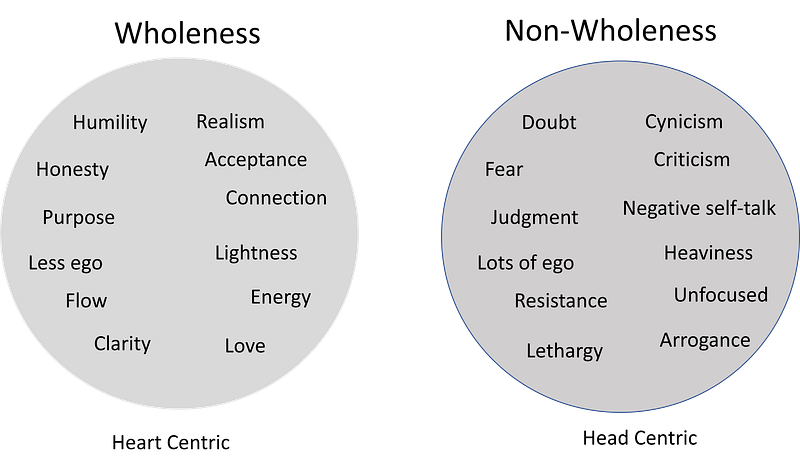
There’s a visual below that lays out some of the elements of wholeness, a more heart-centric approach to life, and non-wholeness, a more head-centric approach.
I'm not saying we live exclusively in one circle or the other. I'm suggesting our pursuit of wholeness will yield a more effective, peaceful, and contented life experience.
When you see it laid out like this, is there any real choice about what to pursue?
Allowing elements of non-wholeness to consume our lives day after day, year after year, does not bring us more contentment, harmony, or wholeness. It just chips away at our spirit and sucks the energy right out of us, slowly but surely.
But there's plenty we can do to develop wholeness in our lives every day.
Here are four simple practices that have helped me on my ongoing journey to being peaceful, content, energetic, optimistic, happy, committed to goodness, and making a positive difference in the world — wholeness in a nutshell.
1. Having clarity of purpose.
Knowing what you want in life. Having a clear vision and making decisions that keep you moving toward your goals. Drawing boundaries and sticking to them. Eliminating any confusion or doubt.
If you want help from the Universe to achieve your dreams, be crystal clear on your intentions.
What helped me gain clarity of purpose was defining how I wanted to spend my time and generate income. I journaled and reflected for months and eventually narrowed down four guiding principles:
- Do work that is of service to others and fulfilling to me.
- Associate with people who share my values.
- Deepen my spiritual practice.
- Create my own business.
These principles gave me the necessary tracks to run on. The details and specifics gradually emerged over a few years. I didn't force them.
2. Living in alignment with my values
Values are anchors that create stability, like the rudder on a ship. You always need a rudder, but if you take it for granted in good times, you’re reminded in the tough times how important a rudder is. Values can change according to circumstance, but the ones that have stuck with me are:
- Humility — The way I view the world is only one possible perspective. I'm open to the fact I don't know everything. I'm curious.
- Responsibility — I'm responsible for my choices. I don't blame others or the world for what happens to me.
- Integrity — I do my best to behave in alignment with my core values. At the end of the day, I may win or lose, but I'm proud of how I behaved.
- Honesty — I speak what's true for me directly and respectfully. I don't sugarcoat, and I'm not demeaning or disrespectful.
3. Practicing meditation
My journey into wholeness began by seeking what can't be damaged or broken within me. I believed there was a life force in the Universe, but believing something and experiencing something are two different things — I wanted to experience it myself.
A Mahatma (great soul in Hindi) told me after I was shown how to go within, "You be the judge of the experience. If you like it, keep going. If not, then quit."
I liked it.
So I kept going, and now, fifty years later, that connection to what is indestructible has unlocked an experience that has filled me with great peace, love, and happiness. I can't say enough about how meaningful it is to connect to something within that has deeply enriched my life.
I practice every morning for twenty to thirty minutes, approaching my practice with an open mind and heart, knowing anything I experience is a gift.
If you've never tried meditation, I encourage you to give it a fair try.
4. Cleaning up the inside.
After ten years as a monk, I returned to mainstream life at thirty-three years old.
I soon realized I had a lot of cleanup work to do in my head. Meditation is food for the soul but doesn't take care of childhood wounding, life trauma, and personality quirks.
I did my time in therapy. There was plenty to work on. It made a massive difference in helping my psychological health, interpersonal relationships, and role as a parent with two young kids.
Years later, I joined a consulting company, Axialent, and worked with Fred Kofman, author of Conscious Business. I did deep inner work and developed a more curious and open mindset, something so vital to living a more conscious life.
I learned about and practiced focusing on the process of achieving goals instead of being consumed with only outcomes. Another critical life lesson if we want to experience more wholeness.
I've done and continue doing shadow work, which is essential if one pursues wholeness. It's helped me come to terms with some of my not-so-nice parts and to be more kind to myself and others.
I worked for months to develop a more abundant mindset by focusing on positive affirmations and visualization. After several months, I felt my brain rewired itself — neural plasticity at work.
I watched as little bits of doubt and fear left me, replaced by confidence and abundance.
Lastly, given I've been an overachieving, perfectionistic A type most of my life, I'm still working on patience, forgiveness, and acceptance of others' unique personalities and styles. There's plenty of room for improvement here.
Final thought.
We find what we focus on. Focus on wholeness.
It's the way to go. You’ll never regret it.
Want some handpicked wisdom at your fingertips? Then, grab your free eBook of 111 Inspirational Quotes!