avatarDark Energy Articles

Free AI web copilot to create summaries, insights and extended knowledge, download it at here

2368

Abstract

tion stage, they were transferred to Astronika for detailed design, fabrication and testing.</p> <figure id="379e"> <div> <div> <img class="ratio" src="http://placehold.it/16x9"> <iframe class="" src="https://cdn.embedly.com/widgets/media.html?src=https%3A%2F%2Fwww.youtube.com%2Fembed%2FqOrGvlBq6zI%3Ffeature%3Doembed&amp;display_name=YouTube&amp;url=https%3A%2F%2Fwww.youtube.com%2Fwatch%3Fv%3DqOrGvlBq6zI&amp;image=https%3A%2F%2Fi.ytimg.com%2Fvi%2FqOrGvlBq6zI%2Fhqdefault.jpg&amp;key=a19fcc184b9711e1b4764040d3dc5c07&amp;type=text%2Fhtml&amp;schema=youtube" allowfullscreen="" frameborder="0" height="480" width="854"> </div> </div> </figure></iframe></div></div></figure><p id="5d8c">The data collected by the RWPI will help understand how Jupiter’s strong, Jupiter-derived electric and magnetic fields interact with Ganymede and Europa, two of Jupiter’s largest moons.</p><p id="1feb">Another instrument that is being developed with the participation of engineers and scientists is SWI. That is, an instrument for observing submillimeter waves generated by excited molecules in Jupiter’s atmosphere.</p><h1 id="1b02">Does life exist near Jupiter?</h1><p id="bb2f">But the Jupiter system fascinates not only because of the possibility of understanding the origin of planetary systems. What most electrifies researchers is <b>the possibility of life existing there.</b></p><p id="ffea">Jupiter’s moons, particularly Europa, have a very good chance of being home to life. All because of the possibility of a liquid ocean of water beneath the ice surface. Previous observations of this moon’s surface indicate that it is very geologically active, most likely due to forces generated by Jupiter’s powerful gravity. Such delivered energy should be sufficient to support life on an object so far from the Sun.</p><h1 id="e4b2">Four years to study the Jupiter system</h1><p id="5de6">The main designer of the JUICE probe is Airbus. It was in the halls of this space giant that JUICE’s 10 research instruments were integrated into one huge probe. It was also there that the largest solar panels ever installed on a probe were built and assembled. They are as large as 85 square meters in area!</p> <figure id="167b"> <div> <div>

Options

   <img class="ratio" src="http://placehold.it/16x9">
            <iframe class="" src="https://cdn.embedly.com/widgets/media.html?src=https%3A%2F%2Fwww.youtube.com%2Fembed%2FFw17N3rdN7s%3Ffeature%3Doembed&amp;display_name=YouTube&amp;url=https%3A%2F%2Fwww.youtube.com%2Fwatch%3Fv%3DFw17N3rdN7s&amp;image=https%3A%2F%2Fi.ytimg.com%2Fvi%2FFw17N3rdN7s%2Fhqdefault.jpg&amp;key=a19fcc184b9711e1b4764040d3dc5c07&amp;type=text%2Fhtml&amp;schema=youtube" allowfullscreen="" frameborder="0" height="480" width="854">
          </div>
        </div>
    </figure></iframe></div></div></figure><p id="e62e">The probe is expected to study the gas giant’s system for nearly four years. <b>During that time it will make 30 observation flybys over Jupiter’s moons.</b> Ganymede alone will devote as many as nine overflights. To make this possible, however, it must first travel a long way and perform four gravity assist maneuvers aimed at giving the spacecraft the proper speed.</p><p id="08aa">JUICE will join NASA’s Juno probe. Later, another American probe, Europa Clipper, will reach the Jupiter system. They are to work together to send as complementary and accurate data to Earth as possible. Interestingly, both JUICE and Juno are derived from another mission — Europa Jupiter System Mission — Laplace. It was supposed to be a joint venture between NASA and ESA.</p><div id="9f7e" class="link-block">
      <a href="https://readmedium.com/nasas-probe-has-taken-a-unique-photo-of-mars-it-shows-a-bear-af6919836161">
        <div>
          <div>
            <h2>NASA’s probe has taken a unique photo of Mars. It shows a bear</h2>
            <div><h3>Straight into the lens of the US space probe’s high-resolution camera stares a bear. He has a pair of eyes and a…</h3></div>
            <div><p>medium.com</p></div>
          </div>
          <div>
            <div style="background-image: url(https://miro.readmedium.com/v2/resize:fit:320/1*ETHLknRP9zWRQL6BtabcYA.jpeg)"></div>
          </div>
        </div>
      </a>
    </div><p id="3e72"><b>Cool that you made it to the end of this article. I will be very pleased if you appreciate the effort of creating it and leave some claps here, or maybe even start following me. It would be nice if you also left a tip! Thank you!</b></p></article></body>

Toward the Jupiter System. It’s time to start the countdown to the launch of the JUICE mission.

The European Space Agency’s six-ton probe JUICE is waiting in Toulouse for transport to French Guiana. There it will be installed in the hatch of an Ariane 5 rocket, which will carry the probe toward the Jupiter system in mid-April. This is ESA’s first-ever Large mission.
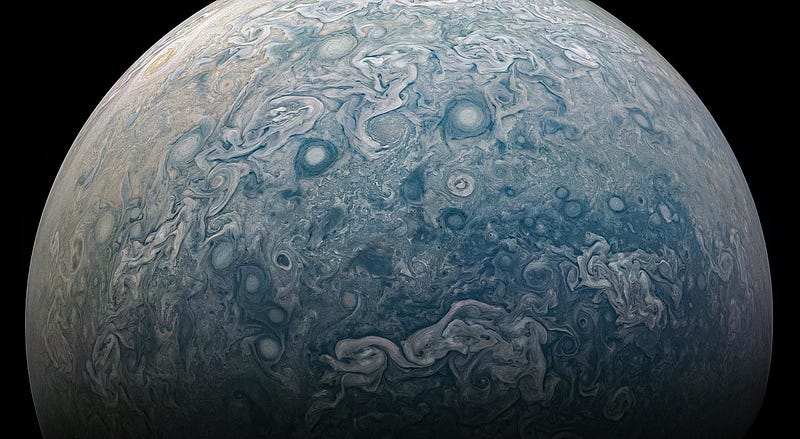
[Photo: NASA/JPL-Caltech/SwRI/MSSS, Public domain, via Wikimedia Commons]

The launch of the JUICE mission, or JUpiter ICy Moon Explorer, is the most anticipated space event of the first half of 2023. The probe was supposed to launch as early as last year, but a slowdown from the pandemic caused JUICE’s component integration to be prolonged. Fortunately, another launch window opens in April. If the probe can be sent at this point, it will take 8.5 years to travel to the Jupiter system. To get there it will have to travel 6.6 billion kilometers.

What is the Jupiter System?

Why are we talking about the Jupiter System and not Jupiter itself and its moons? Jupiter with its moons forms something like a planetary system within a planetary system. This mission will open a new window into our understanding of the Universe. There are many indications that Jupiter may have become a star, but its evolution was interrupted. If we know its structure, the forces acting between this gas giant and its moons, we will better understand the genesis of the Solar System. And also the formation of other planetary systems.

JUICE, the largest spacecraft ever built for an interplanetary exploration mission, features 10 scientific instruments created by extensive international teams. One of them, RPWI (Radio Plasma Wave Investigation) is used to measure the physical properties of plasma and its interaction with the space environment. All components of the mechanical systems were developed at the Space Research Center of the Polish Academy of Sciences during the initial stage of the mission. Then, at the implementation stage, they were transferred to Astronika for detailed design, fabrication and testing.

The data collected by the RWPI will help understand how Jupiter’s strong, Jupiter-derived electric and magnetic fields interact with Ganymede and Europa, two of Jupiter’s largest moons.

Another instrument that is being developed with the participation of engineers and scientists is SWI. That is, an instrument for observing submillimeter waves generated by excited molecules in Jupiter’s atmosphere.

Does life exist near Jupiter?

But the Jupiter system fascinates not only because of the possibility of understanding the origin of planetary systems. What most electrifies researchers is the possibility of life existing there.

Jupiter’s moons, particularly Europa, have a very good chance of being home to life. All because of the possibility of a liquid ocean of water beneath the ice surface. Previous observations of this moon’s surface indicate that it is very geologically active, most likely due to forces generated by Jupiter’s powerful gravity. Such delivered energy should be sufficient to support life on an object so far from the Sun.

Four years to study the Jupiter system

The main designer of the JUICE probe is Airbus. It was in the halls of this space giant that JUICE’s 10 research instruments were integrated into one huge probe. It was also there that the largest solar panels ever installed on a probe were built and assembled. They are as large as 85 square meters in area!

The probe is expected to study the gas giant’s system for nearly four years. During that time it will make 30 observation flybys over Jupiter’s moons. Ganymede alone will devote as many as nine overflights. To make this possible, however, it must first travel a long way and perform four gravity assist maneuvers aimed at giving the spacecraft the proper speed.

JUICE will join NASA’s Juno probe. Later, another American probe, Europa Clipper, will reach the Jupiter system. They are to work together to send as complementary and accurate data to Earth as possible. Interestingly, both JUICE and Juno are derived from another mission — Europa Jupiter System Mission — Laplace. It was supposed to be a joint venture between NASA and ESA.

Cool that you made it to the end of this article. I will be very pleased if you appreciate the effort of creating it and leave some claps here, or maybe even start following me. It would be nice if you also left a tip! Thank you!

Space
Science
Life
Technology
News
Recommended from ReadMedium