

Top ETFs for Long-Term Wealth Building.
Just Keep Buying.
As I have covered before, investing your hard-earned dollars is not as complicated as some might believe, nor as daunting as many “financial advisors” often make it out to be before signing you up to draw AUM fees off your investments.
Given the amount of coaching sessions I have given lately about what to buy in an IRA or brokerage account, I figured I would share some of my personal favorites, many of which I own. These are not specific instructions or recommendations. Do your own research.
Disclaimer: The information provided herein is for educational and informational purposes only and should not be construed as financial advice. Any investment decisions should be made after consulting with a qualified financial advisor and considering individual risk tolerance and financial goals. Past performance is not indicative of future results. All investments carry inherent risks, and individuals should carefully evaluate their own financial situation before making any investment decisions.
Over the long term, buying low-cost exchange-traded funds (ETFs) that track major indexes (such as the S&P 500) will be less risky than single stocks and outperform higher cost, higher turnover, and actively managed Mutual Funds. This is true no matter what Dave Ramsey tells you.
Index ETFs are especially tax-efficient in a brokerage account.
Such a strategy also provides a simple approach that allows the average investor to dollar cost average over weeks, months, and years into predetermined positions.
There are three main categories of ETFs that I like to include in my portfolios. They are Foundational, Growth, and Dividend.
Let’s look at my favorites.
A Foundational ETF would track a major index like the S&P 500.
VOO (Vanguard S&P 500 Fund) and VTI (Vanguard U.S. Total Stock Market ETF) are my two favorites here.
Both funds charge a small .03% fee annually and have returned over 12% annually, in the last 10 years.
I like to make a Foundational ETF around 50% of my portfolio.
My next category, a Growth ETF, aims to benefit from high growth and high upside of quickly emerging technologies and trends. For this category, I like QQQ (or QQQM) (Invesco NASDAQ ETFs), VUG (Vanguard Growth Index Fund ETF), and VGT (Vanguard Information Technology Index Fund ETF).
This category of funds will typically carry a bit more expense at .10% or so, but VGT, for instance, has returned over 13.03% on average, annually, since inception (2006). It's up a whopping 249.94% in total since then.
I usually aim for about a 25% allocation to a Growth-focused position, as the overall volatility (how much the ETF moves up AND down) will be greater than the Foundational position.
My last but not least category is a Dividend ETF, with appreciation potential. This is an important distinction as some dividend funds will only seek income without regard to capital appreciation (when the price of the ETF goes up).
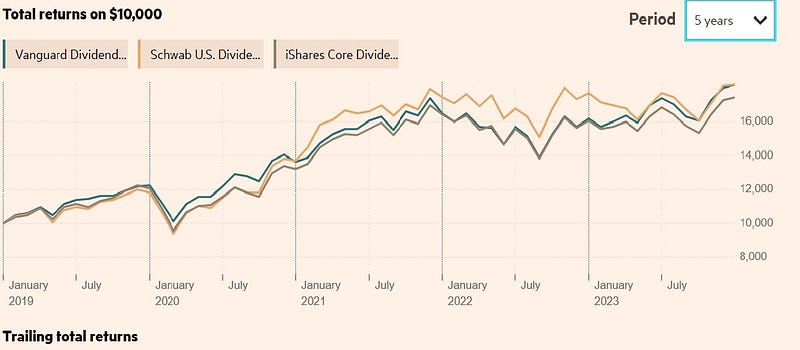
For this group, I like VIG (Vanguard Dividend Appreciation Index Fund ETF), DGRO (iShares Core Dividend Growth ETF), and SCHD (Schwab US Dividend Equity ETF).
All three funds charge low expenses of around .06% and have returned upwards of 11% on average annually, in the last 10 years.
All three funds of course pay a dividend anywhere from 1.8% to 3.5% annually, per share. Reinvesting those dividends will buy you more shares over time, supercharging your returns. Later in life, dividend funds can provide a nice income stream.
Here are all three funds and their returns over the last 5 years. You can’t go wrong with either. Again, do your own research.
What about Bonds?
I think bonds could provide some compelling opportunities here as we likely see the Federal Reserve lowering rates later in 2024. That said, I approach my portfolios with growth in mind. Historically, Bonds have only served to reduce volatility and provide income. But even BND hasn’t done a very good job of preserving capital over the last decade or so. Hence, I don’t include Bonds in my plan for long-term wealth building.
What are some of your favorite ETFs for long-term investing and wealth building?
Thanks for reading!
Some of my other, recent popular stories on finance topics.
The Best Bitcoin ETF’s To Buy, And Whey They Matter
Dave Ramsey’s Investing Advice Is Both Bad And Wrong
I Asked Four, Old, Wealthy Guys Five Questions About Money
The information provided here is for informational and educational purposes only. It is not intended to be, and should not be considered as financial or investment advice. We do not provide personalized financial, investment, tax, or legal advice. The Matadore is not a registered CFP or CPA.


