
Top 7 AI Trends to Watch out for in 2023- and 2024
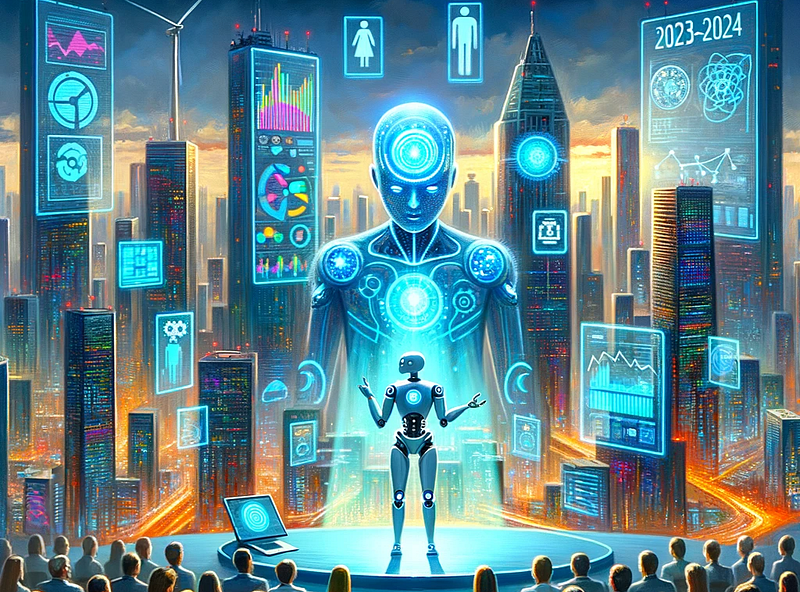
Our world is undergoing significant changes, and some, including me, believe that AI will deeply drive change in the Tech planet but also in our societies.
AI trends are changing faster than ever. Recently, generative AI and AI-powered automation have been growing extremely quickly, making it seem like AI is evolving at double speed, or even faster.
Now, I’m not a fortune teller, but I’ve been in the AI landscape for a while now, and I can confidently tell you that these new trending AI technologies and applications will affect literally everyone, from everyday consumers to IT teams in big companies.
So, hang on tight, and let’s dive into the top 7 latest AI innovations that are currently trending end of 2023- and most likely will stay on trend in 2024.
Generative AI
Generative AI has truly shaken up the tech world and beyond in recent months, emerging as the dominant analytics trend in 2023 as stated by Gartner. This technology offers user-friendly AI models, accessible to all, enabling the generation of text, images, audio, and various other data forms within seconds.
OpenAI has been a dominant force, leading the way with GPT-4 and ChatGPT. Their partnership with Microsoft has further solidified their position. That being said, Google is rapidly advancing, continuously enhancing and expanding the capabilities of Google Bard which has become a very powerful AI tool, but is still behind in terms of adoption. In addition to these industry giants, other competitors are also emerging; notably, Facebook parent Meta has also entered the scene, introducing its ChatGPT rival LLaMA 2.
It is also worth keeping an eye on companies like Nvidia and Intel. They provide the essential hardware, like chips and GPUs, needed to run these large-scale AI models, and as demand continues to grow, their role in supporting this technology will be substantial.
Explainable AI
Explainable AI (XAI) has become essential in today’s market, particularly as businesses adopt AI and ML technologies, seeking more transparency and accountability in their models.
So, what is this trend? Basically, AI generates outputs for you, and XAI explains why.
To understand this better, XAI answers critical questions related to the “how” and “why” of AI systems using a set of techniques and procedures. Providing explanations on how ML models work and clarifying the rationale behind specific outcomes, businesses can promote transparency, fairness, and ethical use but also enhance customer trust. In the specific case of Generative AI, XAI can help remove hallucinations, which is a major limitation of current Generative AI tools like ChatGPT from OpenAI.
Here are some common use cases illustrating the diverse applications of Explainable AI across various sectors:
- Healthcare: In healthcare, explainable AI can help medical professionals explain the diagnosis to the patient and help them understand how a treatment plan will work. It can also be helpful for medical imaging data for diagnosis.
- Autonomous Vehicles: Autonomous vehicles are trained with the help of explainability techniques, which incorporate human-readable descriptions in order to explain the reasoning behind a prediction or a decision.
These are just a few use cases, from the most critical AI applications that require explainability, but Explainable AI can be useful in every AI-driven business aiming to prioritize accountability, transparency and reliability.
Quantum AI
The quantum AI revolution is powered by the combination of two game-changing technologies: Quantum Computing and Artificial Intelligence.
Quantum computers, built on the principles of quantum mechanics, provide unparalleled computational power. Quantum computing is expecting to disrupt many paradigms given the impressive speed it can provide. In Cybersecurity space typically, it is expected to introduce a new set of challenges, as using it by hackers to solve encryption problems or password guessing can put a lot of businesses at jeopardy as stated by Forbes.
Quantum AI (QAI) harnesses this power to solve complex problems at previously unimaginable speeds.
One of the main challenges faced by AI, is its power and computing consumption, requiring (costly) GPU and exceptional computational power.
Unlike traditional computers that might spend hours or even days on calculations, Quantum AI can deliver optimal solutions in a matter of seconds. Additionally, Quantum computers excel at identifying patterns in large datasets, making them highly effective at handling incomplete or corrupted data. In essence, QAI represents a significant shift, enhancing existing AI systems with the remarkable computational capabilities of Quantum computing.
Ethical AI
Ethical AI is on the rise and is becoming crucial for everyone involved in the AI landscape. This includes not only startup executives who are developing AI-driven solutions and the investors supporting them, but also the customers who are using these technologies and society as a whole.
The use of Ethical AI implies having non-biased data sets and non-biased predictions or outputs by the AI systems. As our data sets are in many cases biased by construction, it is becoming challenging to “certify” AI systems as non-biased. However, regulations seems to move forward promoting (or enforcing) Ethical AI and hence tackle such issues.
Policies addressing safe and responsible AI are starting to be recognized globally, and what’s becoming increasingly evident is that ethical AI is no longer an optional consideration; it has become an essential requirement for businesses as stated by the Unesco, regardless of the specific challenges they address.
AI Jobs
Jobs related to AI and machine learning have grown by almost 75% in the past four years, and guess what? This trend shows no sign of slowing down. So, if you’re considering a career in AI and machine learning, you’re making a smart move that promises not only a decent paycheck but also long-term job security. Beyond the hype of some titles that arose lately, like “Prompt Engineer” typically, there is higher demand for more “conventional” roles like ML engineers, Data Scientists, Data Engineers, MLOps Engineers, …
And here’s the exciting part — these opportunities aren’t limited to just one industry. AI and Machine Learning are making waves in healthcare, education, marketing, retail, e-commerce, and financial services, so you have plenty of options to explore.
But there is a less exciting part, and AI might also drive layoffs and job cuts, as businesses prove their ability to increase productivity and massively automate certain tasks with the help of AI. From my perspective, these changes are already happening, so, without being alarmist, it is better to be prepared and adapt ones skills to adopt AI and increase employability.
AI Democratization
AI will truly reach its full potential when it becomes available to everyone and every business to benefit from, and in 2023, this accessibility has become easier than ever. A growing number of apps now offer user-friendly AI functionalities, ranging from predictive text suggestions to creating complex visualizations, making AI accessible for everyone, regardless of technical expertise.
Even if you can’t find an app that suits your specific needs, creating your own has become increasingly simple, thanks to the rise of no-code and low-code platforms. These platforms enable almost anyone to build, test, and deploy AI-powered solutions using intuitive drag-and-drop or wizard-based interfaces.
Ultimately, the democratization of AI will help many businesses and organizations overcome the challenges of the AI skills gap and the shortage of trained data scientists and AI engineers by empowering individuals to step into “self-service” models.
AI Education
AI education has emerged as a major trend in 2023, and this significant shift in the educational landscape was highlighted in the 2023 AI Index Report from the Stanford Institute for Human-Centered AI. The report shows a substantial increase in the investments dedicated to AI in education and a heightened focus on ethical considerations, in particular fairness and transparency.
The year has also witnessed a rise in AI-driven solutions and tools that are revolutionizing education. Various user-friendly tools, including digital assistants and EdTech companies, have been developed to enhance the learning process and optimize the educational experiences for students from diverse backgrounds while making educators’ lives easier in the process.
Final Thoughts
Now, I know that some of you guys might be a bit skeptical about all these AI new trends, and I also know that others are super excited. But here’s the thing — no matter where you stand, one thing is crystal clear: AI is not going away, and it will continue impacting your business, your career, and your everyday life.
So, here’s the deal: Whether you are a business or a professional, you can’t afford to overlook AI’s immense potential. If you want to stay on top of your game, stay informed and educated about it, try to embrace it, understand it, and most importantly, use its power responsibly.
Feel free to share your thoughts! If you want to learn about AI, join my course!