
BUSINESS & IT
TOP 3 Time Management Approaches
Make the most of your time

Time Management, what does that even mean? My short explanation of the term is the following:
A good organization to get things done efficiently.
Here are two common definitions:
- The analysis of how working hours are spent and the prioritization of tasks to maximize personal efficiency in the workplace. [Dictionary.com]
- The practice of using the time that you have available in a useful and effective way, especially in your work. [Cambridge Dictionary]
Why do we have to be efficient?
Time Is Money.
Or as the Greek orator Antiphon, who wrote speeches for defendants in court cases, already stated around 430 BC [Phrases.org.uk]:
The Most Costly Outlay Is Time. — Antiphon.
Easy as that. Time is the most valuable resource for everyone because it is limited. We want to spend the time we have with people and the actions we like.
Therefore, some kind of planning is necessary.
We have fixed schedules and deadlines that limit our time slots. We have free time that we can use how we want. To make the most of our time, we try to manage it accordingly.
The Roman philosopher Seneca wrote in his book “On the Shortness of Life”:
It Is Not That We Have A Short Time To Live, But That We Waste A Lot Of It. — Seneca.

There are tasks that need to be done by yourself in the right quality, in the given time. The more efficiently you work, the more time you have for other tasks.
When you miss a deadline, your boss, customer or colleagues will be disappointed or upset, maybe even angry.
If that happens more often, the worst case could be that you lose your job.
With this article, I want to focus on time management at work, because that’s where we usually have strict deadlines to meet and goals to archive.
But the different time management approaches can also be used for private purposes.
1. Eisenhower Matrix
The Eisenhower Matrix is one of the most popular time management methods. It is easy to implement and effective for prioritizing your tasks.
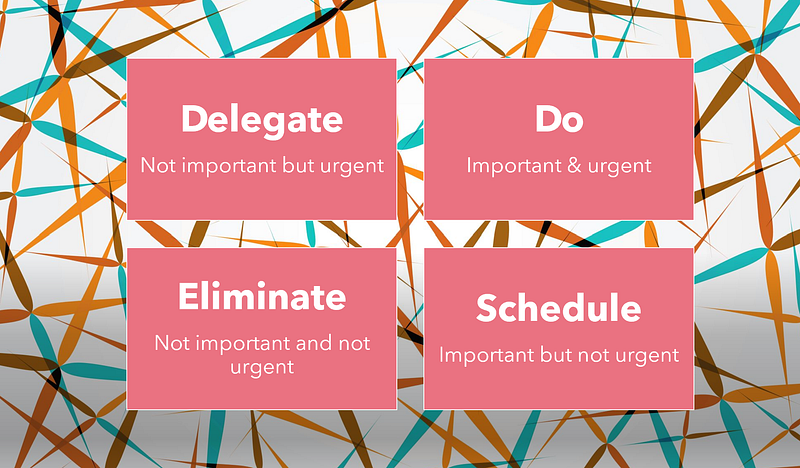
You create a simple matrix with the following four categories:
- not important but urgent → DELEGATE
- important and urgent → DO
- not important and not urgent → ELIMINATE
- important but not urgent → SCHEDULE
Then you assign each of your tasks to one of those categories. You should delegate not-so-important but urgent tasks if possible.
Be aware that delegating needs to be done in the right way to get the results you expect.
You should implement the tasks from the second category “DO” yourself, as they are due soon and likewise important.
You can then schedule and implement the important, but not urgent ones yourself later.
For the fourth category, you should ask yourself if it is necessary to do these tasks at all. If they can’t be eliminated, you can hopefully delegate them or schedule them some time later, if they have to be done by yourself.
Tip
I implemented the Eisenhower method by using my Outlook Email Account.
For each category, I have a folder where I use an Email draft with a description of the item I need to do.
You will find out how I work on them in this article.
2. Pomodoro and 60-60-30 method
Two in one! These two methods are similar. First, I will explain the popular Pomodoro method and then the 60–60–30 method.
The methods are also easy to implement, you just need a clock (e.g. your mobile phone or a kitchen timer) and something to write, like classical pen and paper, Microsoft To-Do or OneNote, or any free tool.
The Pomodoro method can be consolidated into five simple steps.
If you like a more detailed version, you should read the book [1]. There the “Write all tasks down”-step is broken down into a “To-Do Today” sheet with specific columns like the place, date, author, and more details.
To understand the method, these steps are sufficient:
- Write all tasks for today down and prioritize
- Set the alarm clock to 25 minutes
- Work focused for 25 minutes on one task until the alarm goes off
- Take a break of 5 minutes
- After four Pomodoro units, take a break of 20–30 minutes
Fun fact: This method is named after the little kitchen timers that look like tomatoes: Pomodoro is the Italian word for tomato[1].

The 60–60–30 method is basically the same, but with longer time intervals:
- Write all tasks down and prioritize
- Set the alarm clock to 55 minutes
- Work focused for 55 minutes on one task until the alarm goes off
- Take a break of 5 minutes
- Set the alarm clock to 60 minutes
- Work focused for 60 minutes until the alarm goes off
- Take a break of 30 minutes
Tip
I tried both methods, and this is what worked best for me: when taking the short break, firstly I drink one glass of water and then do some quick stretching.
The first long break is for eating, and after another four units of Pomodoro (or a second time of 60–60–30), I am going for a walk.
Depending on what time you start with the method, you can switch the eating and walking, but I think both are important.
Difficulties
I found it difficult to use the strict and short time frames of the Pomodoro method because the tasks should be divided into time slots that fit the method.
Otherwise, you will start with the second task, maybe shortly before the break, which wouldn’t be efficient. The 60–60–30 was easier for me because the slot is bigger.
I could prioritize my tasks in the way that in one slot I could either do:
- 2 tasks of 30 minutes, precisely, one of 30 and one of 30 (or 25 in the first unit)
- or 3 tasks of 20, 20, and 20 (15) minutes
- or one big task of 60 (55) minutes
You could try any time slot and find out which works best for you.
The important part is to focus during the units, work without distraction, and have only a short break in between. After the set of units, you should take a longer break.
Another disadvantage for me: the method works on all items due today — I usually need to structure and plan all my tasks for more than one day.
3. Eat The Frog
Eat the frog is another way of saying “work before pleasure”. The method consists of one rule: do the task you like at least at first.
When you do the worst task in the morning, your concentration and energy are usually the highest, and the remaining tasks of the day will automatically seem much easier.
You will remember that you have already accomplished the most difficult one!
Tip
Write down all tasks and pick your least favorite one. Start right away with that one, with no distractions.
Summary
There are of course more than three helpful methods for time management.
Maybe you miss the Pareto principle, which is also one of the most common time management approaches.
Read here why I don’t recommend that method, though it might be helpful for some of you.
It is now up to you to find one or more time management methods that fit you and your tasks, and start applying them in your daily work routine.
Join with my link to get full access to all stories on Medium!About Me — Iris B. Stehn ▪ Twitter ▪ Facebook[1] source: “The Pomodoro Technique” by Francesco Cirillo, date of publication: 19 October 2006