
Top 10 Latin American Startups to Watch in 2020

This post is from early 2020! Check out my newer post on Latin American Startups to Watch in 2021 here:
By popular demand, I’m releasing another edition of my “Top 10 [Location] Startups to Watch in 2020”. This time I’ll be focusing on Latin American Startups.
If you’d like to catch up on other startups to watch:
- Top 10 Chinese Startups to Watch
- Top 10 Indian Startups to Watch
- Top 10 Israeli Startups to Watch
- Top 10 Middle East Startups to Watch
- Top 10 African Startups to Watch
- Top 10 European Startups to Watch
Each of these posts explores the unique characteristics of each startup market, ranging from the funding sources, past successes/failures, and growth trajectory.
Interested in Investing in Startups Like These?
Check out the Mitchell Ventures syndicate on AngelList here: https://angel.co/mitchell-ventures/syndicate
Latin America’s Startup Environment in 2020
It’s amazing how much a year can change things! When I wrote about the Top 10 Latin American Startups to Watch in 2019, the region was just beginning to emerge as a tech powerhouse.
As I wrote that post close to a year ago, Latin American companies were starting to be accepted regularly into top accelerator programs, unicorns were emerging from the region a few times per year, and many governments were investing significant time and energy in helping startups flourish.

But, despite all of that growth and optimism, I’m not sure that even I thought startups and investments would ramp up so quickly in 2019! For a prime example of that growth acceleration, just check out this chart below.
In the first half of 2019 compared to the first half of 2018:
- Brazil startup investment was up 81%
- Mexico startup investment was up 4.2x
- Colombia startup investment was up 11.5x* (!)
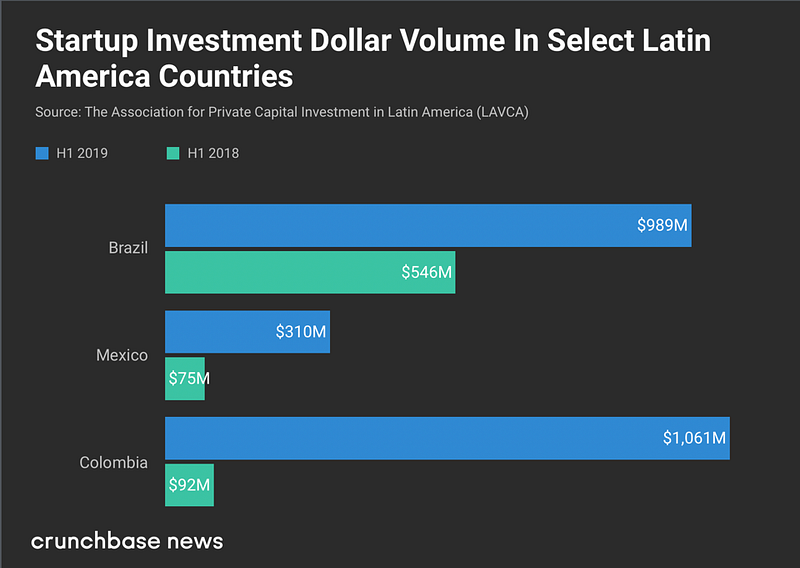
*Note: Much of this massive gain in Colombia was due to a mega-round raised by super-app Rappi.
This rapid growth in funding led to an equally rapid creation of unicorns throughout 2019. Brazil alone saw five unicorns born in 2019 (!) and overall, the region saw 7.
Latin American Unicorns Created in 2019
- Prisma Medios de Pago (ARG) — January 2019, when the private equity company Advent International bought 51% of the Argentine payments company for $700 million.
- Auth0 (ARG) — May 2019, when the Argentine Identity as a Service startup announced a round of $103 million, led by Sapphire Ventures.
- Loggi (BR) — June 2019, when it received funding of $150 million, led by SoftBank and Microsoft.
- Gympass (BR) — June 2019, when it received funding of $300 million, led by SoftBank and by the American fund General Atlantic.
- QuintoAndar (BR) — September 2019, when it received funding of $250 million, led by SoftBank and by the American fund Dragoneer.
- EBANX (BR) — October 2019, when the startup received funding from the US fund FTV valuing it at just over $1 billion.
- Wildlife Studios (BR) — December 2019, when the mobile games startup received an investment round of $60 million led by the San Francisco based VC fund Benchmark Capital, reaching a valuation of $1.3 billion.
Source: Ebanx
The Brazilian innovation platform Distrito estimates that, based on LAVCA data, Latin American startup investment in 2019 reached $3.5 billion.
However, not everything is perfect in the world of Latin American startups. Here is a pretty sobering fact: Only .4% of the $400 billion in venture capital funding deployed between 2009 and 2017 went to Latin American women (Source).
Things are changing, but they’re not moving fast enough. In a 2018 survey of 50 startups selected for accelerator programs in Latin America, 28 percent had female founders (TechCrunch) — experts say that number is growing too.
This year, I’m very excited to feature one of the companies responsible for (at least part of) that change: Laboratoria. Check them out!

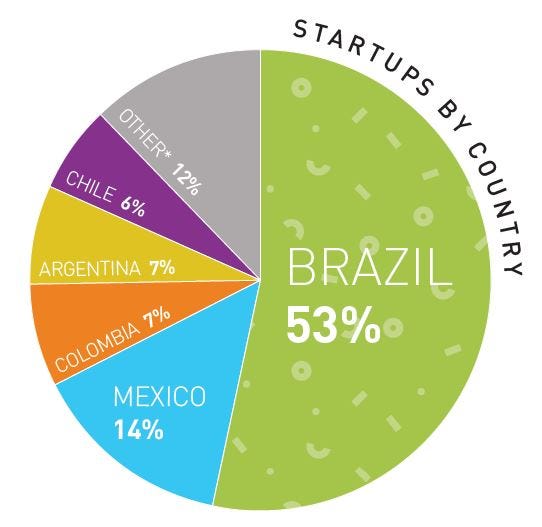
In addition to the heavy male-skew, startups and funding historically have been very concentrated in Brazil (see below). However, as I shared before with the growth in Mexico and Colombia, this is changing rapidly too.
I’m more excited than ever for the future of Latin American startups as they continue to change things for the better in the region and the world!
New! A VC’s Perspective on Latin America in 2020
I’m excited to introduce a venture capitalist’s perspective on the investment market in Latin America.
Chinedu Enekwe and Mark Fleming are the founders of Aux21 Capital.
Chinedu Enekwe has an extensive history as a VC and currently serves as CEO and Managing Partner of AffinityVC and Co-Founder & Board Member at tiphub.
Mark Fleming is an experienced VC who has invested in consumer and fintech startups around the world; helping them to become more globally dominant. Before moving back to the United States, he lived in Hangzhou, China where he was working at Alibaba Group as a part of Jack Ma’s management globalization program.
Take it away Chinedu and Mark, I’m excited to hear what you think is in store for Latin American startups in 2020!
The venture capital industry is still small in Latin America but we see that changing over the next decade. Although small, at about $2 billion dollars, the VC market is 4x larger than it was just 5 years ago. For example, in Brazil, where as noted above, startup investment is up 81%, it is still just .04% of the economy where it is 0.43% in the US (10x).
In the past, the VC community operating in Latin America was fairly local but this has changed. Several International VC’s and corporations (Sequoia, Naspers, Didi, and Alibaba) are already heavily investing in the region. In fact, co-investments with local VC’s represent nearly 60% of all LATAM investments. As more international VC’s enter Latin America we can expect to see more activity at higher valuations. These investors continue to bring access to global markets and increased sophistication so that LATAM startups can begin to compete in several markets at once.
The major selling point for VC’s to invest in LATAM startups is the high smartphone penetration. This means that startups in this region can create companies that tap into this consumer base and grow fairly quickly through social channels. Mobile first technology is a real advantage for Latin America startups that build companies that can scale into this large consumer base.
Fintech is the major sector we are following because the smartphone penetration high yet the use of financial products remains low. A key hurdle in scaling fintech startups has been coordinating the various regulatory issues across the region. Every country wants to entice investment in local startups but governments will need to get rid of longstanding red tape that is inhibiting investment attraction. As each country makes doing business easier, I expect these laws will eventually lead to regional standardization of fintech laws.
In 2020, LATAM’s tech scene is set for another year of double-digit growth. In particular we expect these trends:
* Increased joint investing partnerships between regional LATAM VC’s and international VC’s
* An increase of partnerships between universities and startups & incubators
* Government continuing to streamline fintech regulations
* Look for logistics startups to reach higher valuations in 2020, especially those that link several LATAM countries together
Thanks, Chinedu and Mark! Now to the Top 10.
How Did I Choose This Top 10?
With so many great startups to choose from in Latin America, how could I possibly narrow the list down to only 10?
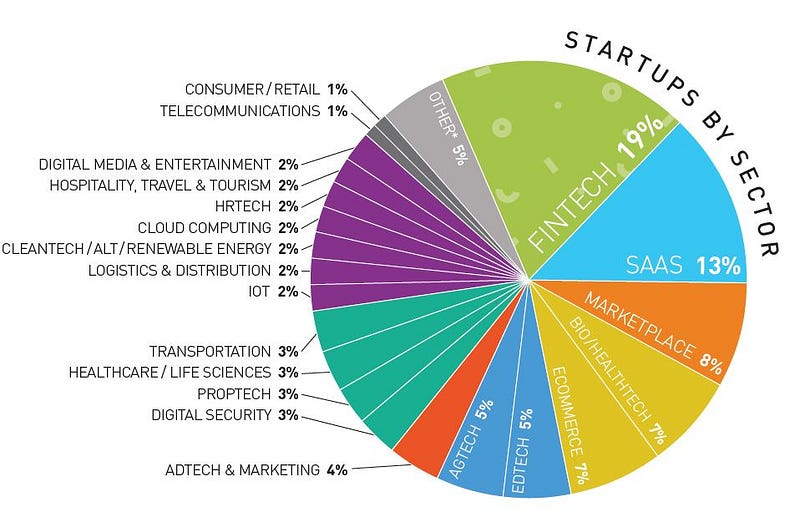
For this year’s list, I focused on countries and companies involved in the most in-demand, scalable, and investor-validated industries. This led me to a lot of Fintech, Logistics, Recruiting, and Real Estate startups.
Enough background, let’s get to the list!
The Top 10 Latin American Startups to Watch
- Liftit: Logistics Platform for Latin America

For those who have read my past posts on companies to watch in Africa and China, my inclusion of a trucking/logistics company should be no surprise!
Liftit is now 3 years old and has rapidly scaled across key markets in the region. The company offers a wide range of logistical support from long haul to last mile. Their technology platform also provides managers with route optimization, monitoring, and notifications.
I expect Liftit to continue to expand to new LATAM countries in 2020 and raise a significant amount of funding this year to do so.
Offices In: Bogota, Quito, Sao Paulo, Mexico City, Santiago
Total Funding: $26.5MM
2. Ualá: Argentine Neobank

Ualá is the massively funded fintech app that you need to know about (if you don’t already!)
Only founded in 2017, the company has already brought in close to $200MM in funding to become the first Argentian Neobank. Investors are hungry to replicate the success of the Brazilian unicorn Nubank, which is currently valued north of $10B (!).
After years of scandal, lack of investment and innovation, banking is finally changing rapidly in Latin America. Fintech startups are right at the center of that change.
But, do we have too many highly funded Neobanks in the region? Only time will tell!
Offices In: Nicaragua, Argentina
Total Funding: $194MM
3. Nequi: Payments, Budgeting, and Financial Goals
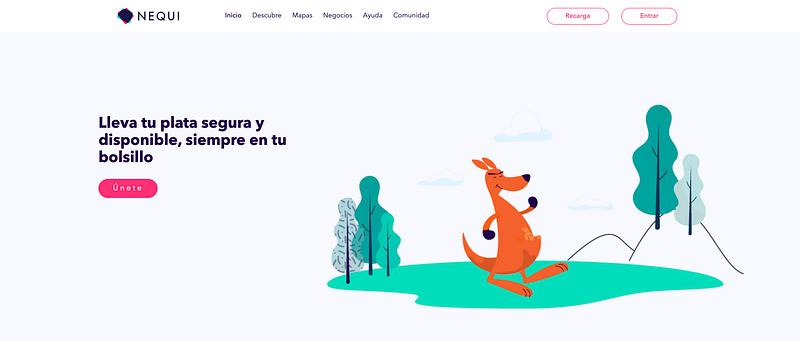
Nequi is also competing in the Neobank market, but focusing primarily on Colombia. They’ve been around since 2016 but have not disclosed funding amounts. In addition to the standard mobile wallet and p2p payment features, Nequi also has a strong partnership with PayPal that makes it very easy to transfer money with relatives in the USA.
Will 2020 be the year Nequi expands to other regional countries and begins disclosing more about their growth and funding? I sure hope so!
Offices In: Colombia
Total Funding: Not disclosed
4. Laboratoria: Coding School for Women

Tech startups need tech talent. Most specifically, they need developers to put their funding to work and to build and scale their products! Laboratoria is a coding bootcamp that helps both train female developers and also connects them to tech companies in the region.

Don’t let their (relatively) small amount of funding fool you, they are scaling fast across Latin America and have made a strong impact already with thousands of graduates!
I especially like how the company has expanded to also offer services to businesses looking to diversify their employees and their workplace. If Latin American startups keep scaling in 2020, they’ll need tons of talent. Laboratoria is an integral part of creating that talent pool.
Offices In: Lima, Santiago, Sao Paulo, Mexico City, Guadalajara
Total Funding: $750k
5. Digital House: Coding School in Brazil and Argentina

Two code schools in the same top 10 list?! Yes! It should be no surprise given what I just said about Laboratoria, that we need many more tech schools in South America.
Digital House already has a strong presence in Argentina and Brazil, but is planning to expand to Mexico and other LATAM countries in 2020.
Offices In: Argentina, Brazil
Total Funding: $20MM
📣 Thanks for reading! If you’re enjoying this post, I know you will find major value in Africa: The Big Deal Startup Deals Database! And, even better, you’ll get 10% OFF with my special link below:
In the Big Deal Database, you’ll find:
- A monthly updated Excel database listing ALL $100K+ funding deals secured by startups in Africa
- Included with your initial subscription: The entire dataset from Jan 2019 to December 2022
- The database includes critical details like the number of employees, funding amounts, type of deal (Seed, Series A, B etc.), whether this transaction was an exit, startup valuation (when disclosed), investors, and much, much more!

If you’re investing or building in Africa or simply want to become as educated as possible on the fastest-growing startup ecosystem, you need the Big Deal Database!
6. Loft: Connecting Buyers, Sellers, and Renters in Brazil
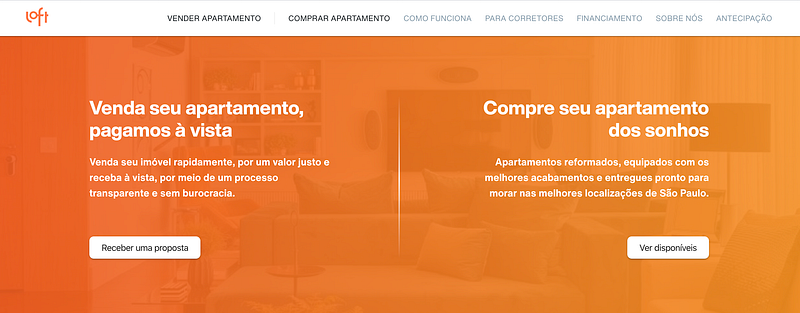
Similar to the financial sector, real estate in Latin America needed a major facelift. Several real estate startups have found early success including QuintoAndar and Sao Paulo based Loft is as well. Loft has raised several rapid-fire scaling rounds, most notably a $175MM Series C investment in January 2020 led by Andreesen Horowitz.
Similar to what Opendoor is doing for low-friction home sales in the USA, Loft is doing for Brazil. After purchasing apartments quickly in cash, Loft renovates and modernizes them before putting them quickly back on the market for new buyers. This process has worked very well for them over the past year and a half since their founding and I expect them to start to scale regionally and even more dramatically funding-wise in 2020.
Offices In: Sao Paulo
Total Funding: $263MM
7. Revelo: Job Matching for Professionals in Latin America

Revelo is bringing a fresh approach for professionals to help them find their perfect jobs in Latin America. The company inverts the hiring process, creating a marketplace for professionals, similar to the initial concept of US-based Hired. In August 2019, the company raised a Series B round of $15MM, providing evidence that the approach is working.
Watch out for Revelo in 2020 as they continue to help thousands of professionals level up and find the jobs of their dreams.
Offices In: Sao Paulo
Total Funding: $20.5MM
8. Emcasa: Real Estate in Latin America

Similar to Loft, Emcasa plays on both sides of the real estate market in Brazil. The market is big enough for more than one player, but 2020 may be a make or break year for Emcasa.
Their last funding round was in 2018 and flipping properties is an expensive business and one that requires scale and a ton of debt funding (usually).
Offices In: Sao Paulo
Total Funding: $7.6MM
9. Unima: Affordable Diagnostic Tests for Remote Areas
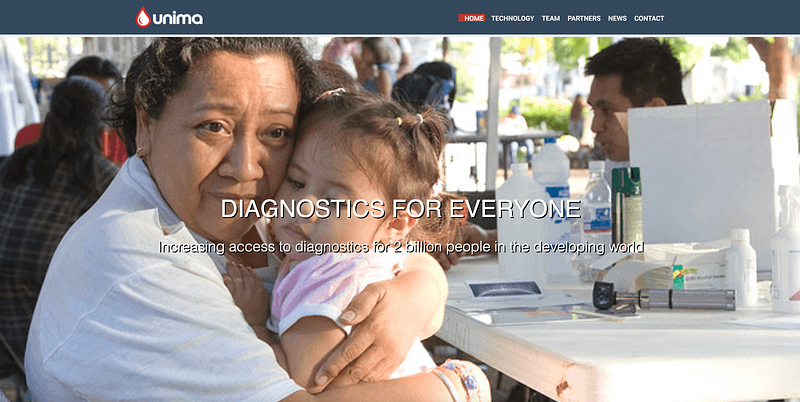
Unima is a very different type of company from the ones I’ve profiled so far on this list. The company offers extremely low-cost diagnostic tests ($1) that can be administered in very remote areas with very little training.
This price point is a 10x reduction from comparable offerings (!)
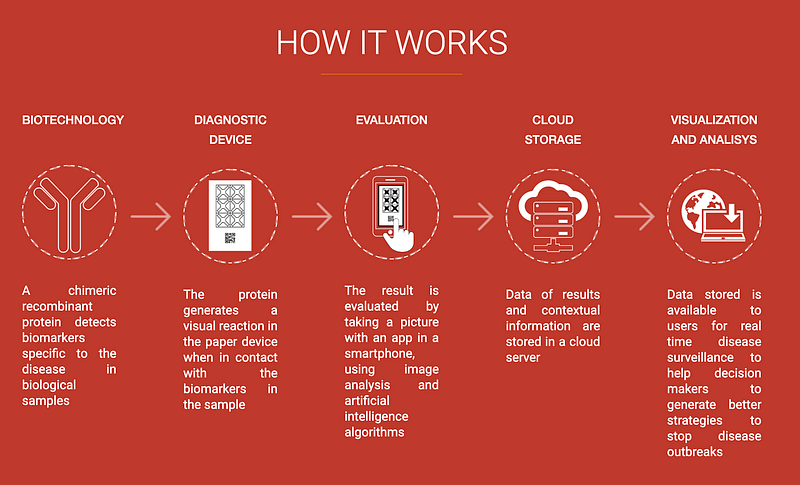
Unima is making an incredible impact throughout the region and the world and I’m very excited to see their continued growth and success in 2020.
Offices In: Jalisco, Mexico
Total Funding: $2MM
10. Kushki: Payment Platform/Backend for Latin America

Kushki is a backend payment platform serving many leading Latin American companies including Rappi, Cabify, and Telefonica.
The company provides a single payment API that works across the Latin American region. Kushki supports these leading startups with currency and local payment options. As these startups scale, Kushki will scale in 2020.
Offices In: Colombia, Ecuador, Peru, Chile, Mexico
Total Funding: Not Disclosed
Honorable Mentions
LinkAPI: Integration Platform
Offices In: Sao Paulo
Total Funding: $1.6MM
Provi: Loans for School
Offices In: Sao Paulo
Total Funding: $1.3MM
La Haus: Technology + Real Estate
Offices In: Colombia
Total Funding: $6.4MM
Workana: Freelancers and Freelance Jobs Online
Offices In: Buenos Aires
Total Funding: $12.2MM
What Latin American Startups Did I Miss?
I’m sure I missed quite a few prolific, fast-growing Latin American startups. Let me know which ones on Twitter at @amitch5903!
Interested in Investing in Startups Like These?
Check out the Mitchell Ventures syndicate on AngelList here: https://angel.co/mitchell-ventures/syndicate
Must Read Books on Latin American Startups
1. 200+ Fast Facts about Technology in Latin America
2. Crossing Borders: A Venture Capitalist’s Guide to Doing Business in Latin America
3. El Valle de Silicio: Why Latin America Will be the World’s Next Tech Boom
More from Alex Mitchell on Medium
📝 Read this story later in Journal.
👩💻 Wake up every Sunday morning to the week’s most noteworthy stories in Tech waiting in your inbox. Read the Noteworthy in Tech newsletter.
Disclosure: Some of the links in this post are affiliate links, meaning that at no additional cost to you, I earn a commission if you click them and purchase a product.