
Tokyo Crow City
Globetrotters September Challenge: Wildlife
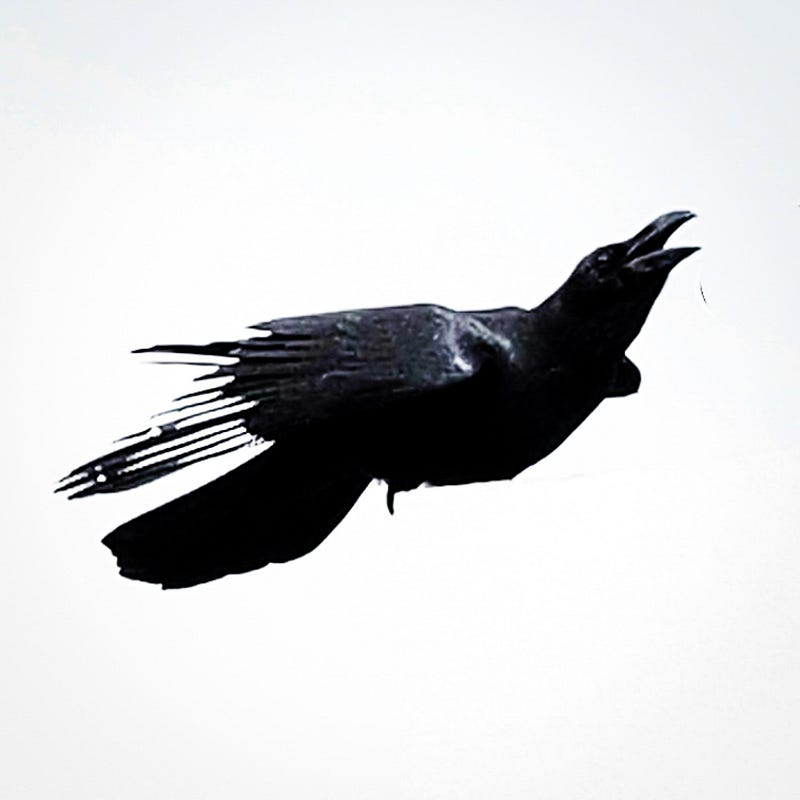
Japan’s got crows. And ravens (we use the same word for both: “karasu”). Lots of ’em. They’re BIG. Much bigger than the ones I’m used to in Toronto. And smart, and sometimes mean.
As we shall see, they’ve played a prominent and vexing role in the daily life of urban and rural Japan for a long time.
But first, a little backstory about me
I have written about the surprises that greeted me when I arrived in Japan. Daily adventures and misadventures are one of the reasons I am still here now: a three-year overseas experience transformed into a 25-year expat life.
Living abroad keeps you on your toes and young at heart.
This is good news because the way things look, I will keep one or both feet in Japan even after retirement.
So, this post will not be my last about my ongoing adventures :-)
One of the biggest surprises that awaited my arrival two and a half decades ago was the diversity of terrain, climate, and even wilderness that makes up the Japanese archipelago: a chain of five “main” islands and thousands of smaller islands and islets that stretch from Hokkaido in the north, almost a part of Russian Siberia, to the far, far south — almost in Taiwan.
Hokkaido is the most remote and least densely populated of the main islands. It is home to some of Japan’s wildest forests, rivers, and mountains, and a refuge for some of Japan’s largest “N” Nature, including the higuma brown bear — an island-sized cousin to the grizzly — giant eagles, Sitka deer, foxes, red-crowned cranes, and wild salmon.
I lived on Hokkaido during my first four years in Japan. That experience of sultry summers in the mountains, active volcanoes, and deep, deep hibernating winters will always be a peak experience in my life.
However, even here on the densely populated “main island” of Honshu, in the vast urban sprawl of Tokyo’s neon-lit streets, cutting-edge technology, and whirlwind of human activity, “city life” has an often overlooked aspect to it: fish and fowl; and the usual furred mammals that share the liminal spaces between human space and the rural suburbia which encompasses it. Koi decorative carp, for example, swim in park ponds and other brackish backwaters; so do ducks and turtles. Photogenic herons and kingfishers fish the shallows. Songbirds alight on power lines and the whispy tops of bamboo, as do pigeons, of course, and crows — more on those in a moment.
Flute-throated cormorants fish the moat around the Imperial Palace at the spiritual and physical heart of the city.
And, in the wilder spaces where the suburbs mingle with the uninhabitable foothills, mountains and volcanoes which take up 70% of Japan’s crowded landmass, macaques and the occasional deer, bear, boar, and indigenous serow are also citizens of the Greater Tokyo Area.
In other words, it was NOT what I expected from the world’s greatest metropolis.
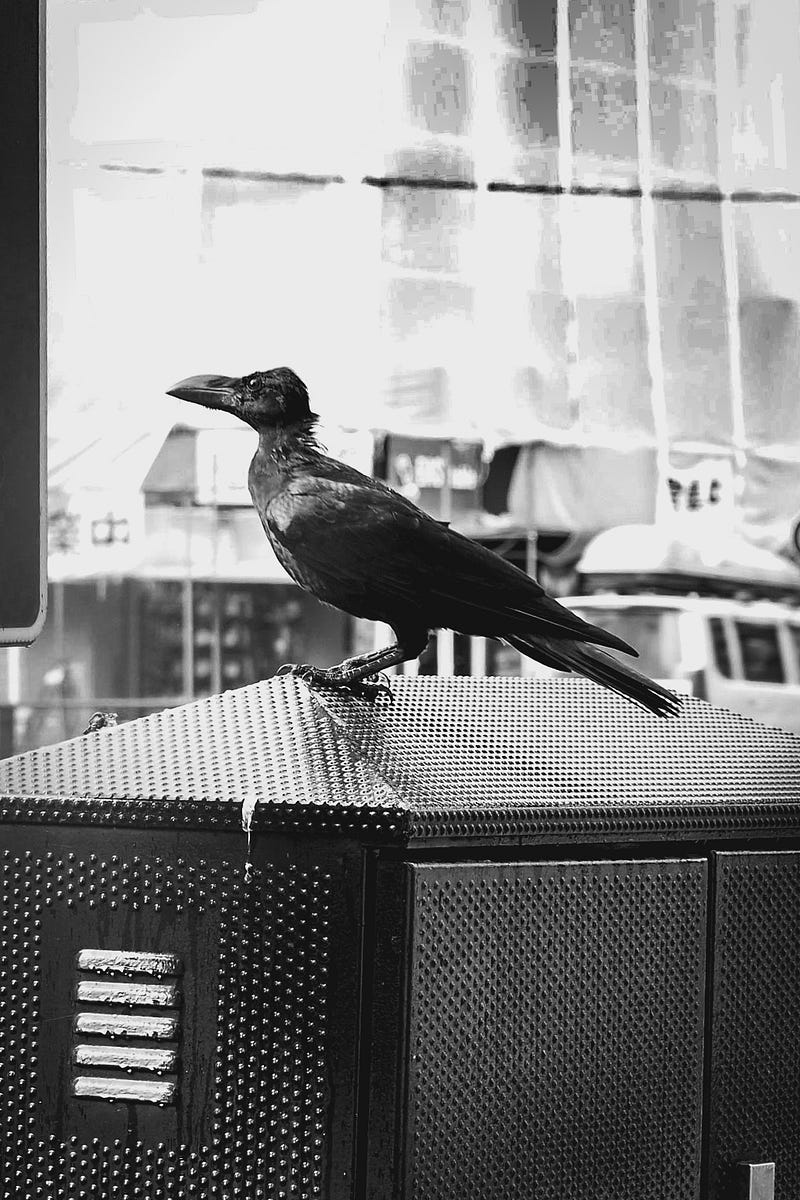
In this post, I want to talk about the most ubiquitous critter in the city, countryside, and even wilderness: the crow.
First, just a couple of notes of clarification. The species that dominates Tokyo’s airspace — and most threatens Tokyo’s morning garbage collection — is the jungle crow, a larger species with body lengths approaching 60cm (two feet in America, Liberia, and Myanmar).
Also, and I Googled this for the record :-), a flock of crows is a “murder.” There is, apparently, a folktale that crows will gather and decide the capital fate of another crow.
Anyone who has seen crows execute one of their own won’t quibble with the appropriacy of the term “murder.” At the international school where I teach, we once had to evacuate the junior school playground of hurried students as a small cadre of particularly fierce crows gruesomely executed one of their own. Blood, feathers, and crow caws everywhere.
In Japan, crows are not always associated with bloodthirsty hunters and scavengers.
Crows in Traditional Religion
In the traditional animist Shinto religion, crows are associated with the sun goddess Amaterasu. In one story, the sun goddess Amaterasu hid in a cave after a quarrel with her brother, the storm god Susanoo. The world was plunged into darkness, and the other gods needed to find a way to coax her out. They gathered outside the cave and made a lot of noise, including crow calls. Amaterasu was curious to see what was happening, so she peeked out of the cave. When she did, she saw her reflection in a mirror and was so startled that she emerged entirely from the cave.
The crow is also considered a messenger of the gods. In another tale, Amaterasu is believed to have sent a white crow from the celestial realm to Earth as a messenger. Over time, the crow turned black due to its misdeeds, but its status as a divine bird remained.
Japanese Shinto also has karasu-tengu, half-crow, half-human goblins, and Yatagarasu, a three-legged crow whose appearance is evidence of divine intervention and today is the emblem of the Japan Football Association. Yatagarasu is said to have appeared to Emperor Jimmu, the legendary first emperor of Japan, and guided him to victory in battle.
Crows in Folktales
Another famous story is about a crow who helped a farmer save his crops. The farmer was having trouble with a group of crows eating his seeds. The crow who helped the farmer told him to plant a scarecrow in the middle of his field. The scarecrow worked well initially, but the crows eventually got used to it and started eating the seeds again.
The crow who helped the farmer told him to change the scarecrow’s clothes daily so that the crows would not get used to it. The farmer did as the crow said, and the scarecrow worked again. The crows were so confused by the scarecrow that they eventually gave up and flew away.
In “The Tale of Genji,” the crow’s cry symbolizes death and misfortune. The crow’s cry that announces the death of Rokujō no Miyasudokoro is particularly poignant, as it marks the end of a tragic love story.
Symbol of Rebirth
Drawing parallels with global myths, the crow in Japanese culture is also seen as a symbol of rebirth and rejuvenation. Their black plumage is associated with the void or the cosmos, and their raucous calls, especially at dawn, signify the awakening of life.
In a particularly nurturing children’s song, “Nanatsu no ko,” a mother crow looks after her seven lovely crow children.
Haiku poets, notably the nature-loving Basho, had it in his heart to find love for birds that, despite their divine associations, already had reputations as pests. They stole food; they were ugly to look at and hear, and so on. But Basho loved nature too much to hate any part of it.
On a withered branch A crow is perched An autumn evening
枯朶に 烏のとまりけり 秋の暮
kare eda ni karasu no tomarikeri aki no kure
Matsuo Bashō, 1680
Nevertheless, he expressed the common view of his audience towards crows in this haiku.
detestable crow this snowy morning he’s beautiful
ひごろ憎き烏も雪の朝哉 higoro nikuki karasu mo yuki no ashita kana
Perception of Crows Today, Especially in Tokyo
Crows are still a common sight in Japan today, especially in urban areas like Tokyo. Crows do perform at least one useful action in that they hunt and eat mice. For a city the size and density of Tokyo, it’s amazing how rarely one sees any mice or rats in the city. The crows have made the rodent problem almost non-existent.
Nonetheless, their perception has changed over the years. If anything, their presence has become even more pernicious to city dwellers.
As noted, crows are intelligent and have keen memories. They remember and can easily find the neighborhood collection spots for household waste, and woe betide the stray bag of garbage which is not adequately camouflaged in a translucent bag and secured under a blue or yellow tear-proof crow net. The contents of said bag will soon enough be scattered across the road, accompanied by the homeowner’s lament as they must clean up the mess.
The City’s War on Crows
The problem has reached the point where the Tokyo city government has implemented a number of measures to control the crow population. These measures include trapping and nest removal. However, crows remain a common sight in Tokyo, and they are likely to continue to be a part of the city’s ecosystem for many years to come.
The Tokyo Metropolitan Government has been waging a war on crows for many years. In the 1960s, the city government launched a program to poison crows. However, this program was met with public outcry and was eventually abandoned.
In the 1970s, the city government launched a new program to trap crows. This program has been more successful, but it has not been able to completely eliminate the crow population.
Today, the city government continues to trap and remove crow nests. The city government also uses a variety of other methods to control the crow population, such as playing loud music and using falconry.
Conclusion
Crows have been a part of Japanese culture for centuries. They are featured in traditional religion, stories, and folktales. Crows are often seen as symbols of wisdom, guidance, and even the supernatural. However, they can also be seen as pests and nuisances.
Crows and ravens, known for their intelligence and adaptability, have found a unique niche in Tokyo’s urban ecosystem. Unlike many other wildlife species that find city life daunting, these birds have thrived amidst skyscrapers and city streets. Their scavenger nature has allowed them to utilize food waste, and their cunning has enabled them to navigate the challenges of urban life effectively.
They serve as nature’s custodians in Tokyo, aiding in waste decomposition by foraging on organic waste, especially in areas where garbage is improperly disposed of.
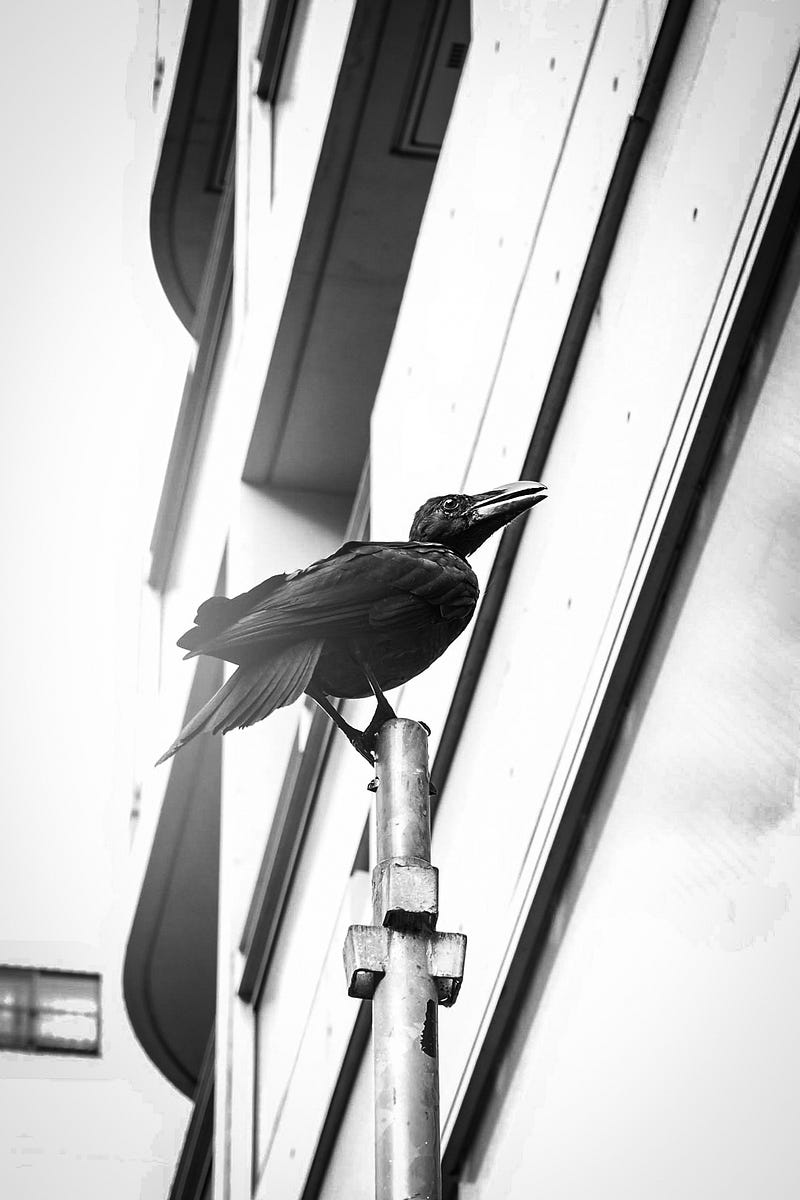
Today, crows and humans continue their on-again, off-again relationship with humans as they have happily (I know — they’ve told me) adapted their clever, scavenging ways to Japan’s developed countryside and cities — some of the busiest and most densely packed in the world, and jammed with all manner of deliciousness just waiting for the bird clever enough to feast on it.
A couple of shout-outs:
To Joel R. Dennstedt for his documented adventures
And Anne Bonfert for her “backyard” wildlife safari