
Todd Monken, head swashbuckler
The secret behind the early season success of the Tampa Bay Buccaneers
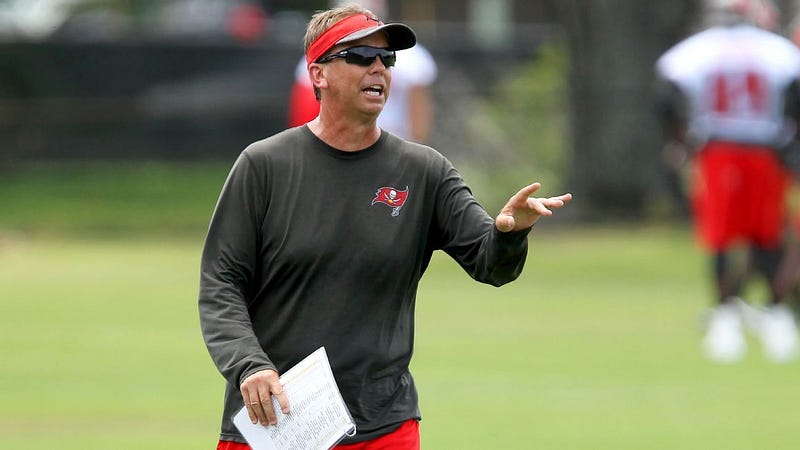
Take nothing away from the fact that Ryan Fitzpatrick leads the NFL in passing yards through the first two weeks of the season. DeSean Jackson leads the NFL in receiving yards through those same two weeks. And Mike Evans is still one of the seven best wide receivers in the NFL. What if the key to Tampa Bay’s 37.5 points per game — the second-highest average in the NFL right now — is actually a guy who doesn’t even play on the field?
Five years ago, Todd Monken was barely-a-blip-on-the-radar head coaching hire at The University of Southern Mississippi, a school that had gone 0–12 the previous season.
After taking that same Golden Eagles team to nine wins just three seasons later, and overseeing an offense that was 12th in the nation in total yards per game and 13th in the nation in points per game, Monken was another nondescript hire by the Tampa Bay Buccaneers, brought on by new head coach Dirk Koetter to be his offensive coordinator in name, even though his true responsibilities were acting as the wide receivers coach and helping install Koetter’s weekly offensive game plan in general.
But whether it was Koetter eventually realizing that the job of the head coach is too cumbersome to where he couldn’t devote that much human bandwidth to designing offensive game plans and calling plays, or whether Koetter — coming off of Tampa’s disastrous 2017 season — decided that something drastic needed to be done if he was to save his job in general (he was one of the favorites to be the first head coach fired in 2018), he decided to cede the full-time play-calling duties on offense over to Monken.
And the rest, as they say, is history (at least so far).
Boom town
Tampa Bay’s offensive explosion wasn’t entirely out of the blue. The Buccaneers scored 89 points in their first three preseason games with Monken calling plays (instead of Koetter), and both Fitzpatrick and Jameis Winston both played well in those games. And through the first two regular season games of 2018, Tampa Bay has the highest-scoring offense in the NFC (scoring more points than the vaunted offense of Sean McVay and the Los Angeles Rams), and only two less points than the offense of the Earth-scorching Kansas City Chiefs.
The interesting wrinkle in all of this is the fact that we’re currently in a time where NFL coaches are, rather ironically, looking toward the college game for more ideas around offensive innovation, headlined by University of Oklahoma head coach Lincoln Riley suddenly becoming “the Oracle of Norman” that NFL coaches spent the offseason consulting. In that vein, the Buccaneers might have a similar innovator right on their own staff.
Monken was brought up with some of the leaders of college football’s spread offense mindsets, including Les Miles (at Oklahoma State and LSU) and Mike Gundy (again at Oklahoma State). Monken turned wide receivers like Rashaun Woods and Justin Blackmon into first round picks, and designed a scheme that was good enough to trick NFL teams into thinking that Brandon Weeden was good enough to play in the NFL. At LSU, Monken helped Dwayne Bowe pile up 990 yards receiving and 12 touchdowns in the former’s offense.
Recognizing two games does not a season make, it’s still hard to discount what Tampa’s offense, with Monken calling plays, has accomplished. On passing thrown more than 30 yards downfield, Fitzpatrick is four-of-five such attempts, with all four of those being touchdowns. Only six quarterbacks had four touchdowns like that last season, according to ESPN Stats & Information research; Fitzpatrick has done that in two games.
Evans went for 147 yards and a touchdown in Tampa’s first game of 2018; he had only one game with more than 100 yards receiving last year, and it didn’t come until Christmas Eve. Through two games, Jackson has three touchdowns; by comparison, he had three touchdowns all of last year. It’s no wonder that he feels rejuvenated to the point where he’s starting to call this offense “unstoppable.”
What’s the rush?
In fairness, it’s not like the entirety of Monken’s offense is making it rain. The Buccaneers average a league-low 2.7 yards per carry, and mustered up a laughable 43 yards rushing against Philadelphia last week. Their inability to run the ball was one of the reasons Philadelphia threatened to actually come back for a win, despite trailing 27 to 7 midway through the third quarter. The talent-versus-scheme argument is the classic chicken-and-egg question; Peyton Barber has been completely uninspiring, and Ronald Jones looked completely unplayable in the preseason.
Given that, Tampa Bay’s future opponents will adjust accordingly. That begs the question: what happens when opponents decide they’re going to basically rush three guys and drop the remaining eight in coverage, forcing Fitzpatrick to make safe and smart throws? We are talking about a guy who’s thrown 15 or more interceptions five times over the past nine years.
Tampa Bay’s guys on offense clearly feel like they’ll cross that bridge when they come to it. For now, Fitzpatrick’s postgame outfit after defeating Philadelphia this past Sunday, which made him look like a cross between Conor McGregor and Liberaace was fitting, because he’s orchestrating the most flamboyantly lethal offense in the NFL right now (this side of Kansas City), with Monken as his designer.
NFL Week 3 Picks
NY Jets at Cleveland (-3) — pick made before the game Indianapolis at Philadelphia (-6.5) Cincinnati at Carolina (-3) Tennessee at Jacksonville (-7.5) New Orleans at Atlanta (-3) Denver at Baltimore (-5.5) NY Giants at Houston (-6) Oakland at Miami (-3) Green Bay (-3) at Washington Buffalo at Minnesota (-16.5) San Francisco at Kansas City (-6.5) LA Chargers at LA Rams (-7) Chicago (-6) at Arizona Dallas at Seattle (-1.5) New England (-6.5) at Detroit Pittsburgh (-1) at Tampa Bay
Last Week: 5–11 Season To Date: 16–15–1


