
Today’s America Reminds Me of South Africa in 1985
Will white Americans avoid Apartheid-era mistakes and get out of history’s way?
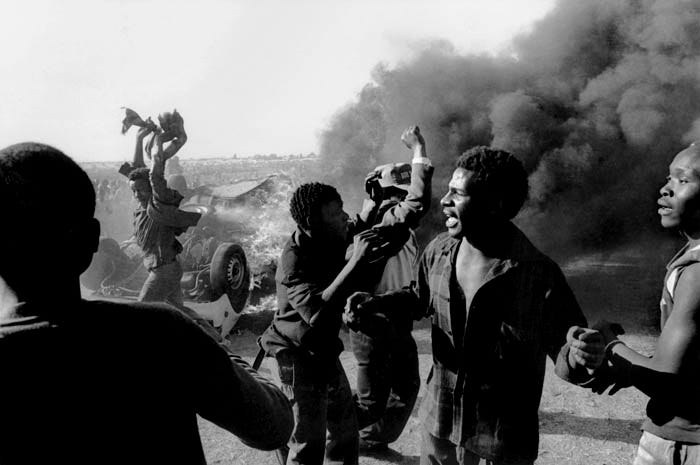
The images and videos of protests and riots in the U.S.A. remind me of my teenage years — the 1980s — in South Africa. It isn’t only the outrage, the police brutality, or the heavily-armed pot-bellied white civilians just itching to get into the fray. Neither is it the commentator-in-chief, laagered in the White House, tweeting about law-and-order to buttress his fading authority. Although he evokes the crocodilian P.W. Botha, I am most struck by the attitudes of white Americans. Several times these past few days, things they have said have evoked in me the most uncanny deja vu.
South Africa in 1985 bears so many similarities and resonances to America in 2020 that I dare not mine them too deeply. The many facets of apartheid racism can be glimpsed in today’s America, excavating the same deep seam of greed, privilege, and dehumanization. And yet the two nations’ paths have often diverged and reticulated in ways that I should best leave to serious historians.
My own experience bears little relevance to the history-making issues at stake in either era or in either country. Nonetheless, I hope it provides some perspective for those people on the sidelines who currently feel threatened by the upwelling of anger, and the eruptions of violence. I am talking to the people who just wish things would settle down and go back to ‘normal’. Who might start a sentence with “I’m not a racist …”. Whose empathy for those who experience racism every day gets trumped by concerns about stability, property, and, yes, law-and-order.
Coming of age in Johannesburg
Apartheid cleft South African society by race, restricting where people could live, work, move, who they could have intimate relations with, and whether they could vote, all on the basis of skin color. The apartheid laws locked the African majority out of society, limiting them to living in crowded ‘townships’, restricting their movement, and preventing economic or political upward mobility. The police enforced those laws with a brutality that often looked like relish.
Neither ‘White’ nor ‘Non-White’ were monolithic categories. Black people came from many different African lineages, with different languages. White people mostly spoke either English or Afrikaans, a home-grown descendent of Dutch. Although the British colonists laid the racist foundation, the Afrikaaner leaders of the National Party enacted most apartheid laws and governed South Africa from 1948 to 1994.
My English-speaking school friends and I, whose parents voted for the Progressive Federal Party, would unironically start sentences disavowing our racism. We would never, we told each other, vote for the Nationalists. Apartheid was their system, and we were unfortunately stuck with it.
We really had no idea how complicit we were. We lacked the perspective. We lived in a genuinely totalitarian state, under a State of Emergency that ensured we only got the government line on events. On the 25th anniversary of the 1960 Sharpville massacre, the South African Police shot at a crowd at a funeral procession near the Langa township killing 35 people. I now know that the police fired the first shot at a 15-year-old cyclist who lifted his hand in a Black Power salute. At the time the news told a different tale, one of valiant police and rampant mobs. The state broadcaster called it “Unrest”, their favorite euphemism, as though society jumped between two quantum states: “rest” or deadly riot.
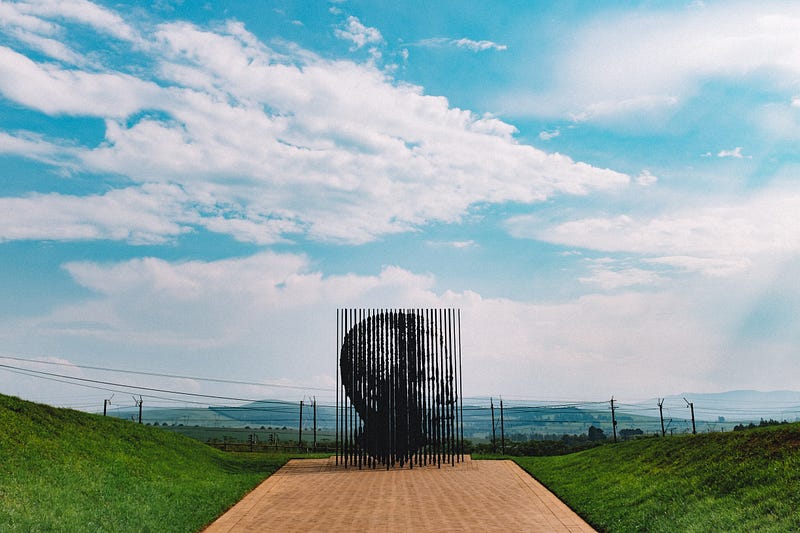
My friends and I knew that apartheid was wrong, sensing the reprehensibility of what was happening to black South Africans. Yet we grew up learning that good, Christian, white people were under siege from Russian-backed Communist hordes. When we heard about Nelson Mandela, the tales were not about a selfless leader, but a juggernaut who refused to renounce violence. We repeated smooth lines about orderly transitions. We worried more about plummeting exchange rates, foreign investment, and American sanctions than about the brutal poverty and disenfranchisement of our compatriots.
Even though President Reagan was pretty cozy with the Apartheid regime, the Democrats in congress were not. More than that, a vocal number of American people considered apartheid an unconscionable stain on humanity’s conscience and demanded its end. White South Africans gleefully deflected their own guilt by pointing out the irony, given America’s complicated history of racism. Yet history shows that the people in America, and many countries around the world, who stood up against apartheid, ended up very much on the right side of history.
I suddenly found myself encountering this strong opposition to apartheid when I traveled to Vancouver in 1988 as an exchange student. Travelling Canada and the U.S.A. as a 17-year-old, suddenly weaned from the anesthetic lies of State media, I saw not only the extent of South Africa’s “unrest” but how Canadians and Americans understood it.
Americans who stood up against apartheid, ended up very much on the right side of history.
That year abroad I waded through a swamp of cognitive dissonance. I believed I wasn’t a racist, and yet I had never interacted with people of other races on anything like equal terms. It became clear how complicit all white South Africans were, irrespective of how progressively they voted, or how bravely they spoke when they were sure the state wasn’t listening. On the few occasions I encountered the Canadian and American police, they acted toward me like genuine peace officers, challenging what I knew about law enforcement.
University and Transition
South African universities, notably my alma mater, have much to be proud of in the way they challenged apartheid and supported their students who protested. And protest students certainly did. The riot police came onto Wits University campus regularly. Students knew how to recognize undercover cops from their ironed stone-wash jeans, and how to neutralize tear-gas by burning lecture notes.
Some of my best friends were revolutionaries. Some of my best friends spent their early twenties worrying about little more than safe parking for their Golf GTis.
Even though many white students joined black classmates in protest, occasionally enduring periods in police custody, many others had far more bourgeois concerns. In this rarified learning environment, surrounded by firebrand student intellectuals and with serious history-making issues to engage in, many students just wanted their contemporaries to obey the law, and keep everything peaceful. They knew apartheid was wrong, and by the early 90s all but the most myopic could tell that it was coming to an end. But if the cops came in and tear-gassed the joint, it would mean they missed second-period Jurisprudence or their Accounting tutorial.
I don’t mean any unkindness toward my classmates or my erstwhile compatriots. I floated between those worlds myself, no less puerile than any of the others. Some of my best friends were revolutionaries. Some of my best friends spent their early twenties worrying about little more than safe parking for their Golf GTis.
White students and other white people lived in safe suburbs, didn’t have to ride public transport, and seldom encountered racism. Police violence was something that happened to other people. They wanted protestors to be peaceful, and policemen to be respected. If they, by which I mean ‘we’, had encountered anything like #BlackLivesMatter, they/we would have reflexively countered with #AllLivesMatter. We would have behaved the way that many American people who believe themselves to be fair, and good, and not racist, are acting today.
We who lived through the death of apartheid have the benefit of hindsight. We can look back and cringe at the trivial nature of our concerns. And we can look back with great pride at how South Africans, somehow, averted the massive catastrophe for which we seemed destined. Many white people agitated and fought for apartheid’s end, just as many white Americans are protesting and working hard to end racism today.
Ultimately, very little of what happened was about us. It wasn’t white South Africans who effected the miracle, but most — eventually — got out of history’s way. And most of us consider it a great honor to have been part of that miracle.
White Americans, right now have a chance to put aside their own relatively trivial needs and to get out of the way of their own nation’s history. All people may indeed be created equal, but not all people’s concerns are equally pressing.


