
A Letter to Americans Who Don’t Want To Self-Isolate
If you really value your ‘freedoms’, then start thinking of yourselves as part of something bigger. Much bigger.
Dear Americans,
We need to talk. This letter contains tough love, dispensed with the best of intentions. The majority of you already get what I am going to say and have been saying it loud and clear for months. This letter is for those of you who feel that the restrictions, guidelines, warnings, and rules associated with the Coronavirus pandemic are a conspiracy, somehow aimed personally at you, or imposed to curtail your cherished ‘freedoms’.
I’m writing to you from a long way away, in a country called Australia. One reason I write is that hopefully you can come and visit us soon. You will see that we are very much like you, but that we do some things a little differently. What is with all those guns of yours, anyway? Haven’t you noticed they tend to kill a lot of people?
Hopefully, I can visit you soon too. I do enjoy visiting your country, especially the places with fewer guns. But before we can get back on those 14-hour trans-Pacific flights, you need to get the coronavirus under control. It is killing even more of your people than the guns are.
Yesterday, not a bad day for the U.S., there were 16,429 new COVID-19 cases. That represents about 1500 times more new cases than the 11 in Australia.
Despite what you might have heard, Australia really does exist. It wasn’t just made up for your entertainment, like some kind of continent-sized version of the Truman Show. If you think Australia is a hoax, then you definitely need to read this. But you also need to watch less television and spend less time on the Internet. So when you finish reading, please take a socially-distanced walk outside, if that is legal in your local area. You need a little screentime-out.
Things can get better
Before I begin telling you how to live your lives, let me tell you something about Australia. As of late May 2020, most of us have been working from home for more than two months now. Children have been doing their schooling from home. Not homeschooling, but checking in with their classes and teachers. The school stuff has presented a challenge for many parents, but the four children who live in my house have done better than I could have hoped.
And now, this week, children returned to school. Many people went back to their workplaces. We can even go to restaurants and pubs if they keep the number of patrons within strict limits.
Those things are all possible because we have very few new cases. I know you don’t all like graphs and numbers, but they can save a lot of reading. This one shows that for a month, Australia has averaged fewer than 20 new cases a day. And our health services are testing the bejeezus out of the population.
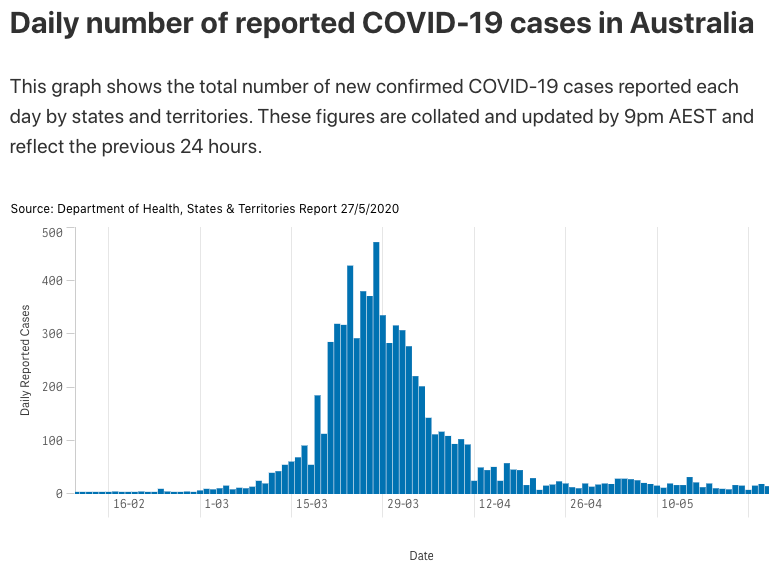
We have had 103 deaths from COVID-19 so far. Compare that with the conservative estimate based on data from your CDC that sometime either today or tomorrow, the U.S.A. will pass 100,000 deaths. This is how the rate of new cases in the U.S.A. looks.
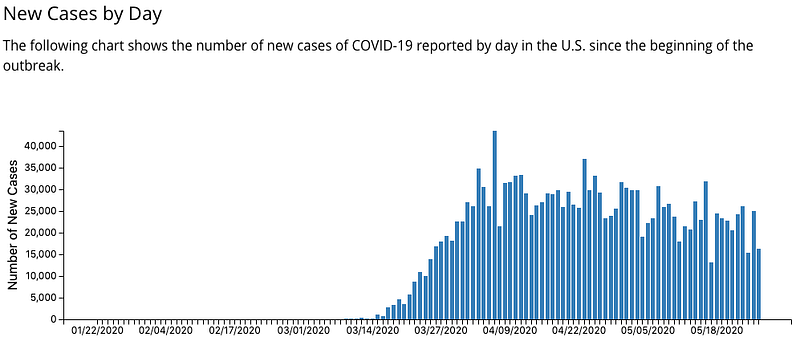
Look hard at the vertical axes on the two graphs. Yesterday, not a bad day for the U.S., there were 16,429 new cases. That represents about 1500 times more new cases than the 11 in Australia. Your population is only 13 times the size of Australia’s.
They don’t call us ‘The Lucky Country’ for nothing
Why are Australia’s numbers of new cases so low?
I’m pleased you asked. Mostly, I believe, because we enjoyed considerable luck. Australians talk about the ‘Lucky Country’ for all manner of reasons, but for one thing, we are lucky to be such a bloody long way from so many places.
We just didn’t have as many people flying into as many airports as you had. As the world’s largest island, we don’t have any road or rail routes coming in, unlike most European countries where roads and trains arrive from all directions. We haven’t even got that many ports.
Nearly two out of three cases in Australia came from outside the country. People flying in for a visit, Aussies returning home, and a cruise ship that was scandalously allowed to disgorge infected passengers in Sydney.
Australia is lucky to be such a bloody long way from so many places.
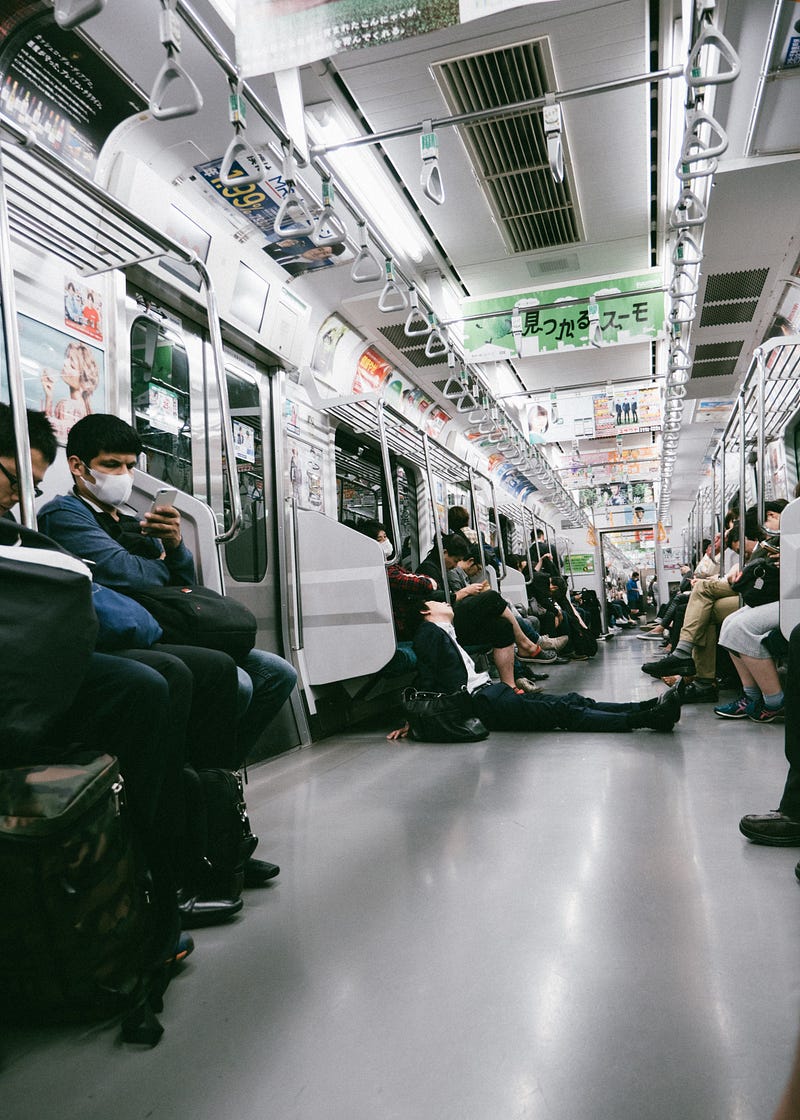
Our other source of luck is that the virus seems not to have transmitted as readily when it got here. We don’t know enough about why we had such luck, but it might have been fortunate that those early cases hit us in summer. Also, while most people in Australia live in cities, most of us live, work and commute at far lower densities than people in, say, New York, London, or Tokyo.
Better leaders, better followers
Another stroke of luck for us comes from our leaders. In a moment, I will criticize your elected leader, so pay attention to the next sentence. I have never been a fan of our Prime Minister, Scott Morrison, or a supporter of his so-called Liberal Party (which in Australia is the conservative main option, like your Republican party). Even though there is so much I don’t like about Morrison and his team, I agree with many that he generally did a creditable job by listening to scientific evidence, imposing stringent rules and guidelines, and stimulating the economy as so many sectors closed down.
Yes, he wobbled, like his ideological brothers-from-other-mothers, Boris Johnson and Donald Trump. You could almost see the cogs turning as he decided whether to sacrifice people to save the short-term economy. Australians are lucky — again — that we don’t have federal elections this year. After a few wrong steps, Morrison he mostly listened to scientific advice.
Make no mistake, Australians are politically polarized, reflexive in their rejection of every utterance by politicians we despise. Once Morrison won a bit of trust for his early actions, he showed his ideological hand a little more. For one thing, he treated universities, our country’s third-largest export earner, incredibly shabbily. But in acting faithfully on scientific evidence early in the crisis, Morrison earned enough trust for people who would never vote for him, like me, to buy into the collective response.
You may be too close to your country’s epic schism over Trump to evaluate his performance with any objectivity.
The countries that have suffered worst from this pandemic, the U.S.A, Brazil, and the United Kingdom, have had incredibly poor, self-serving leaders. Trump, Bolsonaro, and Boris Johnson have wavered over taking responsible action, shown contempt for people’s lives, and taken any opportunity to profit from the crisis.
You may be too close to your country’s epic schism over Trump to evaluate his performance with any disinterest or objectivity. Try, instead, evaluating President Jair Bolsonaro’s performance in Brazil. Here’s a ‘Fair and Balanced’ Fox News story to get you going. Now, which American politician is most like Bolsonaro?
I know, I know, It really doesn’t help to blame everything bad on Trump.
You Americans, especially likely Trump voters, haven’t given leaders much to work with. Maybe Australians just like to ‘chuck a sickie’, but people here really embraced the message to stay home. It helps that we were allowed out to exercise, but apart from the inevitable few idiots, narcissists, and conspiracy theorists, the locals here can give themselves an A+ for buying into the COVID response.
Freedom, but not as you know it
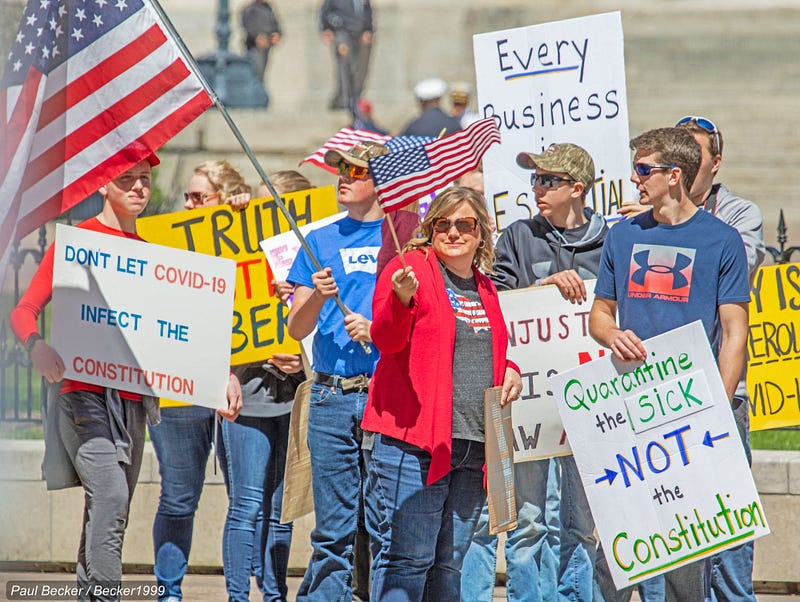
So many people I know in the U.S. have been impeccable in following scientific and medical advice. One friend of mine has not left his home for 9 weeks. Then there are those of you who waddle around with signs, and flags, and guns, protesting against lockdowns, shutdowns, and stay-home orders. As we say here Down Under, you need to take a hard look at yourselves.
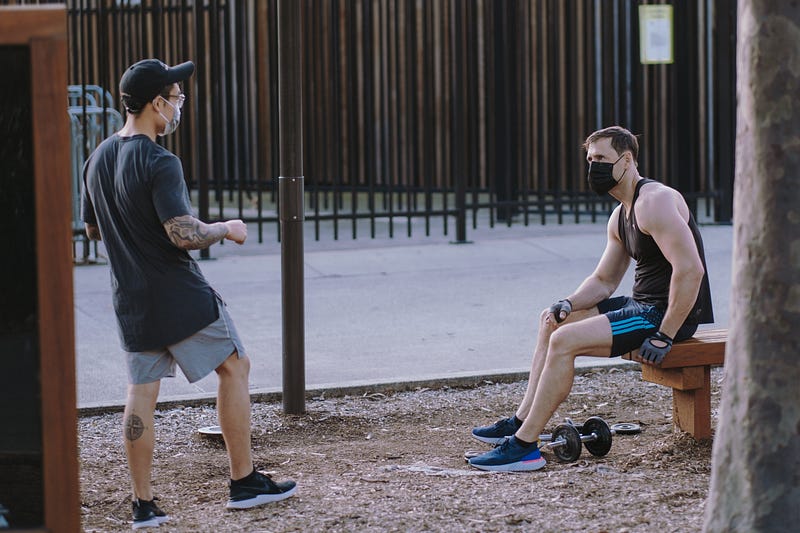
Restricting where you can go and what you can do is not the onset of totalitarian control. It is something that people have had to do in order to get epidemics under control ever since people started living in cities. Not wearing a mask when asked to do so is not a sign of your identity. It is just a sign of your selfishness.
Your grandparents or great-grandparents likely lived through the 1918 flu, polio, and a time when measles, mumps, cholera, and smallpox killed people all the time. When diseases, from the Black Death to Ebola hit, the people who elected to move and associate a little less freely, to stop touching each other, and to be considerate, had higher chances of staying alive. People who bought into delusions of conspiracy let their entire communities down, and often numbered among those who perished.
In those countries that got on top of COVID-19, like New Zealand, Singapore, South Korea, and Australia, people believe they have responsibilities to other people. Even to other people they don’t like, people who don’t look and speak and think like them, and even people who vote for the other party.
It would be silly to believe that any country, other than maybe New Zealand, is out of the woods. We might well get a ‘second wave’. One thing is for sure, though: if we cave in to protestors and conspiracy nuts, we can be guaranteed to experience a deadly second wave.
So what you gonna do?
Ask yourself: “Do you love your country?” If you do, then how about you start being part of the solution.
Ask yourself: “Do you love your freedom?” If you do, then think about your freedom to travel to see relatives and friends. Your freedom to work without getting sick. Your freedom to go out in your community. And your freedom to come to Australia and see that it really is a place, that we really do have summer when you have winter, and that we, like, really really do things differently here.
Because you won’t enjoy the freedom to come here until you and your compatriots get your arses into gear and start behaving like grown-ups. At the moment that looks like it will not happen for a very long time yet.
Yours,
Rob


