
To Eat And Drink For Free
By Claude Dambreville
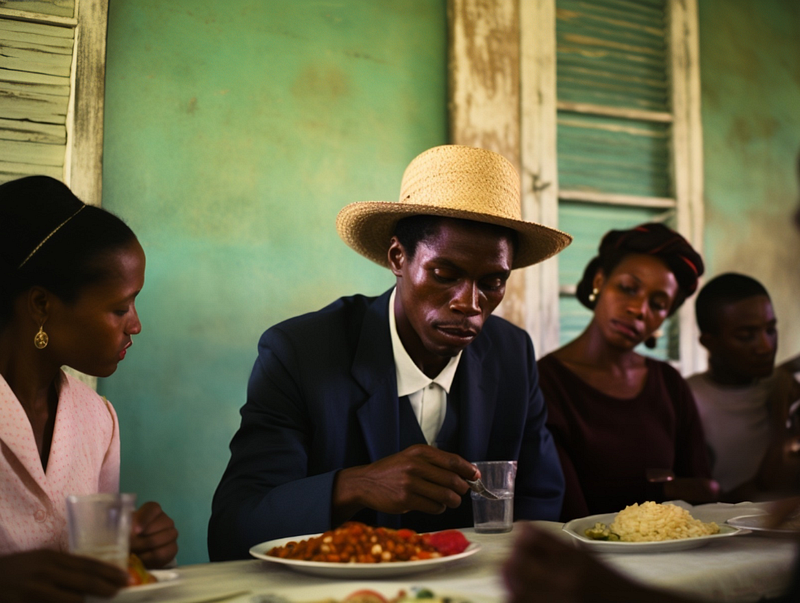
Initially penned in French by my late father, Claude Dambreville, and later translated into English by me, “To Eat and Drink for Free,” vividly portrays the distinctive customs and community spirit within Haitian neighborhoods. This narrative, rich in cultural nuances, offers an insightful glimpse into the unique traditions surrounding wakes in Haiti, as observed by Claude. My translation aims to preserve the soul of my father’s storytelling, highlighting his deep understanding and portrayal of the Haitian societal fabric. As a piece of Claude Dambreville’s enduring legacy, “To Eat and Drink for Free” echoes Haiti’s dynamic spirit and practices in the mid-20th century.
To Eat And Drink For Free
In Haiti’s humble neighborhoods, a perplexing tradition often leads families into unexpected debt with the passing of a loved one. It’s crucial to understand that beyond the sometimes exorbitant cost of funerals, hosting a wake in honor of the departed is seen as an absolute necessity. More often than not, given the cramped quarters of the deceased’s home, orchestrating this vigil becomes a genuine feat. First, there’s the inevitable task of borrowing a dozen chairs from neighbors, squeezing them into an already snug space.
Initially, around ten guests (soon joined by a crowd of local freeloaders drawn by hunger and thirst) will reliably show up, wanting to take advantage of every chance for a free meal at the expense of the bereaved family.
Coffee and tea will be abundant, with rum and soft drinks flowing like water. Guests and ‘dasomanns’ will almost scramble to savor a hearty pumpkin soup paired with golden, crispy fritters.
As the wake goes on — unnecessary but unavoidable — the air fills with robust singing, heartfelt prayers, spirited jokes, and raucous laughter. In truth, it wouldn’t be far-fetched to think the cost of this impromptu gathering could nearly cover the funeral expenses. But what can one do?
Life for the less fortunate is often a patchwork of contradictions. And let’s not forget the weight of public opinion — skipping a wake could become the talk of the town. “Poor so-and-so,” people might gossip, “they sent him off like a stray, without even offering his friends a cup of coffee or a glass of cola.”
“dasomann”: From the French or English ‘assault” and man. In this case, it’s an uninvited guest that invades almost with military precision.
Hi, I’m Vadim. I write tales blending life’s intricacies and possibilities. My stories are bridges to understanding humanity. I’d love for you to follow me (Vadim Dambreville). Subscribe for direct delivery of new explorations. 👇