
To Be Indian-American on 4th of July
Both sides of the hyphen reveal an entire Other world.
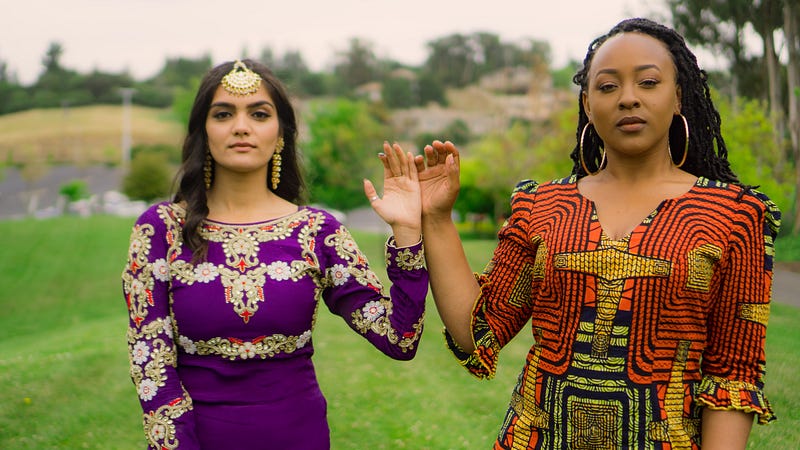
Kids at school would ask me ‘which Indian’ I was. My answer opened a world within that word.
It was 1970, and I couldn’t bridge the gap in my preschool mind between my parents’ version of being Indian at home in Minneapolis and images on TV of The Native American Movement. It was a regional protest movement to demand legal and cultural reckoning for the legacies of American colonial violence against Native-American Peoples. News reports of protests scared me, adding to the horror of Vietnam War footage on The CBS Evening News with Walter Cronkite.
I learned to ignore my wounded conscience as I grew older. It pointed me to consider the selective omissions of Native-Americans in our nation’s promise of democracy.
Growing up Brown and ‘Indian’ remains complicated, even now.
Kids at school saw me as ‘poor,’ because of what they learned in church or on the news about India. They saw me as ‘exotic’, thanks to popular trends in music and culture of the 1960s. They even mimicked Native-American dance traditions to shame me for looking like protesters on the news.
Indian-American means ‘American of Indian origin,’ but ‘Indian,’ does not mean ‘Native-American.’
We all know the story of Columbus’ voyages in search of a sea route to India. I’ve wondered why Europeans continued to call indigenous peoples throughout the western hemisphere, ‘Indian,’ after learning India was not in the New World. Layers contained within the term hold histories of European and American colonization.
European colonizers used ‘Indian’ for their convenience at the cost of accuracy. Colonial powers divided the land and its peoples, drained resources and traditional economies, leaving original inhabitants shattered and dependent.
These histories produced different legacies in the modern era. Most cultures that endured colonialism romanticize time before foreign rule, when they charted their own destinies in harmony with nature — in their homeland.
Disparate associations of ‘Indian’ disturbed me. I couldn’t understand why I had opportunities Native-Americans didn’t seem to have.
I realized my being Brown, apparently foreign, and touched by histories of marginalization contributed to my being Other. It’s true for me as much as it is for Native-American peoples today.
I cross a rickety bridge with baggage in hand, as I unpack history and decide what it means to me today.
Legacies of the British rule in India, both empowering and limiting, pushed my parents to leave India, allowing me a privileged life, with conditions. I’ve learned to transcend others’ ideas about my ancestral heritage and to cultivate empathy for them and for myself, as I shape perceptions of me.
It’s difficult to convey physical distances and cultural diversity crammed into the hyphen between Indian and American.
My friends born and raised in India may not be familiar with American history. They may harbor cultural stereotypes of Native American peoples, based on colonial worldviews and accepted historical narratives.
The British in India created an entire class of Western-educated civil servants and powerful elites to serve as brand ambassadors of their rule, known as the British Raj. These divisions rewarded Indians for loosening their grasp to their traditions, learning English, and adopting European cultural standards in viewing themselves.
My ancestors unwittingly accepted their colonizers’ term ‘Indian’ in this process and found their place in a colonial racial hierarchy, never to rise to the top.
I’m a descendent of that colonial legacy, born and raised in another former colony a world away. I’m re-examining my view of other ‘Indians.’ I’m looking at my previously unchallenged acceptance of cultural biases that historically rendered us ‘the same.’
The burden of acclimating to historical misnomers similarly rests on those who call themselves ‘Indian.’
For people of India, the myriad foreign terms referring to them, such as Hindiin, Hindustani, Bharatiya, and Indian, comprise a repository of cultural identities, like fragrances, tastes, and memories. All hold truths, painful and delicious, each one true in its own way.
India claimed freedom to redefine itself when it joined the family of free nations as ‘India’ in 1947. It wrestles to recast its role in the world as it balances legacy burdens of poverty and hope to uphold its pluralist democracy.
Many Native-American peoples similarly accept the term ‘Indian’ for reasons that have nothing to do with India. It’s a mark of survival over four hundred years of becoming marginalized, forever altered by European plunder and theft. Their enduring ethnicity as ‘Indian’ is a legacy of tradition, loss, change, and survival.
We share an Otherness across oceans and continents, in layers of ‘Indian’ history.
The US government pushed Native-Americans onto reservations throughout the nineteenth century, unlike the British approach to colonialism in India. Westward expansion in the US was happening just as Mahatma Gandhi led my parents’ elders in the march for Indian freedom. My parents were children when they witnessed with pride the birth of a free India; and they came to the US, anyway.
They planted roots in a country where another group of ‘Indians’ didn’t have freedoms like hard-won freedoms left behind in India. The US formally granted full access to America’s promise to my parents when they became naturalized American citizens. The US withheld those very freedoms from Native-Americans.
My family could come to the US because of a law passed in 1965 that allowed non-European educated professionals, scientists, and scholars to immigrate. Supporters of the law celebrated the investment in our future.
But, the government didn’t invest in Native-American talent to honor their contributions to United States. I live on land stolen from them and feel responsible to repay an overdue debt for their losses. My opportunities are a product of burdens, hopes, and accidents that had nothing to do with me personally but come from an accepted race-based hierarchy that leaves Native-Americans empty-handed.
Society buries the tragedy of these disparities in the hyphen.
It’s a twist of history and fate for me. I’m not really Indian; my parents left India. I’m a native-born citizen, though not Native-American, and being Brown with a hyphenated identity is not ‘American enough’ to many of my fellow my citizens, these days.
A flipped monicker and a Brown complexion produce a world of difference. Colonial-era blindness to culture and geography created haves and have-nots and altered views of peoples, now seen through lenses of colonization.
But, I am free.
Saturday was our nation’s 244th birthday. It’s taken me a few days after sifting through layers of ‘Indian’ to realize that images from South Dakota that day triggered memories from my early childhood in Minneapolis. American colonialism’s painful legacies fester in today’s hatreds.
They call on me to hold myself accountable for ignoring my conscience. I’m an Indian-American woman in what I hope is still a pluralistic society trying to shed burdens of its past.
It will take a lot of individual and collective soul searching.
Every hyphenated identity is a walk across a bridge to becoming American. Hyphens are a sign of hope and belief. We need to make amends to Native-American Peoples and African-Americans in atonement for our colonial past and its disparate hierarchical legacies today.
I hope that you will pick up an America history book written from an unfamiliar perspective. You may hear a wounded conscience, like mine, that only awareness and honesty can heal.
Our fraught nation calls on us now to defend democracy, much like Revolutionary-era Minutemen 244 years ago. Today, we must banish our chosen ignorance and honor our sacred ideals; to see each other with fresh eyes, to know our full history, to be brave and honest, and to make amends.
We didn’t commit past sins, but we prosper and profit because of them. We are duty bound to make accessible the fruits of our democracy to those who lost their land and way of life so bounteous orchards of American democracy could grow and flourish.
Don’t fight your discomfort, sorrow, and pain; follow these feelings wherever they may lead you. What will you discover about your American identity, with or without a hyphen?
Please share with me what you find, so I can see our shared history through your American eyes.