
To all those that just resigned, I applaud you.
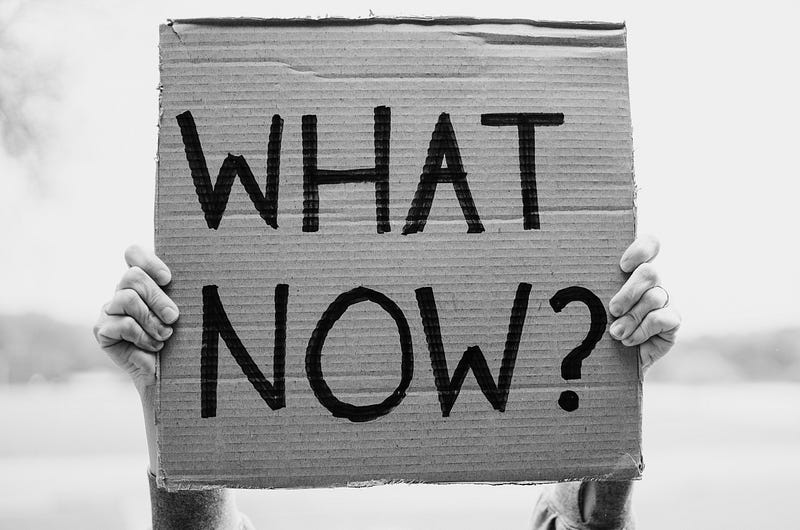
But what comes next may be harder than when you walked away.

My wife, Whit, and I have a mantra we live by:
If it’s not a fuck yes, then it’s a fuck no.
It came to us about two and a half years ago.
My wife and I were teaching and had gone through a brutal school year — both personally and professionally — and finally became a part of the 44%+ of teachers who burn out of the profession. After the school year, we resigned from our positions, got rid of roughly 80% of our belongings, sold our house, and moved 2500+ miles away from the place we called home in Hawaii.
It was a full system reboot for us.
After a month or so of just letting ourselves be, we were sitting in the backyard of my parents’ house, staring up at the stars, passing a joint back and forth because… well… stress… and it just dawned on us.
We were right in walking away.
We were right in taking a step back.
We were right in hitting the reset button.
So why the fuck don’t we do that more often?
Because our mindset towards work was the issue.
Throughout our professional lives, we were constantly being thrown distractions that kept us from honoring ourselves. We spent so much time catering to everyone else’s needs that it had completely depleted us — physically, mentally, emotionally, and spiritually.
At the time, we had just gotten back from a road trip. It was the first time ever that we had gone on a trip for ourselves since before our daughter was born.
There was no conference we had to attend for professional development.
We weren’t taking students to a national competition to compete because we felt pressure from our schools to perform.
We had no business to conduct.
We had no family that we had to visit.
No obligations.
It felt good.
And reflecting on that moment, I remember telling Whit: “We’re not doing that anymore. We’re done putting others’ needs before our own.”
She was right there with me.
After 10+ years together, I can say it’s still one of the most beautiful things in the world when you and your significant other are just vibing on the same page. We had this long conversation on where we wanted to take our lives from that point on, what we wanted our mindset to be, and I capped the conversation by saying: “You know, whatever decisions we make from here on out, if we’re not feeling that it’s a fuck yes….”
“Then it’s a fuck no.” she finished.
At that moment, we had finally hit a crossroads between past and future selves. It dawned on us: Why do we agree to do shit for other people when we’re not making the space to do things for ourselves?
I think when you’ve spent the majority of your life being groomed through traditional school systems, parenting, and social norms to cater to a higher authority and their expectations, the decision to honor yourself first is a painful process. It takes time — and it’s a task that cannot be rushed if you genuinely want to see the growth within yourself that will attract what you want out of life.
Stop acting like “The Great Resignation” is this new thing that came out of nowhere.

I am a firm believer that whenever something starts trending on social media, the issue has either just hit a climax before reform or it is just being given some noise so major media outlets and policymakers can quietly brush it under the rug again.
“The Great Resignation” is no different. There have been years of foreplay leading up to its climax.
Whit and I started seeing the writing on the wall early and while difficult, we feel fortunate we left our positions when we did.
In 2018, I was in my M.Ed. program when it just kind of hit me. When I started the program, I went in intending to go into educational leadership to push reform.
I grew up a teacher’s kid. My mother was a special education teacher for roughly 40 years. I started working in education when I was a teen, which led to managing a tutoring company specializing in the private sector before becoming a classroom teacher myself. From my childhood to working in different school systems, I saw the good, great, bad, and ugly of traditional education systems from every angle. And I knew well before starting my career in education that the system was broken.
When I went into my Master’s, I wanted to do something about it.
Thankfully, I stopped myself from going down that path. I was starting to toy around with ideas for my final research capstone when I realized — despite what political candidates and school officials were pitching — nobody had a solid plan to improve working conditions for teachers or a plan to truly reform education for the better.
They just had far-reaching theories and outlandish expectations — most of which, by people that had hardly or never worked in a classroom. The theories would take years to implement and even longer to see results on a mass scale.
I wasn’t about to wait.
As I got further into my program, I realized how truly broken the school system was — not just for teachers but everyone involved. While it definitely wasn’t the only reason that pushed me out of the profession, the more I studied different school districts and teacher collective bargaining agreements, the faster I thought: This ain’t it. I remember telling Whit after studying another CBA that clearly protected the business of the school and gave a middle finger to the teacher:
“Yeah… fuck that. I’m out. It’s too fucked up. This is not my responsibility to try and fix this thing.”
The decision was made, but the impending questions kept coming up after we resigned.
Whit and I didn’t have a job. We only had so much money in the bank after selling our home, we’re in a new city, we have a family to support, bills to pay, students loans, we’re in our 30s, and we both had no interest in going back to classroom teaching.
“What’s next?”
The short answer at the time was simple: No. Fucking. Clue. And for the first time in our lives, that answer didn’t scare us.
For you, there are two different roads going forward.

I think what people on both sides miss about this whole Great Resignation situation is that the accountability and responsibility for it does not just lie with the employer.
It’s on you too.
If you do not take the time to look inward and find what you truly want out of your life, you will most likely fall back into the same habits (and organizations) that put you in that shitty situation in the first place.
Finding that ideal work situation is like dating.
If you consistently find yourself in an abusive relationship and you’re not questioning the why behind that, then odds are pretty high that it will continue to happen.
On the other hand, if you take a step back and say, “I’m going to do something that is going to be better for me — something that will fill my cup and not someone else’s — but I need to figure out x, y, and z about myself first.” The odds are pretty high you’ll fall into a position or situation that fits what you want.
When we decided to change directions professionally, Whit and I had a ton of ideas, but we chose to put everything on pause while we healed our inner wounds and came together closer as a family. We took a step back, reevaluated, focused on our mental health, let the ideas marinate, and grew closer as a unit. From that experience, we realized the only way we would get the lifestyle we wanted was to work for ourselves.
I’m not saying that’s what you should do because it’s definitely not for everyone, but we weighed out everything, and it’s the path we chose.
Whit and I’s mantra came as a response to a turning point we reached in both our professional and personal lives. We refused to force anything anymore. We physically felt that if it didn’t light us up — if it didn’t get us so excited that it energized our body to do it, then it wasn’t happening.
And we found out early that sometimes you have to say “fuck no” to everything just to give yourself some space to figure what does light you up.
Closing Thoughts
I’ve seen people making demands on LinkedIn, Tiktok, Twitter, Facebook, etc., about what is needed in terms of benefits and pay to bring people back to work. And I see that hiring managers and companies are starting to listen, but most fail to realize that this is not just a benefits or pay issue.
- It’s a relationship issue.
The relationship between employer and employee is changing — much of this driven by poor treatment and mistrust. Both parties need to sit back and figure out what they want out of that relationship and make it clear to each other before positive changes can happen.
- It’s a work environment issue.
With the growth in social platforms and technology, clear boundaries need to be redrawn. There’s a highly toxic enmeshment present within the workforce where people are made to believe they cannot have a life separate from the organization they work for. It’s cult-like.
Stop that shit.
It’s not healthy.
To truly have a “work-life balance,” there needs to be a clear separation of work and life.
- And I would say most importantly, it’s a cultural issue.
Not to say Americans are the only ones, but we definitely have our values twisted when it comes to business operations. Profits over people as a culture have gone on for far too long. When people have been consistently looked at as disposable, it was only a matter of time before it caught up.
All three issues are integral to changing the employer-employee dynamic and they are closely intertwined together. The pay raises and additional benefits that hiring managers are starting to shell out for new hires is just that: a great start — but it doesn’t mean shit unless leaders make some serious changes in how they lead. It also doesn’t help if the resigned people don’t take the time to figure out what they want for themselves before they come back.
By no means will it be easy to change work conditions for the better, but if the time to reevaluate and change is taken, the result could be extraordinary.
I had a mentor tell me once: “New cultures are hard to start, but once they’ve been instilled, they are easy to maintain.” I believe that still carries some weight here.
Want to read more than a few articles a month from one of the best sources of original stories?
Open that wallet, click this link, and spend less than your streaming subscriptions to support a community of authentic writers while getting unlimited access to their stories on Medium.
More from Ian Rush: