
Tired all the Time? If Your Diet is the Problem, it’s Also the Solution
Three key strategies to raise your energy levels

Tired all the time, wiped out, exhausted, fatigued… my clients all have different ways of saying it, but the problem is essentially the same. As a nutrition consultant, I encounter the same health issues time and again. Top of that list, by a mile, is low energy, or however you prefer to put it.
Most of these people are fairly young — usually in their 30s or 40s. Sometimes they are only in their 20s. “You should be bouncing off the walls!” I occasionally comment, and they always agree.
I sometimes think of my clients as perfectly healthy, but not very well. More often than not, they look fine enough, having had their good health confirmed by a raft of medical tests. They hold down jobs, relationships, lives, and their narratives reveal heroic juggling skills. Hardy as they appear, inside they are struggling with exhaustion, coupled with anxiety about their exhaustion.
If that sounds like you, it’s worth considering possible dietary causes of your fatigue, especially if you’ve tried everything else and been given the all-clear by your doctor.
The first thing I ask my exhausted client is if they are getting enough sleep. Second on the list is whether they’ve had a blood iron test. If not, I urge them to get one arranged as soon as. If, in addition to fatigue, my client also experiences weight gain, constipation, or hair loss, I suggest seeing their doctor for thyroid testing.
Once the above possibilities are eliminated, it is time to look at diet. The first and most important step is to identify the cause of the problem. Symptoms can be as complex as the human body itself, and you can save a lot of time (and money) by cutting to the chase.
Below are the three most common causes, in my experience, and how to recognise them.
1 Blood sugar imbalance
I find that an inability to maintain even blood sugar levels throughout the day is the most common cause of fatigue.
Common signs of blood sugar imbalance
- regular and inexplicable fatigue
- mood swings
- poor memory and/or concentration
- food cravings (especially for sweet or starchy foods)
- difficulty waking up in the morning
- depression/anxiety
- irritability
- headache
If, in addition to any of the above, you find it hard to go several hours without eating, your suspicions should be further roused. And even more so if your diet has these characteristics:
- carbohydrate-rich meals with little or no protein and/or fat
- frequent snacking on sugar-rich foods such as biscuits or chocolate bars, and savoury, carby snacks such as chips and crackers.
- regular intake of soft drinks
About blood sugar
Sugar — or more precisely, the glucose in your blood — provides fuel. This glucose comes mainly from the carbohydrates that you eat. Carbohydrates include starchy foods such as potatoes, bread, pasta, rice and other grains, beans, lentils, fruit and vegetables. Like most things, you need glucose in just the right amount: too little or too much are both potentially perilous. Typically, you should have about a teaspoon’s worth coursing through your entire system at any given time. That’s all.
Raised glucose levels stimulate the production in the pancreas of a hormone called insulin. The more carbohydrate eaten, the more insulin produced.
A sudden rush of insulin causes a sudden drop of blood sugar, and therefore energy. So you eat and repeat. Those low blood sugar events become more frequent, leaving you constantly fatigued.
If this is you, your priority is to sort out your diet and ensure a steady supply of energy throughout the day.
Dietary changes for balanced blood sugar and energy levels
- Eat protein with each meal: fish, meat, eggs, dairy, beans, lentils, nuts. Most of these foods also provide fat, which slows the flow of glucose into the blood. Protein is essential for balancing blood sugar and reducing insulin resistance. Insulin resistance occurs when the body is no longer able to deal with the peaks and troughs of blood sugar imbalances and stops responding to insulin, which stays high in the blood, along with glucose.
- Avoid anything containing added sugar
- Avoid refined carbohydrates, especially those with a high glycaemic index.
The glycaemic index is a system which measures the speed at which the carbohydrate component of food enters the bloodstream and raises blood sugar, on a scale of 0 to 100.
Carbohydrates are categorised as having either a low, medium or high GI. It is generally accepted that a low GI is a score of 55 or less, a medium GI is 56–69 and a high GI score is 70 or over. Therefore, your aim is to avoid high GI foods as much as possible and eat mainly low GI foods with some medium scorers.
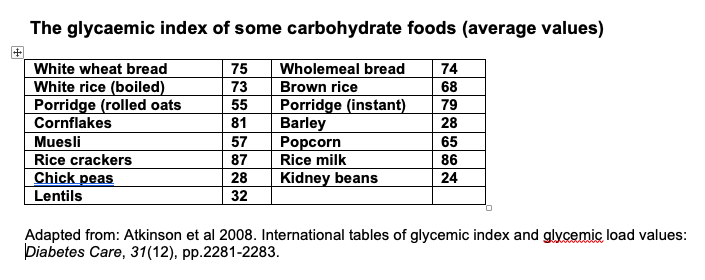
In one study of 82 adults that measured the effects of high and low glycaemic diets, the authors concluded:
“…a high-glycemic load diet was associated with higher depression symptoms, total mood disturbance, and fatigue compared to a low-glycemic load diet especially in overweight/obese, but otherwise healthy, adults.” (Breymeyer et al 2016)
Sugar is undeniably addictive. You are not born with a sweet tooth but if you persevere long enough you can certainly develop one. On the plus side, your cravings can be overcome relatively quickly: you should notice improvements in symptoms within just a few days of making appropriate dietary changes.
You might take fright at the idea of weaning yourself off sugar, but I can honestly say that the vast majority of people I see do not actually find this to be as challenging as they originally anticipated, and report that their cravings leave them within a week.
2 Gluten intolerance
Food intolerance is a strange phenomenon. If you have a true allergy, you’ll know about it, as the reaction can be swift. Not so the slippery intolerance. It can assume a chameleon-like quality, changing apparently at whim: one day fatigue, another day a bloated stomach, or nasal congestion. To compound matters, the effects of unwittingly consuming something tasty but trouble often do not make themselves known for several days, making the culprit hard to isolate.
Any food can cause a reaction; the clue is to look at what you eat and see what features most frequently. In my experience, the most common culprit was by far gluten.
Gluten is the name of a group of proteins found within certain grains, namely wheat, rye and barley. Gluten sensitivity is not the same as celiac disease, or wheat allergy, which until recently were the only gluten-related conditions recognised by the medical community.
Until very recently, gluten intolerance (or sensitivity) was considered the preserve of the “worried well”, an attention-seeking trend outside the peripheral vision of medics.
But now the concept of gluten sensitivity is gaining traction within the scientific community, with the emergence of irrefutable evidence. It has even been given a medical term: “non-celiac gluten sensitivity” (NCGS).
I would be suspicious that gluten was the culprit if my client:
- Ate a lot of wheat — bread and pasta, pastries, cereals… it’s a common denominator in many processed foods.
- Had a lot of digestive symptoms. This is a major clue, because irritable bowel often goes hand in hand with fatigue.
- Had symptoms that affected the brain: foggy mind, apathy, depression.
“The “classical” presentation of NCGS is, indeed, a combination of gastro-intestinal symptoms including abdominal pain, bloating, bowel habit abnormalities (either diarrhea or constipation), and systemic manifestations including disorders of the neuropsychiatric area such as “foggy mind”, depression, headache, fatigue, and leg or arm numbness.” (Lionetti et al 2015)
To find out if gluten is your nemesis, it is worth doing the exclusion/challenge test. This test is considered the “gold standard” method of determining food sensitivities, as blood tests are notoriously unreliable.
There are a number of variations on the exclusion/challenge theme, but I’ve always found this particular system to work well. Others recommend an exclusion period of 2–4 weeks, but I usually find a week to be perfectly adequate. Plus, any longer than that and people are prone to slipping up and accidentally ingesting something containing gluten.
Here’s how you can run your own gold standard test, in four steps.
1 Avoid gluten-containing foods strictly for seven days.
Here is where you’ll find gluten:
- Wheat, and wheat species: spelt, kamut and durum flour
- Wheat derivatives: semolina, couscous, bulgar
- Products made from wheat, including bread, pasta, cakes, biscuits, savoury snacks, croissants
- Rye and rye products
- Barley and barley products
2 Track
Keep a diary of symptoms. You may start noticing changes straight away.
3 Challenge
On day 8, you get to eat a portion of your favourite gluten fix. You might choose a sandwich, or a small bowl of pasta.
Tip: it’s a good idea to do this challenge on a day when you are at home. If you do have gluten sensitivity, you might experience all your old symptoms at once, so be prepared and only have one portion.
4 Observe
Watch what happens. If you really are gluten sensitive, your symptoms will make themselves known clearly.
As well as fatigue, be especially aware of any gut discomfort.
“An overlap between the irritable bowel syndrome (IBS) and NCGS has been detected, requiring even more stringent diagnostic criteria” (Lionetti et al 2015)
In my experience, people with a gluten sensitivity tend to have a cluster of symptoms, that almost always include a digestive disturbance of one kind or another.
If you don’t have gluten sensitivity, but have digestive problems, you may well have gut dysbiosis.
3 Gut dysbiosis
Gut problems and fatigue often go hand in hand. Gluten sensitivity is one sign of that, but it’s not the only one. The link between the life in your gut and your energy levels is profound and well established.
An extreme form of fatigue is chronic fatigue syndrome, also known as myalgic encephalomyelitis (ME). People with chronic fatigue syndrome commonly report gastrointestinal problems.
These people have been shown to have a different gut microbiome from healthy people, with less diversity and more “unstable” bacteria.
Deep within your gut exists a parallel universe of microorganisms, including over 100 trillion bacteria, belonging to over 1000 species. Your inner life is collectively known as the gut microbiota. Some of the bacteria that make up the microbiota are friendly and helpful; some are downright rude and hostile, creating disturbances and upset. So powerful is this microbiota that it is considered a “hidden” organ.
Dysbiosis occurs when there is an overgrowth of the less desirable species, leaving the ones you want much reduced and weakened.
Those “bad” bacteria cause mayhem in a number of ways, including damaging the gut lining. When damage occurs, there may be “microbial translocation” — the movement of gut bacteria into the blood stream.
The result is inflammation and a “leaky” gut. When the gut is leaky, the bacteria that enter the blood effectively have access all areas, and release a toxic substance called endotoxin, which triggers an immune response, i.e. inflammatory proteins, such as cytokines.
It is this inflammation that is frequently at the root of the problem. If you have an inflammatory bowel disorder, such as Crohn’s disease, you have a greater risk of developing chronic fatigue.
Or you may just feel very, very tired.
Further reading
For more information on leaky gut syndrome, you can read about my own experience of the condition in my article How I healed my gut and restored my health.
If your fatigue is accompanied by long-term stress, you may have adrenal fatigue. You can read all about this in How to manage your stress by changing your diet.
If you suspect you may have dysbiosis, you can read more on the subject in my article How gut bacteria can lift depression. Be sure to feed them well.