
How I Healed My Leaky Gut and Restored My Health
In order to heal, you have to get to the root cause.

When I became a nutrition student in 1992, I had a lot of healing to do. I had the irritable bowel from hell. No treatment had worked, be it conventional medicine or the truly woo woo stuff.
It was a good job I was drawn to nutrition as a career subject, because it turned out to be my salvation.
What I discovered, as a student, was that I had something called a leaky gut. Cue much hilarity at that. But when given its scientific nomenclature — intestinal permeability — the condition suddenly assumes the gravitas it demands.
That was the first step. Then I learned how to heal my leaky gut, and therefore my irritable bowel. Twenty-five years on, I remain symptom-free.
Fifteen years a sufferer
For nigh-on 15 years I had lived with daily, often excruciating abdominal pain, accompanied by some extraordinary bloating and gas.
I could have lived with all that. But as a sensitive young adult, I could have done without the spots.
Not, thankfully, on my face. But my chest and back were peppered. I was hugely self-conscious, so only wore clothes that covered up those areas. Summers could be tricky.
(As an aside: during my many years of practice I started to notice that acne on the body rather than the face more often than not was a sign of digestive disturbance, rather than a hormonal issue. Purely anecdotal, but worth noting.)
Private investigations going… nowhere.
In my early, pre-student days, I lurched from one bad lead to another in my quest to resolve all these issues. I saw a succession of doctors and therapists who turned out to be as clueless as I was.
I saw a private skin specialist and had a swanky consultation in a swanky consultation room, all high ceilings and heavy oak furniture. I came away with the same antibiotics that any National Health Service doctor would have given me.
They only made things worse. Later, on my course, I would find out why.
Then there was the homeopath (zero effect), the spiritual ‘healer’ (let’s not even go there) and the Chinese herbalist. The latter, I was convinced, was my man, if only because he was a complete mystery to me. He was practising esoteric knowledge seeped in ancient wisdom, no?
No.
I brewed up the foulest-tasting concoctions, believing the pain would be worth the gain.
There was no gain. And the pain continued.
At the time, I was a nutrition philistine, and had no idea that all my problems were connected. What truly shocks me, even now, is that nor did any of the specialists I consulted.
I came to realise that all my symptoms began and ended in my gut.
Wising up
I acquired two essential wisdoms during my three-year course.
First — when the medics can’t find anything wrong with you, there’s a good chance that it’s your diet that’s the problem. Doctors receive very little training in nutrition, so may not spot the connection between symptom and diet.
Second — if there’s something wrong, you have to identify the cause in order to fix the problem.
So, for the first step on my self-directed healing journey, I invested in two cause-seeking strategies: a stool analysis and a urine test.
Getting there
The stool analysis revealed that I had a severe case of dysbiosis — an imbalance between good and bad bacteria in the gut. The bad guys (actually, they were downright evil) were in control, rampaging through their dark kingdom like some crazed, middle-earth despot.
The good guys were hiding out in some distant intestinal backwater, too few and feeble to do their job, which was to guard my health.
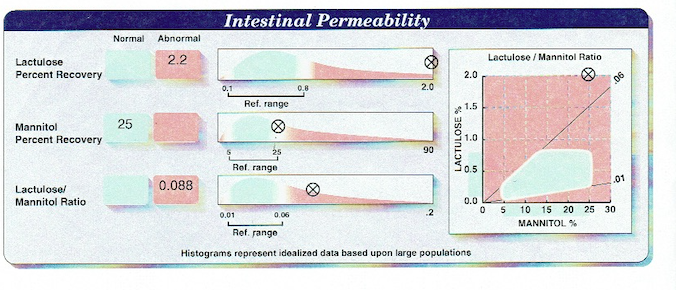
Next came the urine test, the aim of which was to check for intestinal permeability, or leaky gut.
Intestinal permeability arises when the gut lining becomes damaged, and as a consequence, leaky and inflammed.
The gut lining has two main jobs: to allow the passage of digested nutrients and fluids to cross into the blood, and to stop unwanted intruders from doing the same.
This barrier consists of just one layer of cells. Holding these cells together are links, called ‘tight junctions’.
When working properly these tight junctions are like nightclub bouncers, sifting out and blocking the riff raff.
But if they become damaged, they lose their tightness and microscopic holes appear. Toxins, bacteria, undigested food, tiny bits of things that fell on your plate… in they pile.
An almighty battle commences. It starts in the gut, but with access all areas the fallout of this mayhem can show up anywhere. So too can symptoms: as well as irritable bowel, you can experience joint pain, headache, depression, fatigue, food sensitivities, recurrent infections …
The liver normally copes well with the body’s everyday toxins, but when the toxic overload exceeds capacity, they get dumped elsewhere. In my case it was skin.
Sure enough, the urine test confirmed that I was a walking Wikileaks.
What this means
This test involves drinking a solution of two, non-metabolized sugar molecules: lactulose and mannitol. A sample of urine collected over the following 6 hours is taken.
Lactulose is a large molecule and should not pass through a healthy gut lining. If it shows up in urine, that is seen as an indication of intestinal permeability.
Mannitol is a small molecule, readily absorbed. In the healthy gut, the ratio of lactulose to mannitol in urine is low. If the gut is leaky, that ratio is high.
As you can see from my test results above, the lactulose recovered in urine is off the chart, as is the ratio between lactulose and mannitol. Top marks to me!
What causes leaky gut?
Generally, the most likely culprits include:
Certain medications, especially the non-steroidal anti-inflammatory drugs, or NSAIDs, such as aspirin.
I had a history of taking NSAIDs.
Dysbiosis. See above. Taking antibiotics exacerbates the situation, wiping out the good with the bad bacteria. Dysbiosis is the outcome.
Well I knew I had that.
Stress and anxiety. Stress creates damaging chemicals called free radicals.
I was in a permanent state of stress and anxiety.
Smoking. Smoking is free radical hell.
I smoked like a trooper in my late teens and 20s.
Diet. Most especially: alcohol, sugar and refined vegetable cooking oils. Soy, corn and sunflower oil are high in pro-inflammatory fatty acids. When heated to high temperatures, they also produce free radicals.
All of the above.
Allergens. Foods to which you are allergic or intolerant can create irritation and inflammation.
A box I didn’t tick!
What I did next
With the state of my intestines writ large, I could have plunged into despair. Au contraire! I couldn’t have been happier. I knew exactly what to do about it.
First, I started taking probiotics — friendly bacteria to fight the unfriendly. Probiotics also strengthen tight junctions and produce anti-inflammatory chemicals.
Next, I really tidied up my diet.
Out went every refined carbohydrate and vaguely sugary item. These foods feed the hostile bacteria in the gut, the last thing I needed. In came as many low carbohydrate vegetables as I could manage, especially leafy greens and the brightly coloured variety, including peppers, tomatoes, red onions and aubergines.
These vegetables are loaded with antioxidants that fight free radicals, and plant chemicals that fight inflammation.
In came lots of live natural yogurt (loaded with probiotics) and oily fish. This category includes salmon, herring, trout, anchovies, sardines and mackerel. I also took fish oil supplements, for good measure. Fish oil is highly anti-inflammatory, so combined with the probiotics formed a significant part of my arsenal. And fish is a complete protein, essential for any kind of healing. So too is zinc, rich in fish and meat.
Out went anything that contained pro-inflammatory, refined vegetable oils.
A self-imposed ban on alcohol was put in place. A well-known contributor to leaky gut syndrome, I stayed clear for months (most of the time). I’d already long given up smoking.
Free at last
It took several months to complete the healing process. But it happened, and all my symptoms gradually vanished. The digestive mayhem and poor skin that had made my life misery for so long completely cleared up. I felt hugely better: mood, sleep and general sense of wellbeing rose steadily. Calm was restored, and it was wonderful. It still is.
In the years that have followed, I have seen many cases of leaky gut. Whenever I suspect that a leaky gut is the cause, I suggest the urine test. It takes, I find, at least two months to heal, so a test is helpful to know you are on the right track.
That’s half the battle won.


