Author tips
Tips for Formatting Fiction on Medium
It’s time to help your readers!

I’ve been reading a lot of fiction on Medium recently. A lot.
And as I said in a recent list of reading recommendations, I think that the state of fiction on Medium is very healthy (even if it remains much smaller than non-fiction).
I’ve also been chatting to a lot of fellow authors here and on Twitter, and one thing that has come up are issues around how best to format a fiction story on a website that (let’s be honest) is not really designed for the purpose.
For example, there are several things that are not immediately obvious from reading the first paragraph of a story:
- What genre it is? Is this even fiction?
- Is it a scene? A chapter of a longer piece?
- Is it connected to a broader story or world?
- Is it serious or humorous?
- Is it ‘suitable for work’ or not?
I personally find it much harder to pick up on these things via tags or skim-reading with fiction than with non-fiction.
The tips in this article should help you to make this all much clearer to your reader, helping them have a better experience… and boosting your reads in the process!
1. Provide a brief synopsis.
One of the easiest and best ways that you can orient your reader is to provide a simple explanation of what the story is about, right at the beginning. Not necessarily a blurb, but more of an overview of what they are getting into.
Here is an example of a chapter from my ‘Choose your own adventure — collaboration’ publication:
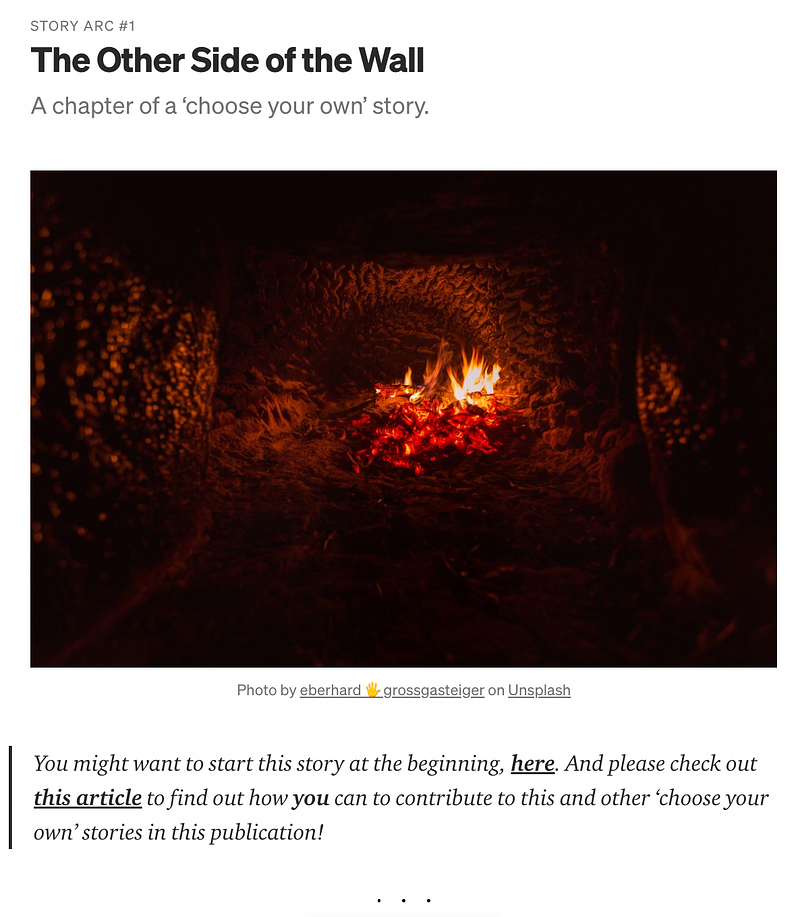
It’s not perfect, but as can be seen, you’re not starting the story cold. Instead, you get some orienting information to guide you.
2. Include a link to other relevant work.
Another thing you can see in the image above is that the story includes an easy-to-access link taking the reader to another relevant piece — in this case the beginning of an ongoing story.
If you have a pair of interconnected fiction pieces, you might want to point them towards ‘part 1’. Or maybe you have gathered all of the relevant stories into a list? If so, give them link to that.
Don’t assume that everyone who clicks on part 2 or part 3 has read the earlier stories. Medium’s feed is not that smart!
3. Indicate that it’s fiction, e.g. in a kicker or the synopsis.
Again, let’s not forget that most articles on Medium are non-fiction. And while there is a thriving community of authors, it’s much smaller.
That means that when most readers click on a title/image in their feed, they are expecting a blog post rather than a fiction story.
Why not start off right away by stating that it’s fiction in the title, subtitle or kicker? You could even give a few more details in there, as this example shows:
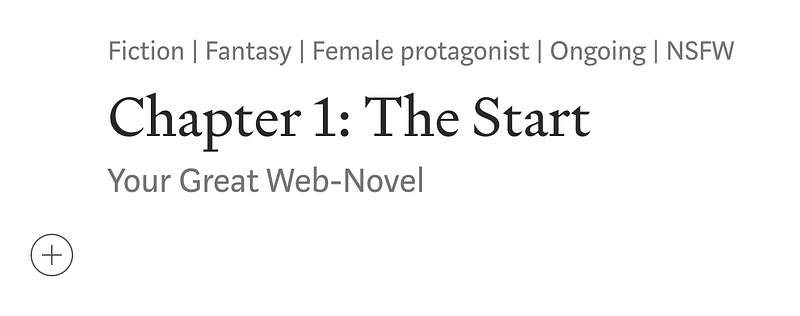
Your readers will thank you for letting them know what they are getting into!
4. If it’s a chapter of an ongoing piece, provide links to the previous and next instalment.
Have you heard of a web-novel? As the name suggests, it’s a novel that is released on the internet. What’s more, the typical approach is to release these stories a chapter at a time, with authors often taking advice from reader comments on board as they go.
There are some dedicated web-novel sites like Wattpad and Royal Road, and these usually have built-in navigation buttons that take readers back (or forward) one chapter, or to an index.
We don’t have that here on Medium, but you can create your own, perhaps using the ‘quote’ formatting as I have in the example below:
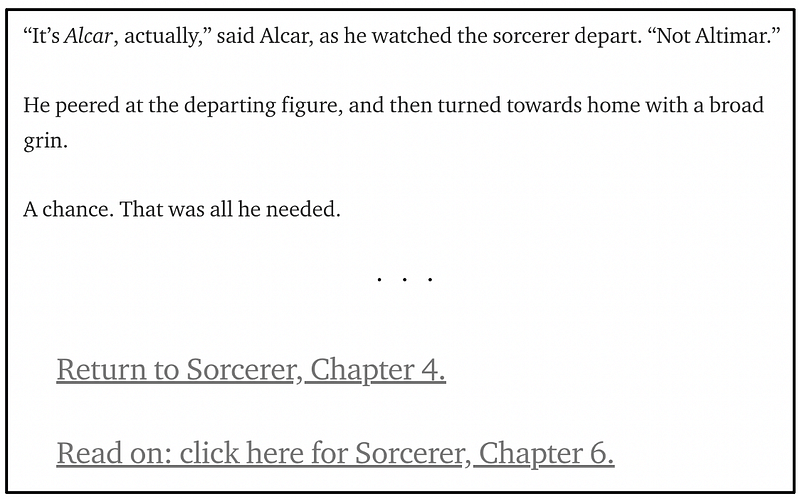
Clearly linking to the next chapter is especially important, but don’t forget that readers might miss one — or might just want to flick back to check something that they forgot. So I like to include the previous chapter, and chapter 1 as well.
5. Expanding on the above, make a full contents page!
Why not take this a step further, and make a contents page for your web-novel on Medium?
Again, the site doesn’t have that functionality built in, but you could grow your own by simply making a page with a bunch of links and adding another one each time you publish a new chapter.
Again, here is an example that I created:
And here’s one by Rodney Goodall:
You can see how this might look on the page in the following example by kt lee:
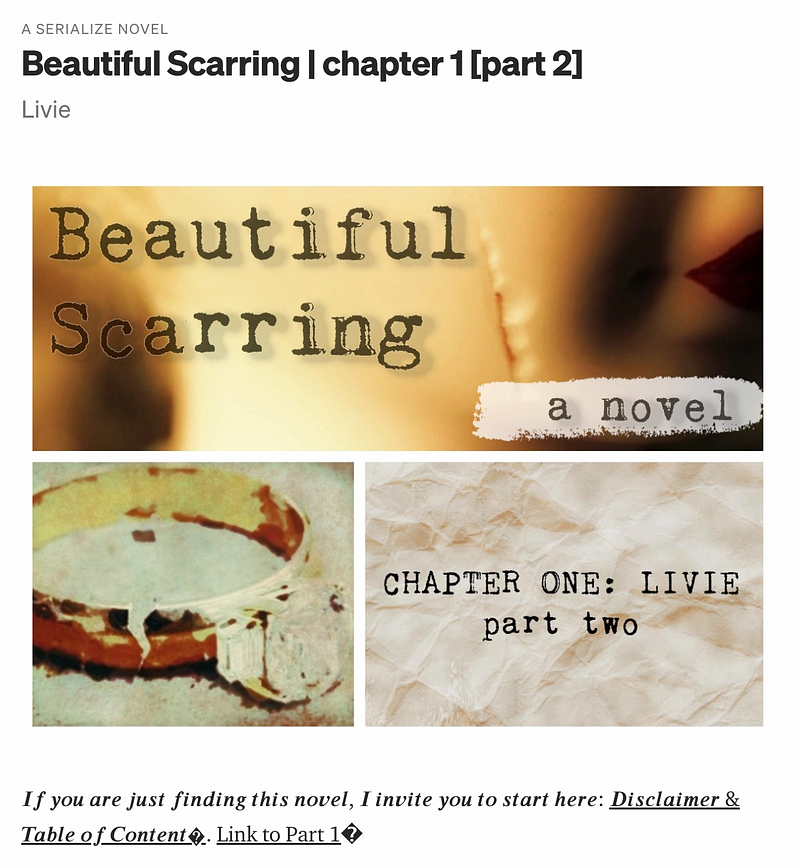
Clear labelling and a link to Chapter 1 are given too.
Easy, right?
6. Stick to the same formatting rules as other Medium articles
There are certain expectations held by most readers on Medium, especially ones who have been here a bit longer.
These include:
- Title in title case (and formatted with the big ‘T’ icon);
- Subtitle in sentence case (formatted with the small ‘T’);
- Image straight after the subtitle;
- Keep intro paragraphs brief;
- In general, using short paragraphs or otherwise breaking up the text.
Following these norms makes your piece more accessible, and I honestly don’t see a good reason to ditch any of them for fiction. For one thing, they make your writing look more professional… and that sense that you know what you are doing isn’t going to hurt.
More importantly, these improve readability for on-screen reading. Longer paragraphs might be the norm in printed books, but they can be off-putting when reading on a phone or laptop.
7. Tag your audience
Consider tagging readers who commented on the previous piece. It’s easy to read chapter 1 and then completely fail to see chapters 2–10 because of Medium’s algorithm!
If people have taken the time to engage, I don’t think it hurts to let them know that the story is continuing.
Think of it as an invitation to your great fiction party!

I hope these ideas help.
At the very least, they should help your readers 😎 📚 ☕️
J. F. Danskin is an author of LitRPG and historical fantasy. His series ‘Sparta Online’ is based on ancient Greek wars and myths, while Sorcerer, Level 1 and related stories are based around a fantasy game called ‘Shadow Kingdoms’.
If you enjoyed this article, you may find this one helpful too: