
Tipcat
But only if you feel the feline provided excellent service
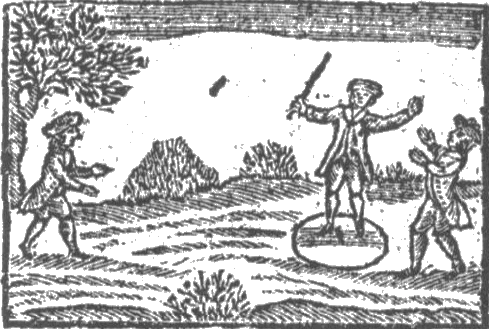
Today’s New York Times Spelling Bee letters:
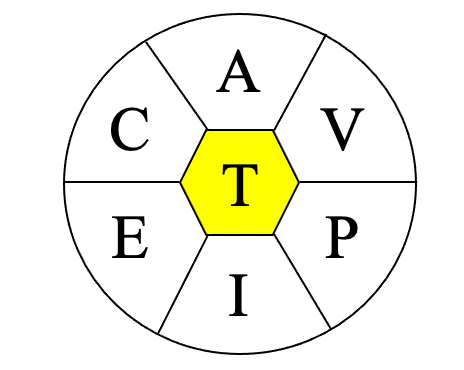
A, C, E, I, P, V, and center T (all words must include T).
Merriam-Webster says…
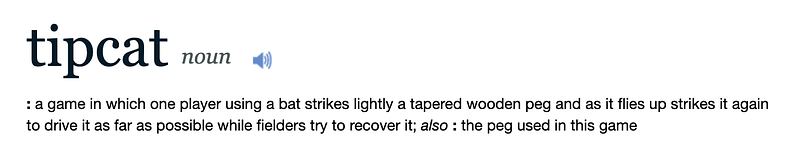
Silly little dictionary! Don’t you know that tipcat can’t possibly be a word if the New York Times says it ain’t?
For further fascinating facts, check out the Spelling Bee Master.
What’s your favorite dord* from today’s puzzle?
My Two Cents
I don’t know if the person credited in Wikipedia for the image at the top of this article is the Isaiah Thomas. I hope so, because (1) that would be pretty cool in and of itself, and (2) it would be ironic — possibly in the Alanis Morissette sense — since Isaiah Thomas is a hall-of-fame basketball player, not someone who played a game that’s weirdly similar to baseball. (Are you listening, Mr. Abner “ripoff” Doubleday?)
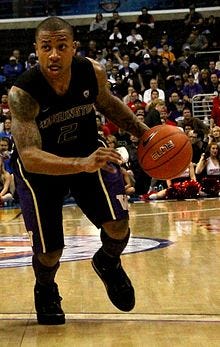
Thomas, whose best season was probably 2016–2017 with the Boston Celtics, is currently not active with any NBA team. Now, if you’re thinking of the hall-of-famer, you need to deduct the first “a”: Isiah Thomas.
Play ball! I mean, play billet!
Although I found instances of tipcat spelled with a hyphen, I’m going to defer to the dictionary’s spelling. Otherwise, I’m screwed, as the Spelling Bee would be correct in not accepting a hyphenated word.
Tipcat was a game played by two players with a stick and another stick. Why it wasn’t called stickstick is anyone’s guess.
The origin of the word seems to come from tip (in the sense of striking lightly) and cat (a tapered peg). The latter is also known as a billet, or chunky piece of wood.
The billet, usually tapered on both ends, was tipped, or struck, with a large stick about the size of a broom handle. Not as easy as it might sound, since the tipping was done with the billet inside a small circle drawn on the ground. So the batter or hitter would have to somehow fling the cat in the air, and then strike it with the larger stick.
Sort of like when your little league baseball coach would throw the ball up lightly before smacking a grounder that would go dribble under your glove. Except in tipcat, the hitter has to use the stick to both lift the billet in the air and then give it a good whack.
The opponent would then offer a certain number of points, based upon their estimation of the number of hops or jumps necessary to cover the distance that the billet was hit. If the batter thought the distance had been underestimated — in other words, that the opponent was offering too few points — the batter could decline the offer and literally measure the distance in jumps and get that score.
Now, since there seems to be no penalty guess wrong, if I had been the opponent my strategy would have been to consistently underestimate. That way the batter would have to jump around all game long to get their points. That might tire them out and get them to tip the cat a lesser distance as the game wore on.
Now, my clever readers are probably thinking: What if your opponent uses the same strategy? That’s a great question! To which my answer is the same one that professional athletes have to solve their competitive challenges.
Steroids.
Tipcat has been played in different forms across the world and therefore has many international aliases:
▹ Gillidanda in southern Europe and the Indian subcontinent
▹ Țurca in Romania and Moldavia
▹ Cead, or Cleas na Slise, in Ireland
▹ Jachigi in South Korea.
▹ Alak Dolak in Iran.
▹ Knurr and Spell in West Yorkshire.
▹ Nipsi or Nipsy in Pennsylvania Dutch communities (but not the Amish)
If you want to read more details about tipcat (nipsy), you can scroll to page 12 in the Summer 1974 volume of Pennsylvania Folklife. There are some interesting details about how the game is played, its history, and the equipment used.
No mention of steroids, though.
Dogcat
In the English-speaking universe, Tipcat is also known as cat, one-a-cat, pussy, piggy, and… catdog.
Now, those of you who were young kids or parents of young kids in the late 1990s might remember a Nickelodeon cartoon called Catdog. Why not Dogcat? Maybe the creator, Peter Hanna, was a cat person. Had he been a dog person, the dog end may not have looked as, well, goofy.
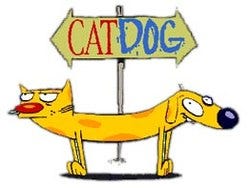
According to Hal Erickson, who wrote Television Cartoon Shows: An Illustrated Encyclopedia, 1949 Through 2003, Catdog was a conjoined twin of a cat and a dog that share the same body with no tail or hind legs.
This immediately brings up the question: how does Catdog use the bathroom. And no, I’m not talking about showering.
Although they are best friends and brothers (wait… brothers?), their personalities are very different, recalling such classics as “The Odd Couple”, “Laurel and Hardy”, and “Abbott and Costello”.
Despite the ridiculous premise, I have a bit of a soft spot for Catdog because the theme song was catchy (those in the know may be humming it now, as they read), and my youngest brother was a fan. Wait, no, that can’t be. He was already a teenager by then! Well, someone I knew was a fan.
Maybe, just maybe, that someone was me.
Okay, then. Moving on to our usual conclusion: Despite the fact that tipcat may have inspired our second American Pastime (the first one is “being outraged”) the editors of the Spelling Bee puzzle insisted on declaring tipcat a dord.*
You can check out my previous entry on another dord* here:
*What the heck is a dord, you ask? Here’s the answer: