
Phonon
No, this article isn’t about powering up any digital gadgets

Today’s New York Times Spelling Bee letters:
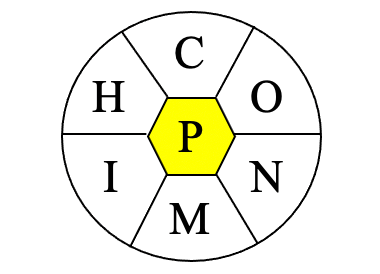
C, H, I, M, N, O, and center P (all words must include P).
Merriam-Webster says…
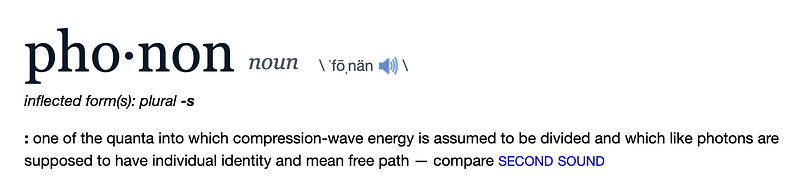
Silly little dictionary! Don’t you know that phonon can’t possibly be a word if the New York Times says it ain’t?
For further fascinating facts, check out the Spelling Bee Master.
What’s your favorite dord* from today’s puzzle?
My Two Cents
So, yeah, this article has nothing to do with phones (that I can think of), yet I hinted at them in the subheader and showed one explicitly in the photo. Can you blame me? Would you have continued reading if I had mentioned I was going to talk about condensed matter physics?
You would? Oh, well you’re going to be disappointed by how feeble my understanding of the subject matter is.
It’s a Sunday and readers are looking for something light and breezy. Unfortunately today’s Spelling Bee did not have a lot of “non-words”. Most days I can count on at least twenty or thirty from which to select my daily dord*. Today I got a baker’s dozen, of which a few don’t show in the dictionary. And I can’t very well tease the dictionary if it’s actually rejecting the word too, can I?
So phonon it is. But first…
A picture’s worth a thousand paper cuts
In our modern society, one of the true barometers of the passage of time is changes in technology. And today I made the mistake of testing that premise. I always try to use Medium’s Unsplash partnership to search for photos. In order to find the picture I ended up using, I typed in “old phone” and hit enter.

I was horrified to see that almost every photo that popped up showed a phone that I had used at some point in my life (down to the graffiti on the payphone). Why the search also yielded a vinyl record is beyond me. Phone-o-graph, perhaps? That’s a cheeky photographer!
Boy, did I feel old all of a sudden. Determined to disprove my decades on this planet, I changed the search term to “antique phones”. It didn’t help matters much. In fact, it made me feel worse.
Still, I did manage to find a picture of a phone that I never got to use, even as a kid. So that’s the one I decided to go with today.
E.T. phonon, E.T. phonon!
A “collective excitation in a periodic, elastic arrangement of atoms or molecules in condensed matter, specifically in solids and some liquids.”
Maybe that’s what the cute little ugly alien was talking about all along.
If you got the movie reference and were a teen when the film was first shown in movies, you’re about my age… and probably used the same type of phones over the course of your life that I did.
Interestingly, I thought the collegiate version of Merriam-Webster’s definition was easier to understand than the one the Unabridged uses (and which I featured in the screenshot). Here’s the collegiate explanation: “a quantum of vibrational energy (as in a crystal)”.
The etymology is simple: phon- (sound) + -on (quantum unit).
Now, it turns out that phon is not just a prefix, but also a word in and of itself. It’s a term that refers to the logarithmic unit of loudness level. Hmmm, maybe I should have picked that word. Too late now; I’ve already written more than half the article.
The example sentences the dictionary provided were also helpful, I thought:
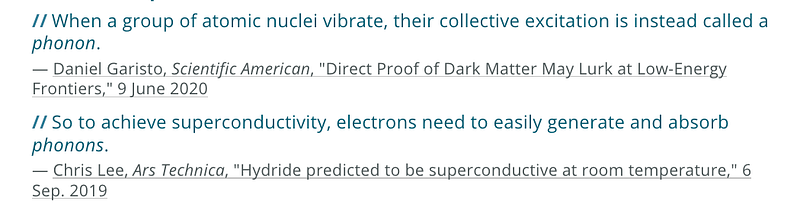
Okay, Scientific American is a mainstream science journal. Lots of people from different walks of life read it. So maybe phonon should not be considered obscure by the editors of the Spelling Bee puzzle. (I’m assuming it was excluded for being obscure because it certainly isn’t obscene. What’s obscene is the amount of words I’ve already typed while trying to avoid a subject matter I’m having a hard time grasping.)
Wikipedia — whose contents I always try to verify — also helped clarify things a bit by saying this: “Phonons can be thought of as quantized sound waves, similar to photons as quantized light waves.”
Then they muddled everything up by saying this:
“A phonon is the quantum mechanical description of an elementary vibrational motion in which a lattice of atoms or molecules uniformly oscillates at a single frequency. In classical mechanics this designates a normal mode of vibration. Normal modes are important because any arbitrary lattice vibration can be considered to be a superposition of these elementary vibration modes (cf. Fourier analysis). While normal modes are wave-like phenomena in classical mechanics, phonons have particle-like properties too, in a way related to the wave–particle duality of quantum mechanics.”
At this point I’m just grasping at straws. Although I did understand that last sentence.
Basically, phonons are the photons of sound. I think they should just sell bumper stickers with the phrase and leave it at that.
However, Wikipedia also provided this cool little GIF that, much like Rorschach inkblots, can probably be given many valid interpretations. Though if what you see are pink rhinos having sex while eating ham sandwiches, I do suggest you seek professional counseling.
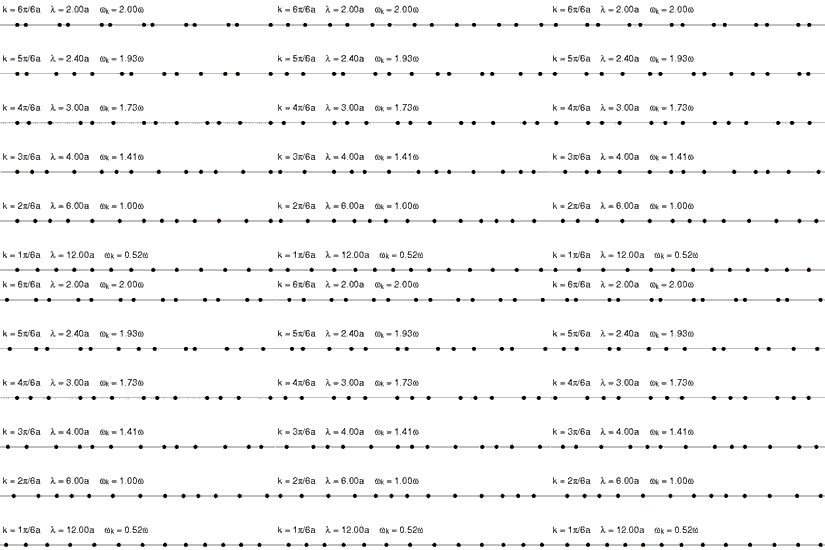
The official explanation is this: These are the first six normal modes of a one-dimensional lattice, or a linear chain of particles. The shortest wavelength is at the top, with wavelengths getting longer in successive rows. Supposedly, the motion of waves to the right can be seen in the last line.
And because I don’t want you to feel that you just read a thousand words about something that has no practical purpose in your life, I’ll add that phonons are important in both thermal and electrical conductivity.
Which probably is more useful in new phones than in old ones.
In any case, phonon is a real word and has real-world applications. Despite, that the editors of the Spelling Bee puzzle insisted on declaring phonon a dord.*
You can check out my previous entry on another dord* here:
*What the heck is a dord, you ask? Here’s the answer: