
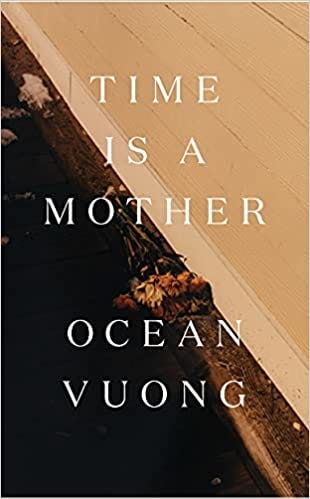
‘Time Is A Mother’ by Ocean Vuong
A Counter Arts Book Club review
“on my desk this field of snow where you’re lying too still all I have to do is write the right words & I’m
beside you (again) but all these letters & nothing
says your face — fashioned from nouns muscular inflection bones
hardened with the alphabet’s reduction see? a flick of my wrist & a house rises from the snow
a wide porch — like you wanted — sunflowers in the front yard”
— excerpt from ‘Dear T’, Ocean Vuong, ‘Time is a Mother’ (p. 31).
The poem highlighted above, leans heavily into the idea that our writing can go a long way towards making memories solidify again. ‘Dear T’ also connects this poetry collection directly to Ocean Vuong’s ‘On Earth We’re Briefly Gorgeous’, which was part of last year’s book club list (read my essay about that book here). The novel features a character called ‘Trevor’ who is the first love of ‘Little Dog’, the main character who we are aware carries much of the author’s own self, given this novel is known to be semi-autobiographical. I adored the story he told there, along with Vuong’s beautifully lyrical writing, so was extremely keen to get to read this new poetry collection.
In 2019, Vuong’s mother passed away from cancer. ‘Time Is A Mother’ is therefore full of grieving — and his grief over his mother’s death bleeds over at the edges of words and verses to encompass the grief he feels about the condition of the planet as a whole.
Vuong told Morning Edition’s Rachel Martin that time is different now that he has lost his mother: “when I look at my life since she died in 2019, I only see two days: Today when she’s not here, and the big, big yesterday when I had her.”
— We celebrate National Poetry Month with poet Ocean Vuong : NPR’s Book of the Day : NPR
Divided into sections, the collection contains a number of separate poems, yet blends into one as a discussion of loss and grieving; but also joyful memory and healing.
A small book, twenty something poems, yet there is such an array of significant subjects covered, moulded and melded together as they are in the poet’s own slight frame.
We see a family history of three generations, also as in ‘On Earth We’re Briefly Gorgeous’. In ‘Time Is A Mother’ Vuong’s mother and grandmother, (their escape from Vietnam during it’s war against America), are joined by Vuong’s partner Peter and his family history, a grandmother evading imprisonment in Auschwitz (see the poem ‘Nothing’). Both families escaping to America, making it possible for grandsons to meet and fall in love decades later.
Yet the future and America, safer and better as they undoubtably are, still have their issues.
In ‘Not Even’ Voung writes:
“I used to be a fag now I’m lit. Ha.
Once, at a party set on a rooftop in Brooklyn for an ‘artsy vibe’, a young woman said, sipping her drink, You’re so lucky. You’re gay plus you get to write about war and stuff. I’m just white. [Pause] I got nothing. [Laughter, glasses clinking]
Because everyone knows yellow pain, pressed into American letters, turns to gold.
Our sorrow Midas touched. Napalm with a rainbow afterglow.”
- excerpt from ‘ Not Even’, Ocean Vuong, Time is a Mother (pp. 35–36).
Künstlerroman is the term used to describe the type of novel in which the main character is an artist; in which his growth from childhood into some form of creative success as an adult is detailed.
In his poem of that name, Ocean Vuong portrays himself (‘he/the man’) pressing a rewind button, then watching himself on film, unspool back through snippets of his life. We see it all, contained in only a few lines —awards and book-signing; parents, friends and lovers; drugs, war, love, sex and death.
“through towns whose names you hear only when a hurricane passes through, gas stations overgrown with ragweed and asters, past an alley wide as a gravestone, over gravel medians where somebody’s sister was last captured on CCTV. I see him walk backward into a row house with eight satellite dishes jammed on the garage roof. The dark of a basement. The sound of needle wrappers torn open, the occasional face from high school, thirty-twoed and sucked out under a two-second match.”
- excerpt from ‘Kunstlerroman’, Ocean Vuong, ‘Time is a Mother’ (p. 50).
Vuong doesn’t shy away from the grit of life. Far from it — and he is an open book when it comes to divulging things he has done and seen. As we see above he writes candidly about his drug taking; and the toll addiction has on the youth of rural America is one of the themes running through his novel. However, there is also a more recent stay in what looks to be a rehab clinic, trying to get ‘clean’, get better in terms of his mental health, for the sake of having a future with Peter.
“they have one flew over the cuckoo’s nest can you believe it but hey I think I’m getting better” “through the clinic window where a girl on Methadone claps alone at a beige butterfly knocking its head up the beige wall Peter I’m wearing your sea-green socks to stay close…..”
“……Peter I think I’m doing it right now finally maybe I’m winning even if it just looks like my fingers are shaking.”
- excerpts from ‘Dear Peter’, Ocean Vuong, ‘Time is a Mother’ (pp. 6–8).
The poem above is disjointed, a perfect picture of a mind floating hither and thither, unable to remain focused; but at least (as Vuong says) feeling as though he is returned to his own mind from a fugue state ruled erratically at best by his drugs of choice.
However, ‘Dear Peter’ is far from the only poem in this collection which meanders lazily or leaps frenetically from one subject to another. Of course others contain reference to drug-taking, but there are emotional states which mimic (or compliment) this frazzled, unfocused train of thought and style of writing too. In grief — or at least describing his experience of deep, soul crushing grief — Ocean Vuong writes poetry which can be extremely challenging to read.
Some reviewers have complained that at least some of the pieces in ‘Time is a Mother’ are utter flops, exactly because of the experimental seeming manipulation of form which arises in this collection. I, on the other hand, feel that if you give the poems the time and effort required to unpick their rhythm, the impact of their emotional cadence will become even greater rather than reduced.
Which brings me to the last of the poems from ‘Time Is A Mother’ that I want to look at specifically: ‘Dear Rose’.
This is certainly one of the poems which the reader needs to spend some time with. We need to work out how to read these lines for meaning. How to deconstruct and reconstruct the sections, once identified, in order to make sense of the multiple strands of story the poet is telling. Strands which are wound and entangled intricately, like the strands of real lives truly are. Strands which represent memories of his mother — both his own memories and her own — weaving and plaiting in spiralling patterns. Almost in the fashion of strands of DNA. Genetic memory, knitting and holding them together, even beyond death.
“………….to make fish sauce you said you must bear the scent of corpses salted & crushed a year in a jar tall
as a boy they dropped with slick thumps like bullets each word must stop somewhere — why not a yellow poet…”
“if reading is to live in two worlds at once why is he not here Ben said you can do anything in a poem so I stepped right out of it into this one to be entered is to be redefined the bullet achieves its name by pushing flesh into flesh I was struck by these words we say…”
“…joy it’s almost perfect you smiled your nose deep in the jar because the bullet makes you real by making you less which is perfect in poems the text amplified by murder -ous deletions leads to inevitable art….”
“ate your lunch of Wonder Bread dipped in condensed milk in the parking lot alone you bought me pencils reader I could not speak so I wrote myself into silence where I stood waiting for you Ma to read me do you read me now do you copy mayday mayday you who dreamed of dipping shreds of chicken
into fish sauce as you hid in the caves above your village you white devil girl starving ghost”
“….say the hole in your brother’s back is not a part of your brother but your brother aparted who is still somewhere running because I wrote it in the present tense the bullet held just behind his death an insect trapped in amber…”
“in Sài Gòn reader who cannot read or write you wrote a son into the world with no words but a syllable so much like a bullet…”
“……….I’ve plagiarised my life to give you the best of me & these words these
insects anchovies bullets salvaged & exiled by art Ma my art these corpses I lay side by side on the page to tell you our present tense was not too late”
— excerpts from ‘Dear Rose’, Ocean Vuong, ‘Time is a Mother’ (pp. 72–8).
There is so much life and emotion contained in ‘Dear Rose’. So many important memories. For not just one, but two lives, lived separately and lived together. Yet Vuong wants more — and he squeezes scads of references to his craft into this poem too. Pages, words and tenses — all for his mother, the reader who cannot read.
We get the sense that he’s not done yet, either. Two collections of poetry and one novel, the same themes being collated and rehashed constantly. Vuong’s therapy, his grief and addiction; family history amid war and violence; prejudice felt and prejudice told, spanning two different lives and two different countries — and through this book, ‘Time Is A Mother’, we do begin to see a way ahead. The poet has begun to clear away some of the cobwebs of grief to make way for the occasional ray of sunshine, a little warmth, a sliver of joy and some small kernel of hope for the future.
I for one can’t wait to see where that takes him. For if Vuong’s lyrical prose and imaginatively, purposely crafted poetry is this lovely coming from a place of darkness, his work from a place full of light could be truly marvellous to behold!
“These ghost poems are about the cavernous corners of loss, grief, abandonment, trauma and war, but that doesn’t result in nihilism or apathy for life; in fact, Vuong approaches death like an entrance rather than an ending. “I was made to die but I’m here to stay”, he asserts in The Last Dinosaur.”
Thank you as always for your time spent reading here. If you are interested in the Book Club titles (only one per month), they and other pieces of work written about them are being collated here:
For last years list of titles and some essays, go here:
If you enjoy my writing, I would usually take a moment at this point to suggest contributing to my struggling finances by ‘tipping’, buying me a coffee, or perhaps signing up to medium via my referral link — but today I thought I might try something else out.
Below you will see a link to a list of books I would love to read (and some lovely little ‘collector’s editions’ of old favourites):
Check out some other titles I would love to read and review in my list here
Please note: this link takes you out of the Medium and into a wishlist on another website.
Yes, I know, Amazon (and it’s associated horrors). I’m aware and that’s not my ideal for longer term use. I’m going to be looking into alternative online bookshops which will allow me to provide the same list with a rather better ethical ‘footprint’.
However, as a new idea I’m working on, if you have a moment could you please comment and let me know if you would feel more, or less, inclined to showing appreciation by buying a book (compared to the usual request for donations of cash)?
Don’t worry, I won’t hold you to that! I just want to survey your opinions.
So, thanks again for your time. Stay safe. Stay warm. Stay well. With love — Sadie.


